

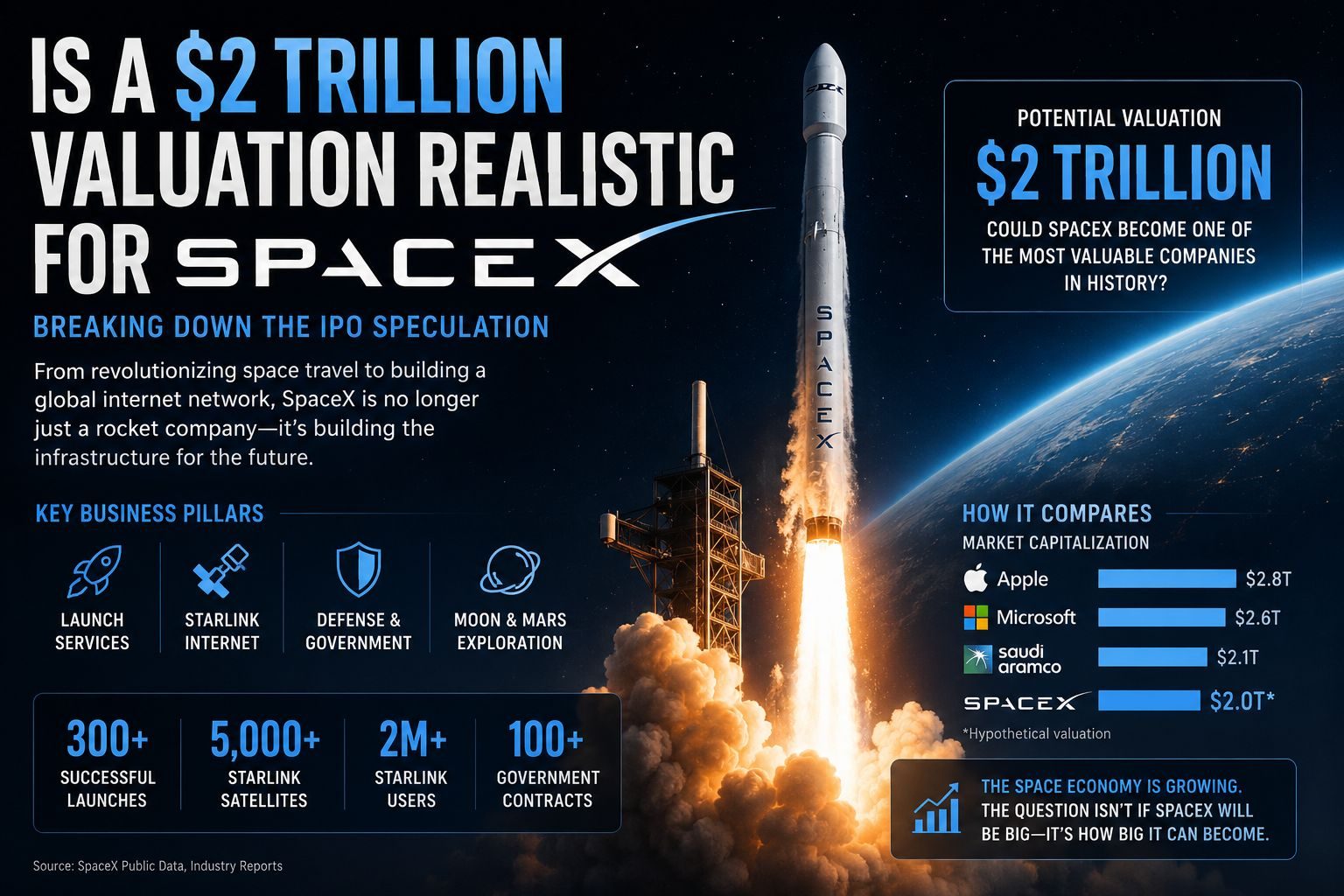
The idea of a $2 trillion valuation for sounds like something pulled straight out of science fiction. Rockets launching every week, satellites blanketing the globe with internet, dreams of Mars, reusable spacecraft landing like scenes from a movie it almost feels too cinematic to measure in dollars. Yet here we are, watching investors and markets quietly whisper a question that once seemed absurd: Could SpaceX really become one of the most valuable companies in history?
At first glance, the number feels impossible. Two trillion dollars is territory reserved for giants that dominate everyday life. Companies reach those valuations after years of embedding themselves into how billions of people communicate, shop, work, and spend money. When people hear “rocket company,” the instinctive reaction is often simple: How could rockets possibly be worth that much? After all, launching things into orbit sounds expensive, niche, and far removed from normal economic life.
But that’s where the story around SpaceX starts changing.
The company many people still think of as a rocket manufacturer is quietly evolving into something much larger. Rockets may be the engine, but they are no longer the entire business model. In reality, SpaceX is building infrastructure and history tends to reward infrastructure companies far more aggressively than people expect. Railroads changed commerce. Telecommunications reshaped information. Cloud computing rewrote software. SpaceX is betting that orbital infrastructure could become the next major platform layer of the global economy.
Think about what’s already happening. Through its satellite internet system, the company isn’t merely launching hardware into space; it is trying to create a communication network that bypasses traditional limitations on Earth. Remote villages, airplanes, ships, military operations, disaster zones the ambition is internet everywhere, without relying on towers or cables. Suddenly the conversation shifts from “rocket business” to “global connectivity business,” and investors understand recurring revenue businesses far better than launch contracts.
This is often the moment where speculation gets louder. If SpaceX can create a system generating consistent subscription revenue worldwide, comparisons start emerging with telecom giants, cloud companies, or even platform monopolies. A trillion-dollar narrative becomes easier to imagine when markets stop valuing launches and start valuing ecosystems.
Still, getting to $2 trillion is another level entirely.
The optimistic case sounds powerful. SpaceX dominates launch economics with reusable rockets, continues expanding satellite internet subscriptions, becomes deeply tied to government and defense infrastructure, powers future lunar and Mars logistics, and effectively turns space access into a utility. In that world, investors may stop asking whether the company is expensive and instead ask whether it owns the rails of a future space economy.
Imagine a future twenty years from now: commercial factories operating in orbit, asteroid resource exploration becoming viable, satellite-based AI infrastructure, ultra-fast global communication, private lunar industries. It sounds futuristic — maybe even ridiculous — until you remember that reusable rockets sounded unrealistic to many people not long ago too. Markets love pricing tomorrow before tomorrow arrives.
Yet there’s another side to the story, and it deserves equal attention.
Speculation often runs faster than reality. A $2 trillion valuation assumes extraordinary execution across multiple industries at once. Space remains brutally expensive, technically difficult, and politically sensitive. Governments regulate launches. Competition is increasing. Satellite congestion raises concerns. Profitability at massive scale is never guaranteed, even for groundbreaking companies. Investors sometimes confuse technological brilliance with automatic financial certainty.
There is also the danger of hype cycles. Every transformational industry experiences moments where imagination outruns economics. During the dot-com era, many believed the internet would change everything — and they were right. But countless companies collapsed because being early or exciting did not automatically mean sustainable value. The internet became enormous; not every internet company became gigantic.
That historical lesson matters here.
The strongest argument for SpaceX is not simply that rockets are cool or Mars sounds inspiring. It is that the company sits at the intersection of several giant economic themes at once: defense, telecommunications, transportation, infrastructure, AI connectivity, and national security. Few companies occupy so many future-facing categories simultaneously. If investors ever decide those markets converge into one dominant ecosystem, valuation models could become dramatically larger than traditional aerospace math suggests.
But realism matters too. Even if SpaceX never reaches $2 trillion, the company may still become historically valuable by reshaping entire industries. Sometimes the bigger story is not whether the headline number becomes reality, but how expectations themselves reveal changing beliefs about the future.
Years ago, people laughed at electric vehicles replacing gasoline dominance. They dismissed reusable rockets as fantasy. They doubted private companies could seriously challenge government-led space exploration. Today, many of those assumptions look outdated.
So, is a $2 trillion valuation realistic?
Maybe not today. Maybe not soon. But the question itself says something fascinating: markets are no longer debating whether space matters they are debating how massive the space economy could eventually become. And that shift in thinking might be the biggest story of all.#SpaceXEyes2TIPO