
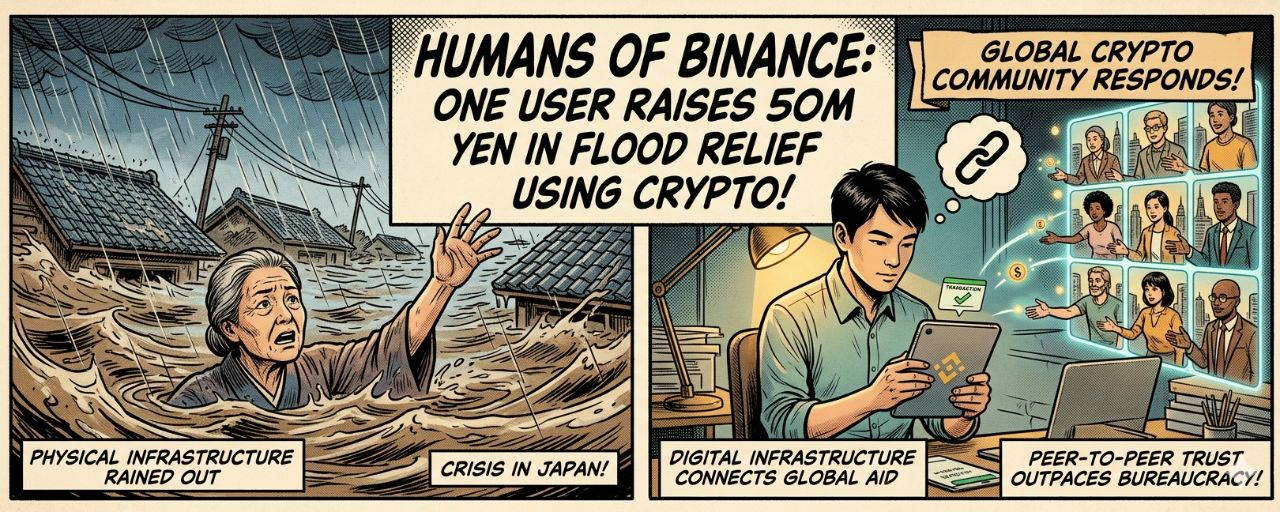

The sound of rain against a window pane usually invites introspection, but on one particular night in Japan, that sound carried a deeper, more ominous weight. As rivers broke their banks and muddy water began to swallow roads, bridges, and local neighborhoods, millions of people found themselves physically isolated. In the middle of this unfolding crisis, a quiet Binance user sat in front of a glowing monitor. They were not looking at price charts or calculating market movements. Instead, they were watching local distress signals multiply across their social feeds, realizing that while the physical infrastructure around them was failing, the digital infrastructure remained completely intact
When a natural disaster hits, the most immediate requirement is not sympathy, it is resource deployment. Traditional financial systems, burdened by operating hours, weekend closures, and multi-day clearance protocols, are fundamentally ill-suited for the chaotic timeline of a crisis. Recognizing this vulnerability, this single user decided to pivot away from speculation and tap into the latent power of a global digital network
The Convergence of Crowd and Crypto
The initiative began as a grassroots appeal. The user leveraged their personal network to establish a transparent channel for digital assets, an effort that quickly gained momentum and caught the attention of corporate philanthropic arms. By integrating with structured platforms, the campaign found a massive amplifier. The operational framework of blockchain philanthropy is detailed thoroughly on the Binance Charity Blog, illustrating how individual intent can instantly align with institutional architecture
What followed was a remarkable display of borderless cooperation. Within a remarkably short window, donations began pouring in from various time zones and jurisdictions. The global community responded with extraordinary speed, echoing the historical spirit of digital solidarity seen in early community milestones like the ones archived on this Binance archive post. The campaign eventually crossed a staggering milestone, securing 50 million Yen in crypto-based relief funds. The profound human impact of these rapid response initiatives, and the relief they bring to affected families, is captured intimately in this human-interest feature video
Redefining the Speed of Trust
Traditional charity mechanisms often function like a black box. A donor drops fiat currency into a portal and simply hopes that, after administrative deductions and bureaucratic processing, a fraction of that value reaches the destination months later. Blockchain technology flips this paradigm completely
By utilizing an immutable ledger, the Japanese flood relief campaign offered absolute transparency. Every wallet address was visible, every transaction verifiable, and every satoshi accounted for. When water is rising in someone's living room, a three-day banking delay is not just an inconvenience, it is an systemic failure. Crypto coordinates relief by replacing traditional bureaucracy with mathematical certainty, ensuring that aid lands precisely when the crisis is at its peak
This event forces us to re-examine the relationship between digital spaces and physical reality. We frequently criticize online communities for being cold, hyper-financialized, or detached from actual human suffering. Yet, this initiative proved that a shared ledger can cultivate a shared conscience
The 50 million Yen did not materialize out of institutional obligation or corporate public relations. It came from thousands of disparate individuals across the globe, bound together by a common protocol and a collective sense of empathy. Technology did not dilute the human element, it gave human empathy a faster, more resilient vehicle to travel on
A New Philosophy for Global Aid
How should we define the ultimate value of a decentralized network? Is it measured solely by market capitalization and trade volume, or should it be evaluated by its capacity to protect a community during a storm?
If a decentralized group of global citizens can outpace traditional humanitarian agencies during a localized crisis, the future of disaster relief must change. We are moving toward an era where borders matter less than internet connectivity, and where peer-to-peer trust can bypass the limitations of centralized institutions
As we look ahead to the future of humanitarian aid, this event leaves us with structural questions to ponder. If we can mobilize millions of dollars across borders in a matter of hours without a single intermediary, what else can we solve? Are we willing to trust code to preserve our humanity when the physical world fractures around us?
The successful mobilization in Japan suggests that our tools are only as cold as the intentions behind them. When the next storm comes, the systems we choose to rely on will define our resilience. It forces a realization that lingers long after the waters recede: maybe crypto was never only about money
read it too : https://www.binance.com/en/blog/charity/4416870007213799450