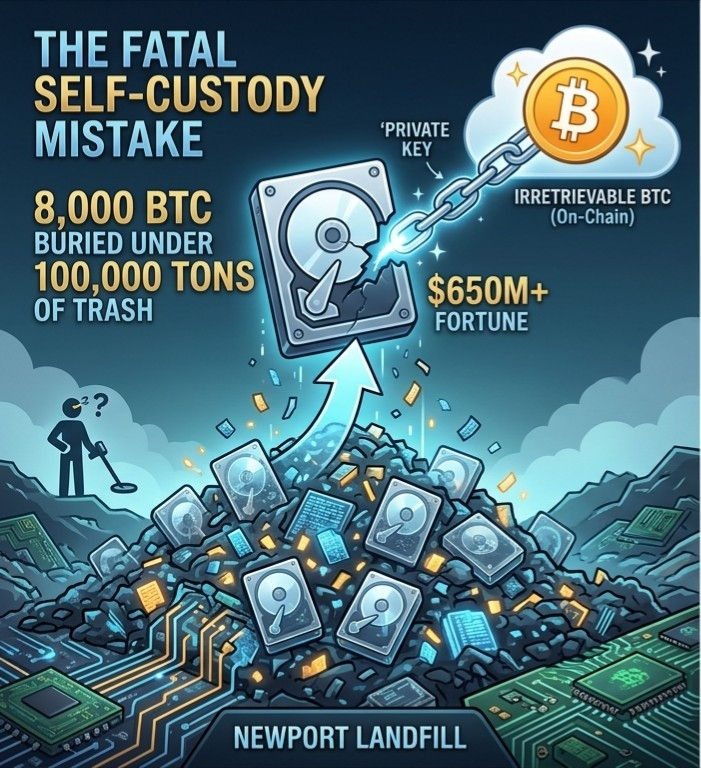
Imagine looking out over a local landfill, knowing that somewhere beneath a mountain of garbage lies a tiny plastic square worth over $650 million.
This is the daily reality for James Howells, an IT worker from Wales. Back in 2010, when Bitcoin was just an obscure experiment, James used his personal laptop to mine approximately 8,000 BTC. He stored the private keys on a basic laptop hard drive.
📉 The Fatal Mistake:
In 2013, during a household deep clean, James threw the drive into a garbage bag, confusing it with an empty one. By the time he realized his mistake, the bag was already buried deep within the Newport City Council landfill.
For over a decade, James has fought a grueling battle with local authorities. He has offered them multi-million dollar cuts of the fortune, proposed advanced AI-driven scanning grids, and assembled ecological teams to safely excavate the site. The answer? A consistent, firm "No" due to environmental and safety concerns.
🧠 The Analytical Lesson:
James’s story isn't just a meme; it is the ultimate cautionary tale of self-custody. His 8,000 BTC sits perfectly intact on the blockchain ledger, visible to the entire world via data aggregators, yet completely irretrievable. It highlights why secure, decentralized backup systems, hardware wallets with seed phrase redundancy, or trusted institutional custody solutions are absolute requirements for long-term wealth preservation.
👇 If you woke up tomorrow and realized you threw away $650M, what would your next move be? Let's talk in the comments!
#bitcoin #CryptoHistory #SelfCustody #CryptoStoryTime #Web3Lifestyle