
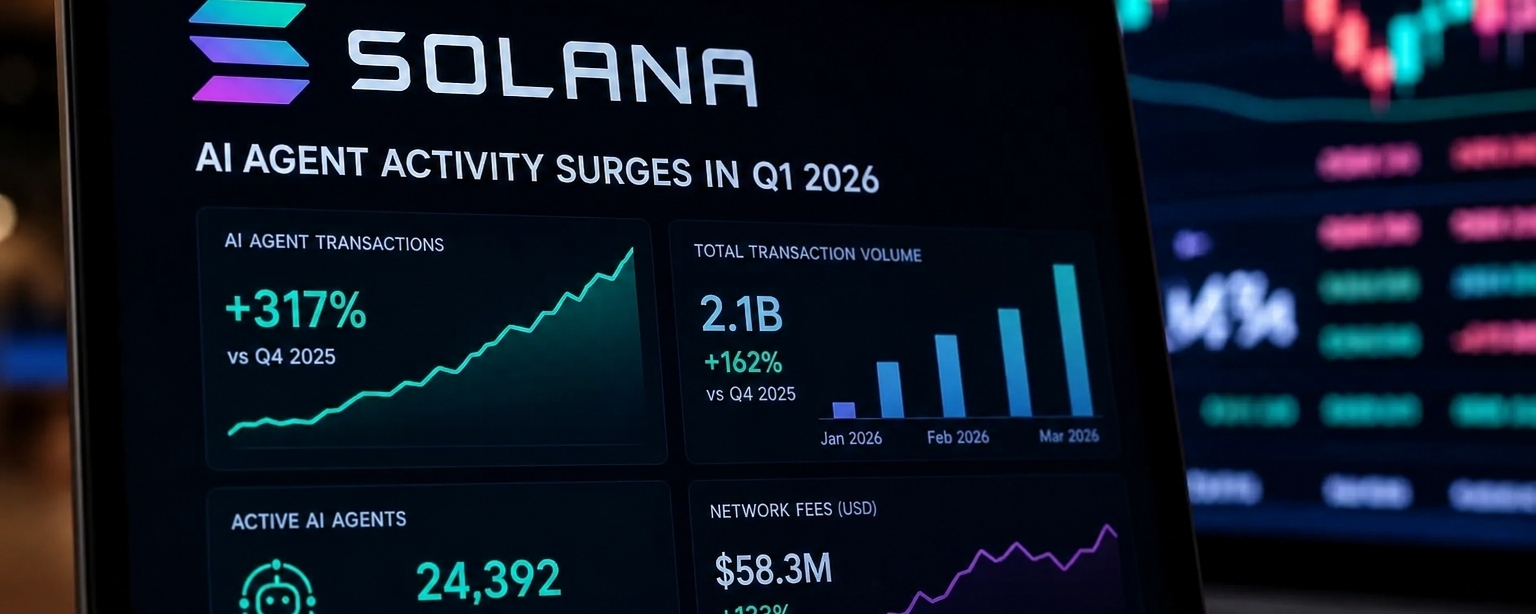
The rapid expansion of AI-powered blockchain applications is beginning to reshape on-chain economies, and has emerged as one of the primary ecosystems benefiting from the trend. During the first quarter of 2026, activity linked to AI agents on Solana increased significantly, contributing to higher transaction volumes, increased decentralized application usage, and growing demand for network infrastructure.
AI agents autonomous software programs capable of executing blockchain transactions, interacting with decentralized finance protocols, trading assets, or managing on-chain operations without constant human input have become one of the fastest-growing segments in crypto. On Solana, these agents are increasingly being integrated into DeFi platforms, gaming ecosystems, social protocols, and automated trading systems.
According to industry analysts and on-chain tracking platforms, AI-related wallet activity on Solana surged throughout Q1 2026, with many protocols reporting substantial increases in automated transactions generated by machine-driven systems rather than traditional retail users. The shift highlights how blockchain networks are evolving beyond simple peer-to-peer financial systems into infrastructure layers capable of supporting autonomous digital economies.
One of the key factors driving this growth is Solana’s high-speed and low-cost transaction environment. AI agents often require continuous interaction with smart contracts, real-time market data processing, and frequent execution of microtransactions. Networks with high fees or slow confirmation times create limitations for these systems. Solana’s architecture, designed for scalability and throughput, has made it attractive for developers building AI-native applications.
Several projects operating within the Solana ecosystem have already launched AI-driven products ranging from automated portfolio managers to decentralized AI assistants capable of executing trades, staking assets, or interacting with NFT marketplaces autonomously. The growing ecosystem has also encouraged infrastructure providers to expand services focused on AI workloads, including data indexing, compute layers, and decentralized storage solutions.
The rise in AI agent activity has also produced measurable economic effects across the network. Increased transaction volume contributed to higher validator revenue and greater demand for SOL, the native asset of the Solana blockchain. Some analysts argue that AI-generated economic activity could become a major long-term source of network utilization, particularly as autonomous systems begin handling larger portions of decentralized financial operations.
At the same time, the trend has introduced new discussions surrounding network congestion and resource allocation. Because AI agents can operate continuously and at scale, some developers have raised concerns about spam-like transaction behavior or excessive computational demand during periods of peak activity. In response, ecosystem participants are exploring optimization tools and infrastructure upgrades aimed at balancing scalability with sustainable network performance.
Investor interest in the intersection of AI and crypto has also accelerated during 2026. Venture capital firms and blockchain-focused investment groups have increased funding toward projects building autonomous agent frameworks, decentralized AI marketplaces, and machine-learning integrations on Solana. The momentum reflects broader market expectations that AI-driven applications could become a defining narrative of the next crypto adoption cycle.
Beyond finance, AI agents are beginning to expand into consumer-focused use cases. Some applications now allow AI systems to manage social media interactions, coordinate DAO governance participation, or execute gaming-related strategies entirely on-chain. Developers believe these autonomous systems could eventually support fully digital business models operating with minimal human oversight.
While the sector remains early in development, Q1 2026 demonstrated that AI agents are no longer a theoretical experiment within blockchain ecosystems. Their growing presence on Solana is already producing visible economic activity, influencing network usage patterns, and attracting both developer and investor attention.
As competition between blockchain ecosystems intensifies, Solana’s ability to support scalable AI-driven applications may become one of its most important strategic advantages in the broader digital asset market.
#SolanaAIAgentEconomicImpact #Ecoprotocol$76.7MHack #SECTokenizedStockExemption #RussiaDumaCryptoMonitoringBill #SpaceXEyes2TIPO