

Key Highlights
HYPE is trading at $48.10 — up +6.59% in 24 hours and +89.17% year-to-date — with a market cap of $12.24 billion.
The SEC is preparing an "innovation exemption" that would officially allow tokenized traditional securities to trade 24/7 on decentralised crypto platforms — one of the most significant U.S. regulatory shifts toward on-chain infrastructure ever announced.
Bitwise has committed to devoting 10% of management fees from its Hyperliquid ETF ($BHYP) to buying and holding HYPE on its balance sheet — with a minimum 12-month holding period.
Hyperliquid's HIP-3 RWA open interest has hit a new all-time high of $2.6 billion — positioning the protocol as the natural beneficiary of the SEC's regulatory green light for tokenized securities.
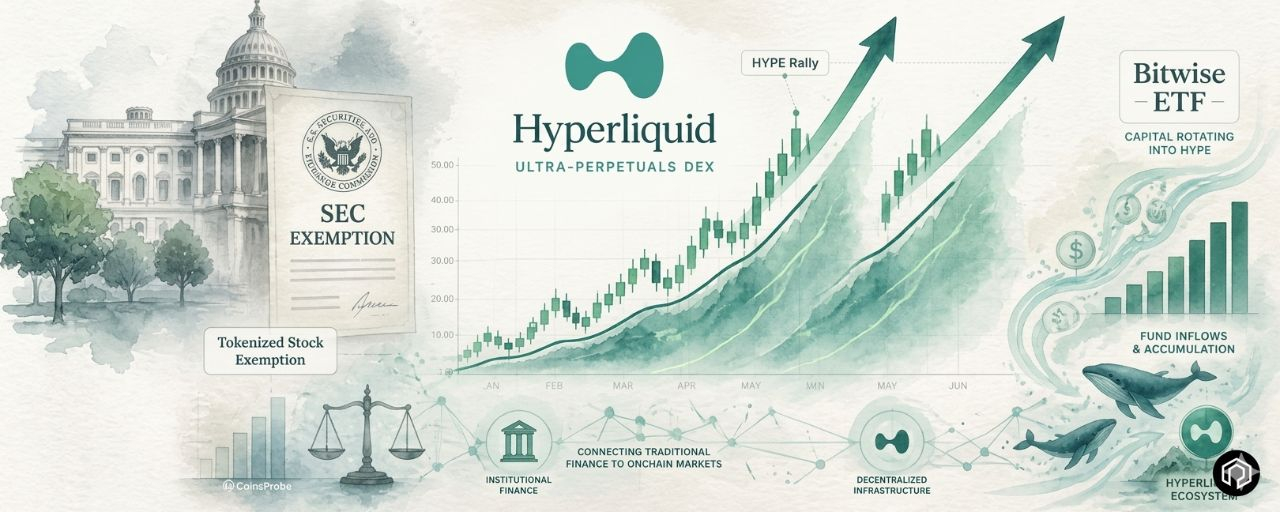
Hyperliquid is surging toward new highs — and today the reasons are impossible to miss. Two powerful catalysts have landed simultaneously: a landmark U.S. regulatory development that directly validates Hyperliquid’s entire real-world asset strategy, and a public commitment from a major ETF issuer to hold HYPE on its balance sheet as a long-term conviction position. The market has responded immediately — HYPE is up +6.59% to $48.10 with a $12.24 billion market cap and a year-to-date gain now pushing toward +90%.
 Hyperliquid (HYPE) Price/Source: Coinmarketcap
As we covered in our Coinbase and Circle USDC partnership, our SpaceX Pre-IPO SPCX listing, and our CME and NYSE lobbying analysis, Hyperliquid has been at the centre of the most consequential debates in on-chain trading in 2026. Today’s developments suggest the regulatory tide is shifting decisively in the protocol’s favour.
Catalyst 1 — SEC “Innovation Exemption” for Tokenized Stocks
The first and most significant catalyst comes from a surprise development flagged by @KobeissiLetter: the SEC is preparing to release an “innovation exemption” — a formal regulatory framework that would officially pave the way for trading tokenized versions of traditional securities on decentralised crypto platforms.
The core implications of the announcement:
Tokenized stocks tradeable 24/7 on-chain — For the first time under a U.S. regulatory framework, traditional securities could be tokenized and traded continuously without the market hours, settlement delays, and intermediary friction of legacy equity markets.
Decentralised platforms formally recognised — The exemption would explicitly cover on-chain platforms — a direct acknowledgement that decentralised infrastructure is a legitimate venue for securities trading rather than an unregulated grey area to be shut down.
Potential to reshape the U.S. stock market — If tokenized stocks can be traded on-chain with regulatory blessing, the entire structure of American equity markets becomes open to disruption — 24/7 access, global participation, instant settlement, and on-chain transparency replacing T+1 clearing and centralised exchange monopolies.
The timing of this announcement is extraordinary for Hyperliquid specifically. As we detailed in our HIP-3 open interest ATH analysis, Hyperliquid’s RWA perpetuals ecosystem — stocks, indices, commodities, and pre-IPO contracts — has been building exactly this infrastructure for months. With HIP-3 RWA open interest now at a new all-time high of $2.6 billion and trade.xyz having already listed equities, indices, and pre-IPO perpetuals for companies including SpaceX, OpenAI, and Anthropic — Hyperliquid is not preparing for tokenized securities trading. It is already doing it.
The SEC’s innovation exemption transforms Hyperliquid’s existing product suite from operating in regulatory ambiguity into a framework-compliant infrastructure layer for the future of securities trading. This is the regulatory green light the entire RWA sector has been waiting for — and Hyperliquid is positioned at the centre of it.
Catalyst 2 — Bitwise Commits to Holding HYPE From ETF Fees
The second catalyst comes directly from one of the most respected asset managers in the digital asset space. Bitwise — whose $BHYP Hyperliquid ETF is already live — has announced it will devote 10% of the management fee from $BHYP to buying and holding HYPE tokens on its balance sheet, with a minimum 12-month holding period.
This commitment is significant on multiple levels:
Financial alignment — Unlike a standard ETF that simply provides price exposure, Bitwise is deploying its own fee revenue into the underlying asset. This creates a direct economic link between $BHYP’s success and Hyperliquid’s protocol health — the more AUM the ETF attracts, the more HYPE Bitwise accumulates.
Long-term conviction signal — A 12-month minimum holding period is not a trading position. It is a statement of conviction that HYPE’s fundamental value will be higher in a year than it is today — a meaningful signal from an institutional manager with deep research capabilities and significant reputational skin in the game.
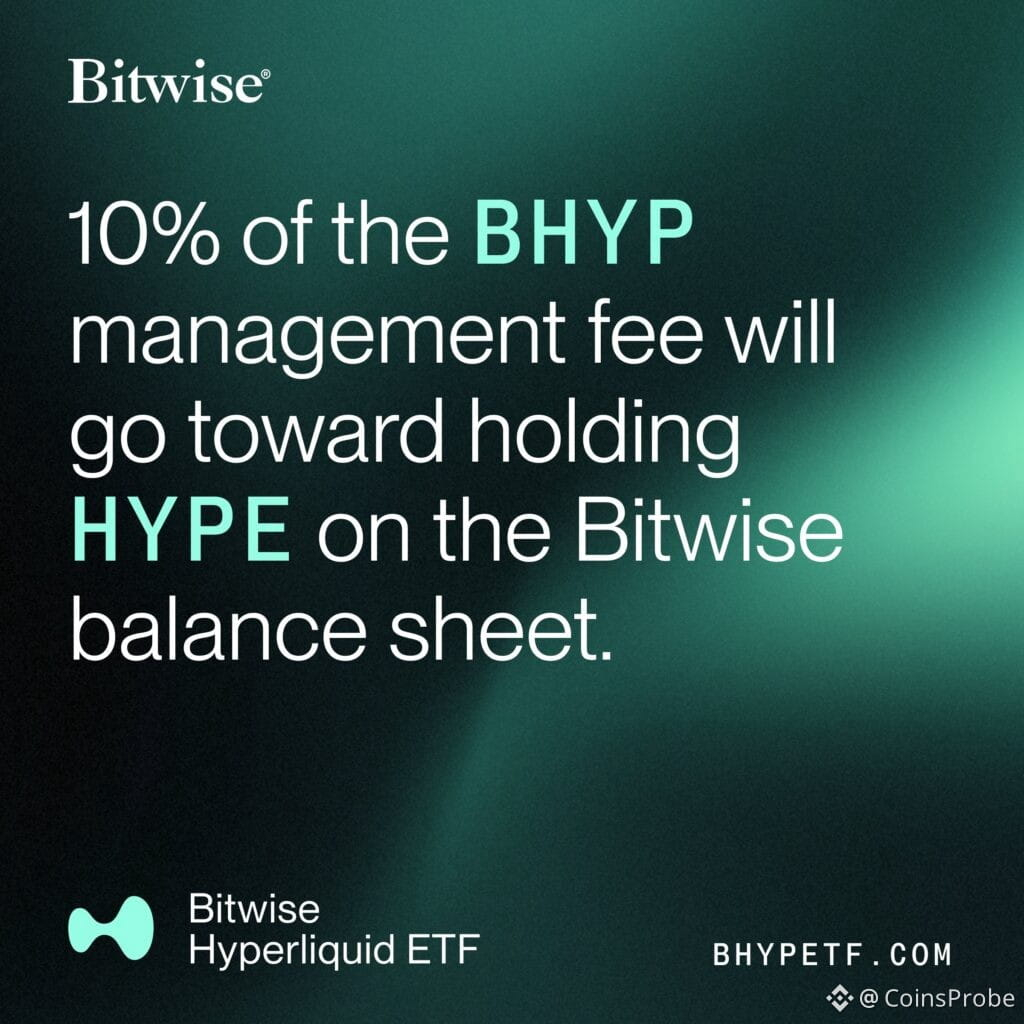 Source: @Bitwise (X)
Protocol alignment — Bitwise’s framing captures the logic precisely: “If the protocol succeeds, the community succeeds.” This echoes Hyperliquid’s own revenue model — where 97% of trading fees fund token buybacks — creating a structural flywheel where platform growth drives fee revenue, fee revenue drives buybacks, buybacks reduce supply, and reduced supply supports price appreciation. Bitwise adding to that flywheel through ETF fee deployment amplifies the mechanism.
Institutional credibility — Bitwise is not a speculative crypto fund. It is one of the most established and regulated digital asset managers in the U.S. Its public commitment to hold HYPE on its balance sheet sends a credibility signal to other institutional allocators that are watching before committing.
Why These Two Catalysts Together Matter More Than Either Alone
In isolation, the SEC innovation exemption is a regulatory development that benefits the entire RWA and tokenized securities sector. And Bitwise’s HYPE commitment is a positive but incremental institutional signal.
Together, they are transformative for Hyperliquid specifically — because they validate the same thesis from two different directions simultaneously:
The SEC exemption says: tokenized securities on decentralised platforms are the future of markets — and Hyperliquid is already the leading platform for exactly that.
Bitwise’s commitment says: institutional capital is aligning with Hyperliquid’s protocol long-term — not just providing price exposure but taking a balance sheet position in the native token.
The combination — regulatory validation plus institutional capital commitment — is the dual signal that marks the transition of a protocol from a crypto-native phenomenon to a mainstream financial infrastructure player.
HYPE Price Context
$HYPE has surged over 1,177% since launch — and the +89% year-to-date performance reflects a token that has been consistently rewarded for delivering on product, partnerships, and regulatory positioning simultaneously. With the SEC innovation exemption potentially opening the entire U.S. equity market to on-chain tokenization, the total addressable market for Hyperliquid’s RWA infrastructure has just expanded by an order of magnitude.
Bottom Line
Today’s two catalysts — the SEC’s innovation exemption for tokenized securities and Bitwise’s 10% HYPE balance sheet commitment from $BHYP fees — represent the most significant institutional and regulatory validation Hyperliquid has received since launch. The protocol’s $2.6 billion RWA open interest ATH confirms the infrastructure is already built. The regulatory green light confirms it is now compliant. And Bitwise’s balance sheet commitment confirms institutional capital is aligned for the long term.
Hyperliquid is no longer just the leader in on-chain derivatives. It is becoming the foundational infrastructure layer for the future of securities trading.
Disclaimer: The views and analysis presented in this article are for informational purposes only and reflect the author’s perspective, not financial advice. Technical patterns and indicators discussed are subject to market volatility and may or may not yield the anticipated results. Investors are advised to exercise caution, conduct independent research, and make decisions aligned with their individual risk tolerance.