
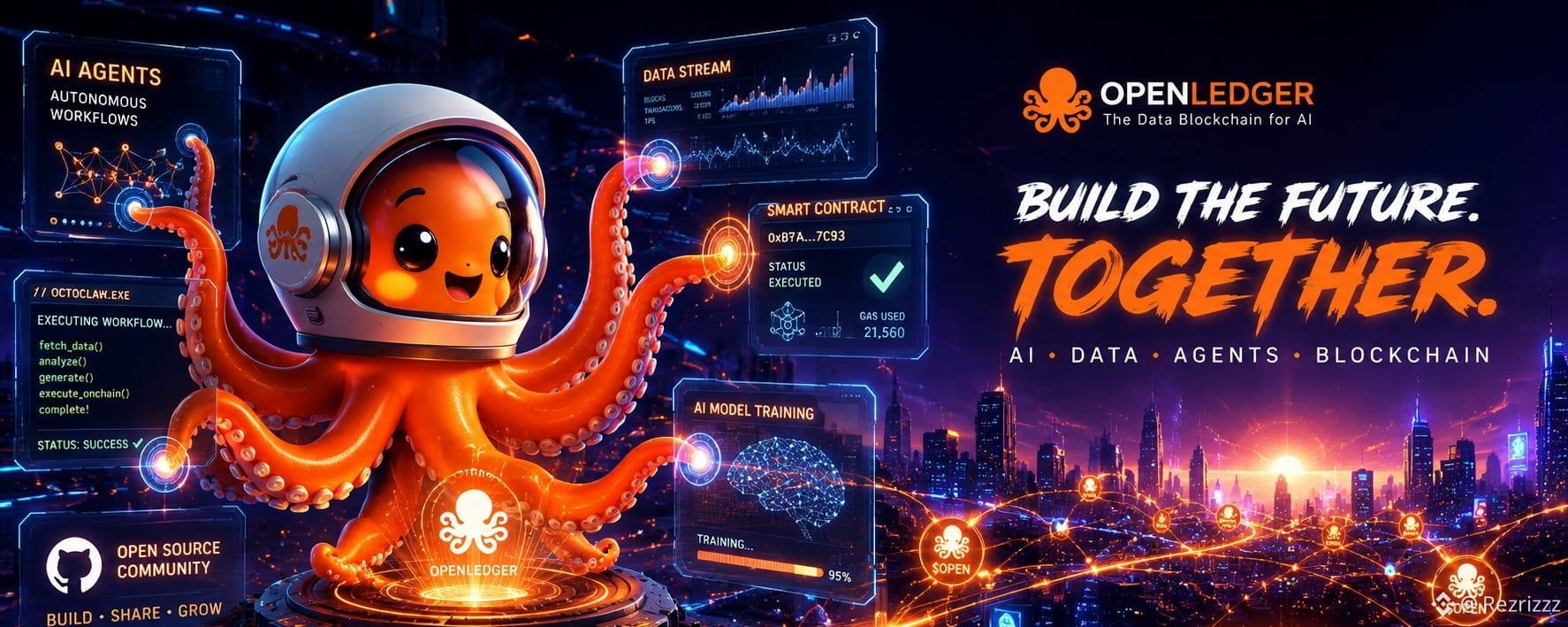
"Stop overthinking. Start building.”
At first glance, it sounds simple. But in today’s rapidly evolving AI + Web3 landscape, this message from @OpenLedger carries real weight. It reflects a deeper shift happening across the industry, a transition from passive users to active creators.
For years, most people in crypto have been participants: trading tokens, following narratives, or interacting with applications built by others. But OpenLedger is pushing a different vision,one where anyone can become a builder, not just a user.
From Consumption to Creation
With the release of its open-source vibe-coded platform, OpenLedger isn’t just introducing another tool. It’s lowering the barrier to entry for innovation.
“Vibe coding” represents a new way of thinking about development. Instead of rigid frameworks and steep learning curves, it emphasizes creativity, experimentation, and speed. It allows builders to focus on ideas first, and structure later.
This matters because the future of Web3 won’t be defined by a handful of large teams, it will be shaped by thousands of small, creative builders pushing niche ideas forward.
OpenLedger is positioning itself as the foundation for that movement.
The Rise of Autonomous Execution
At the same time, we’re seeing the emergence of intelligent agents like "OctoClaw", systems that go beyond assistance and move into execution.
This is a critical evolution.
Traditional tools help users complete tasks.
Autonomous agents perform those tasks independently.
When you combine:
• Open-source infrastructure
• AI-driven agents
• On-chain execution
You unlock something far more powerful than a typical dApp.
You create systems that can:
- Analyze data in real time
- Generate outputs
- Execute decisions on-chain
Continuously adapt without human intervention
This is where OpenLedger begins to stand out — not just as a platform, but as an ecosystem enabling autonomous workflows at scale.
Why This Changes Everything
The real innovation isn’t just in the technology, it’s in the accessibility.
By making its platform open-source and encouraging participation through initiatives like #OpenCode, OpenLedger is turning innovation into a shared process.
Ideas no longer need to stay locked behind teams or funding rounds.
They can be built, tested, and shared openly.
And in an environment like this:
1. The best concepts rise faster
2. Collaboration accelerates development
3. Communities become co-creators, not just audiences
This creates a compounding effect where each new project strengthens the ecosystem as a whole.
$OPEN: More Than Just a Token
In this context, $OPEN takes on a different meaning.
It’s not just a tradable asset.
It represents access to a growing network of:
• Data infrastructure
• AI capabilities
• Autonomous execution systems
As more builders enter the ecosystem and deploy real use cases, the value of that network grows, not from speculation alone, but from actual utility and adoption.
A Builder-First Future
We’re entering a new phase in Web3.
The early days were about exploration.
The next phase is about creation.
The projects that succeed won’t just attract users, they’ll empower builders.
OpenLedger is clearly leaning into that direction:
- Open infrastructure
- Creative development tools
- Autonomous agents
- Community-driven innovation
This combination positions it at the intersection of two major trends: AI and decentralized systems.
Final Thoughts
The shift is already happening.
The question is no longer whether AI and blockchain will merge, it’s how fast builders will adopt the tools that make it possible.
Openledger isn’t asking you to watch from the sidelines.
It’s inviting you to participate.
Because in this new era, the biggest opportunities won’t belong to those who observe…
…but to those who build early.
So ask yourself:
Are you still watching… or already building?
$OPEN 🚀
