
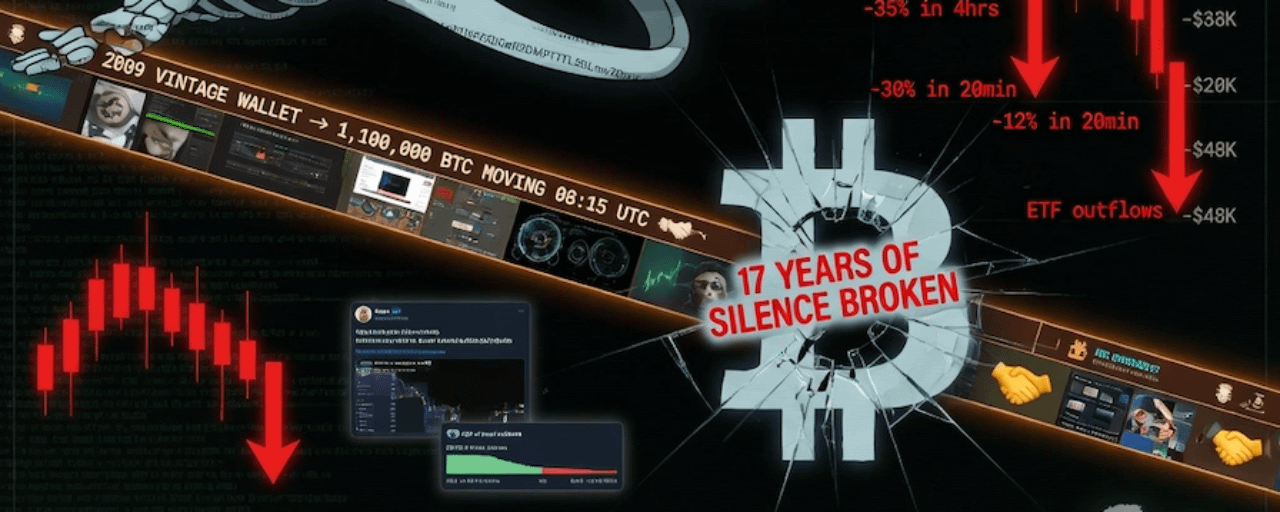


$88 billion. One wallet. Seventeen years of silence.
That's the dormant fortune sitting in the original Bitcoin addresses—coins mined by Satoshi Nakamoto during the network's first year, untouched since 2009, now worth more than the GDP of most nations on Earth.
Tomorrow morning, the blockchain flickers. A transaction broadcasts from a 2009 vintage wallet. One million Bitcoin begins moving toward exchanges.
What happens next isn't theoretical. It's a stress test civilization isn't prepared for.
I've traded through Mt. Gox, the China ban, COVID's March 2020 liquidation cascade, Terra's death spiral, and the 2024 halving supply shock. None of them compare to the structural nightmare of the sleeping whale awakening after seventeen years.
Let me walk you through exactly what the market would face—and why the price action would be the least terrifying part.
The Numbers That Should Keep You Awake
1.1 million BTC. Estimated Satoshi holdings. Distributed across approximately 22,000 addresses from the "Patoshi pattern"—unique mining signatures linking these early blocks to the network's creator.
At $80,000 Bitcoin: $88 billion.
For context: That's larger than the entire Bitcoin ETF complex built since 2024. Enough to buy major stakes in essentially every blue-chip company on Earth. A position that, if realized, would make Satoshi the 15th wealthiest person alive—without having touched the funds in over a decade and a half.
And it represents 5.3% of all Bitcoin that will ever exist.
This isn't a whale. This is leviathan.
The last time these addresses moved was January 2009. Block 9, to be precise—when Satoshi sent 10 BTC to Hal Finney as a test. Since then: seventeen years of silence. Immutable, perfectly preserved silence that has become foundational to Bitcoin's mythology.
Until tomorrow.
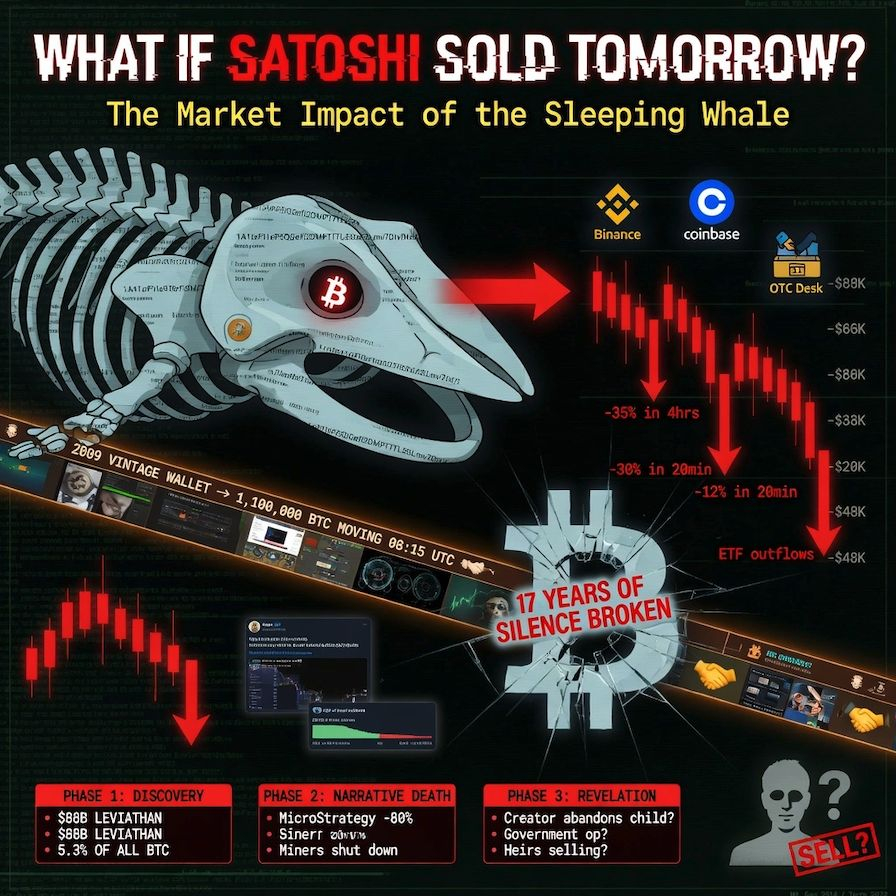
Phase One: The Discovery (Minutes 0-60)
At 08:15 UTC, a blockchain analyst notices it. A 2009 vintage address just broadcast a transaction. His hands shake as he checks the block explorer. Then another address moves. And another.
The tweet goes out. The screenshot spreads.
Within minutes, every major exchange risk engine triggers. Derivatives platforms automatically reduce leverage limits. Funding rates invert as shorts pile in. The price doesn't drop—yet. Because nobody knows if this is a sell or just a shuffle.
The market freezes in that terrible uncertainty between signal and confirmation. Bitcoin drops 12% in twenty minutes—not from selling pressure, but from existential terror.
Because here's what the market understands instantly: If Satoshi is selling, no technical analysis matters. No support levels hold. No institutional buyer is large enough to absorb this flow.
The god of the protocol just became the seller of last resort.
Phase Two: The Confirmation (Hours 1-6)
The coins hit exchanges. Not Coinbase. Not Binance. Over-the-counter desks first—places designed for size without slippage.
But $88 billion isn't "size." It's the entire OTC market for months compressed into days.
Word leaks. Institutional desks start quoting spreads you haven't seen since 2018: $4,000 wide. Then $8,000. "We'll buy your Bitcoin at $55,000" they tell panicked sellers, knowing they can pick up Satoshi's coins at $40,000 on the other side.
The price drops 35% in four hours. Not because the market can't absorb the selling—because the market is recalibrating what "value" means when the protocol's creator has abandoned it after seventeen years.
This is the part most traders miss: The financial impact is secondary to the narrative destruction.
Every Bitcoin bull case ever written includes the same foundation: "Even Satoshi never sold." It was proof of commitment. Proof that this wasn't a scam. Proof that someone believed enough to create a fortune and never touch it for seventeen years.
That proof just evaporated.
The price hits $52,000. Then $48,000. The ETFs face record outflows. Not because retirees hate Bitcoin—because financial advisors see a headline they can't explain to clients.
Phase Three: The Structural Breakdown (Days 2-7)
Here's where it gets dangerous. Not for price. For the protocol itself.
The sudden release of 1.1 million Bitcoin into circulation doesn't just crash the market—it fundamentally alters the supply distribution assumptions that underpin institutional models.
MicroStrategy: The Proxy Collapse
MicroStrategy holds 818,869 BTC at an average purchase price of approximately $66,385. At $80,000 Bitcoin, they're sitting on $11 billion in unrealized gains. No margin calls. No forced liquidation.
But in a Satoshi-sell scenario, that doesn't matter.
MSTR trades as a leveraged Bitcoin proxy. When Bitcoin drops 35%, MSTR drops 60%. When Bitcoin drops 50%, MSTR drops 80%. The equity becomes a falling knife that convertible debt holders rush to convert and dump.
Saylor doesn't face liquidation. He faces investor abandonment. Shareholders flee the "Bitcoin treasury company" narrative as toxic. The convertible notes convert to equity that gets immediately sold. The strategy that built a $100 billion company becomes a $20 billion cautionary tale.
The Miner Death Spiral
Mining operations with debt-funded ASIC expansions watch their collateral value evaporate. Hash rate begins dropping as unprofitable operations shut down. Difficulty adjusts downward—but not before the network's security budget faces genuine stress.
The very infrastructure that validates Bitcoin becomes endangered not by price, but by fear of price.
The ETF redemption Cascade
GBTC and spot ETF products face record outflows. Not because the Bitcoin is bad—because advisors need to explain to clients why they're holding an asset the creator just abandoned.
$88 billion in outflows in a month. The trusts must sell Bitcoin to meet redemptions. Which drives price lower. Which triggers more redemptions.
The reflexive spiral that thought experiments are made of.
The "Why" That Matters More Than The What
Forget the price action. The signal is the message.
Satoshi selling isn't a liquidity event. It's a revelation event. It means one of three things:
Scenario One: Satoshi is alive, watching, and has decided Bitcoin failed its mission. Centralized. Co-opted. Captured by Wall Street after seventeen years of watching institutions accumulate. The creator abandons the child they raised.
Scenario Two: Satoshi died, and the keys passed to heirs who don't understand the optics. Estate sale. Probate liquidation. Seventeen years of patience destroyed by inheritance law. The least malicious cause, but equally devastating.
Scenario Three: Satoshi never existed as an individual—and the keys are controlled by an entity (government, corporation, early consortium) that waited seventeen years for maximum extraction value.
Each scenario destroys a different pillar of the Bitcoin narrative. Decentralization. Sovereignty. Trustlessness.
The market can recover from $35,000 Bitcoin. It can't recover from "the creator was a government operation all along."
Historical Precedent: When Ancient Whales Moved
This isn't theoretical. We've seen early wallet movements before.
2017: A 2011 wallet moves 111,114 BTC. Market drops 15% in hours. False alarm—turned out to be liquidated exchange funds, not Satoshi.
2020: 50 BTC from February 2009 moves. Twitter panics. Price drops 5%. Later attributed to an early miner unrelated to Satoshi.
2021: 2010 wallet moves 1,000 BTC. Barely registers.
The market has developed scar tissue.
But Satoshi coins are different. They're mythological. They represent the origin story—the immaculate conception of digital scarcity. Moving them after seventeen years isn't a transaction.
It's desecration.
The Counter-Case: Why It Might Not Matter
There is a bullish read. Cold, brutal, institutional:
"Finally. The uncertainty is resolved."
For seventeen years, institutional allocators faced one unquantifiable risk: What if Satoshi dumps? Now that risk is gone. The coins are distributed. The overhang cleared. Bitcoin trades with full float known.
The supply is finally, truly finite.
Some funds would view this as opportunity. "Buy the fear." Accumulate what panicked retail dumps. Build positions for the next decade knowing the original holder is out.
The price would recover. Maybe not to $80,000 next month. But to new highs eventually. Markets adapt. Mythologies fade. Fundamentals reassert.
But this optimistic case requires believing institutions would step into the greatest narrative collapse in financial history. That the "why" wouldn't matter.
I'm not confident. Seventeen years of market experience tells me narrative is liquidity. Destroy the story, and the money follows.
The Professional's Preparation: What You Actually Do
You can't hedge this. There is no options structure that protects against Satoshi selling.
But you can structure your exposure for systemic shock:
1. Assume the tail risk exists. Your position sizing should account for 50% intraday moves—not as probability, but as possibility. If you can't survive that drawdown, you're too large.
2. Separate conviction capital from trading capital. The coins you believe in for 2030 don't sit on exchanges. They don't have stop losses. They don't get touched because someone moved ancient Bitcoin after seventeen years.
3. Watch the chain, not the price. If 2009 vintage addresses activate, you have hours—not days—to make decisions. Blockchain monitoring tools are essential infrastructure, not optional indicators.
4. Prepare the narrative you'll need. The headlines will be catastrophic. The FUD will be institutional-grade. You'll need to explain to yourself, your LPs, your family—why you're holding—while the world burns.
That explanation can't be "number go up." It has to be deeper. Structural. Based on something Satoshi can't destroy with a transaction.
The network. The hash rate. The global demand for non-sovereign settlement.
The Final Reality
Satoshi selling isn't a bug in the system. It's the ultimate stress test.
Bitcoin was designed to survive this. The protocol doesn't care who holds the coins. The difficulty adjustment doesn't recognize "original" wallets. The network settles transactions regardless of market cap.
The system survives. Participants might not.
Those who panic sell at $35,000 won't buy back at $200,000. They'll sit out the next bull cycle, telling themselves they "got out before the crash" while the market makes new highs without them.
Those who hold through the terror—who understand that one transaction doesn't invalidate seventeen years of network security—will capture the full cycle.
The sleeping whale isn't a threat to Bitcoin.
It's a filter. A crucible. A mechanism for transferring coins from weak hands to strong ones through the greatest psychological test the market can devise.
And if tomorrow comes, and that ancient wallet awakens after seventeen years of silence?
You'll learn exactly which hands are yours.
The fortune is $88 billion. The silence was seventeen years. The lesson is priceless. The choice is yours.
(Disclaimer: This is a shared experience, not financial advice. Past performance does not guarantee future results. Crypto trading involves risk.)
