

Honey! Do you know? When I first looked at autonomous on-chain agents, what struck me wasn’t the intelligence layer people kept talking about. It was the silence underneath it. A wallet executes, liquidity reroutes, positions rebalance, collateral shifts between protocols, and from the outside it feels almost ordinary now. Fast. Clean. Predictable. But the deeper you go, the more you realize none of that coordination survives without a second system operating quietly in parallel. Not the agents themselves, but the mitigation architecture constantly questioning whether every action should be allowed to complete.
That distinction matters more than most people think.
Right now the market is obsessed with automation. On-chain agents are handling treasury management, liquidation routing, arbitrage execution, staking optimization, even governance participation. Across Ethereum L2 ecosystems alone, automated smart contract interactions have climbed sharply over the past year as gas efficiency improved and intent-based infrastructure matured. On some DeFi protocols, well over 60% of transactions now originate from automated systems rather than direct human execution. That sounds like efficiency. Underneath, it also means attack surfaces are multiplying faster than most users notice.
Because autonomous coordination changes the nature of risk.
Traditional exploits usually targeted isolated weaknesses. A bad oracle. A reentrancy bug. An admin key leak. But autonomous systems introduce state dependency across multiple protocols simultaneously. One manipulated condition no longer affects a single contract. It can redirect an entire chain of machine decisions.
You can already see traces of this pattern emerging. In 2024 alone, crypto exploit losses crossed roughly $2 billion depending on the reporting source, but the more important detail was structural, not numerical. Increasingly, attacks exploited coordination assumptions rather than single lines of code. Flash loan manipulation is the obvious example. An attacker temporarily distorts liquidity conditions, an automated system interprets the distorted state as legitimate, then executes exactly as designed. The exploit is not breaking the machine. It is convincing the machine reality changed.
That subtle difference explains why mitigation systems are becoming foundational infrastructure rather than optional security layers.
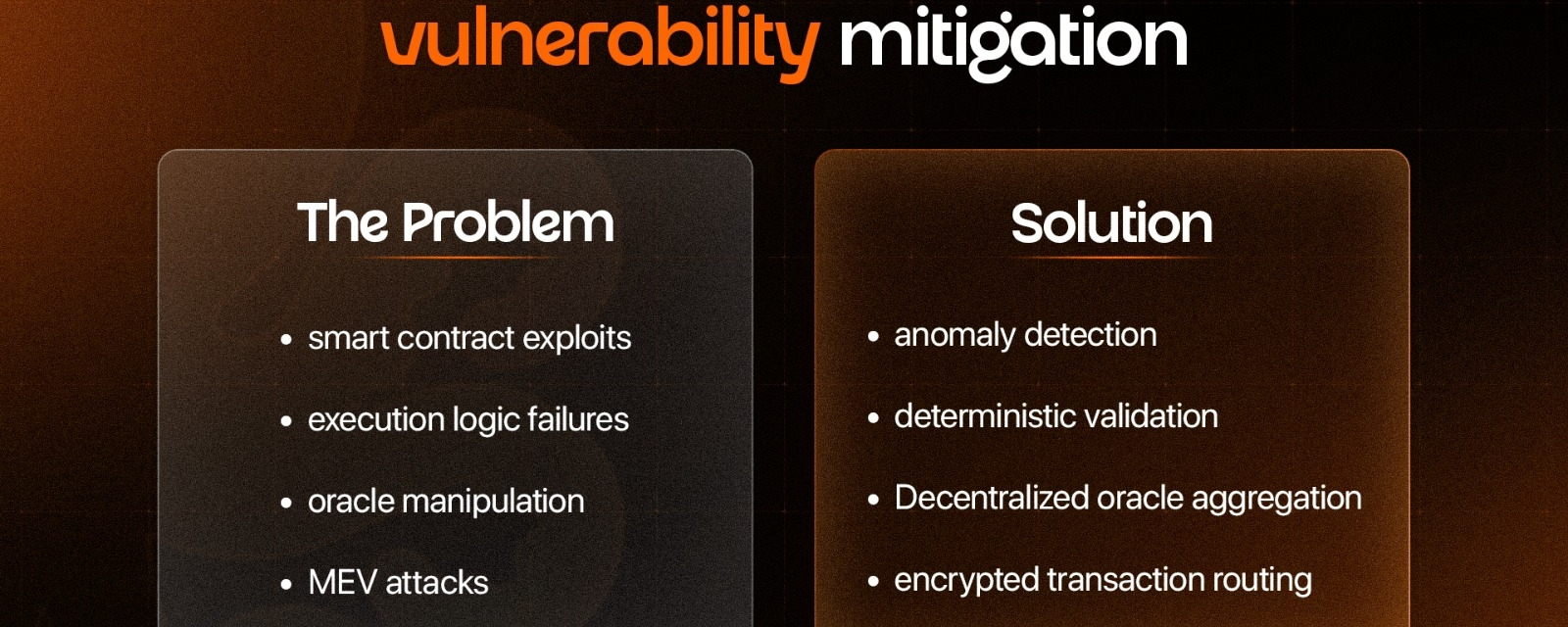
On the surface, mitigation looks simple. Transaction simulation. Rate limits. Oracle validation. Circuit breakers. Multi-sig approvals. But underneath, the real work is probabilistic interpretation. The system is constantly asking whether observed state transitions make contextual sense relative to historical behavior, liquidity depth, execution timing, validator ordering, and cross-protocol dependencies.
Think about a treasury agent moving $40 million in stablecoin liquidity across chains. Surface level execution might only take seconds. Underneath, defensive systems are checking whether bridge latency suddenly changed, whether liquidity pools show abnormal imbalance, whether oracle heartbeat timing drifted, whether mempool activity suggests sandwich positioning, whether correlated protocols are simultaneously experiencing unusual withdrawals. None of that is visible to the user. The visible action is one transaction. The invisible layer is continuous skepticism.
Understanding that helps explain why modern mitigation systems increasingly resemble behavioral intelligence rather than static security tooling.
A few years ago, protocol defense mostly meant auditing code before deployment. Audits still matter, obviously, but they were built for deterministic software assumptions. Autonomous coordination environments are partially non-deterministic because agents react to changing market conditions in real time. That means security can’t stop at deployment. It has to persist during execution.
That creates another effect people underestimate. Security systems themselves are becoming orchestration layers.
Take oracle defense as an example. Most people hear “oracle manipulation” and think price feed distortion. The deeper issue is temporal trust. If an autonomous lending agent reacts to prices every 12 seconds while an attacker can distort liquidity for 9 seconds, the attacker doesn’t need permanent manipulation. They only need enough distortion to redirect one machine decision. Mitigation systems now respond by aggregating multiple feeds, delaying sensitive execution windows, cross-validating TWAP behavior, or introducing confidence thresholds before allowing high-value actions.
To users, that can feel slower. Less elegant. Sometimes frustrating.
But speed without validation is exactly what exploit-driven systems depend on.
You can see this tension clearly inside MEV environments. Ethereum validators and searchers extracted billions from transaction ordering opportunities over recent years, and autonomous agents now operate directly inside those same contested environments. An execution agent chasing yield across fragmented liquidity pools is not moving through neutral infrastructure. It is moving through adversarial terrain where visibility itself becomes exploitable.
That’s why private mempools, encrypted transaction propagation, and intent-based execution systems are gaining traction. Not because they sound advanced, but because open visibility creates informational asymmetry. If an autonomous agent publicly signals its next move before completion, external actors can reshape the environment around it.
Meanwhile, mitigation systems are adapting in increasingly layered ways. Some protocols now simulate transaction outcomes across multiple future state conditions before allowing execution. Others isolate high-risk contract interactions inside constrained permission environments. Some autonomous vaults impose dynamic withdrawal friction only during volatility spikes, not permanently. Early signs suggest the industry is moving toward adaptive defense models rather than static rule systems.
And honestly, that shift feels necessary.
Because the uncomfortable truth is that fully autonomous financial coordination introduces systemic fragility if validation layers fail to evolve alongside automation layers. Machines compound efficiency, but they also compound error propagation. A human trader might hesitate during abnormal market conditions. An improperly secured autonomous agent executes instantly unless something underneath intervenes.
That “something underneath” is becoming one of the most important architectural shifts in crypto.
What makes this especially interesting right now is the broader market context. Capital efficiency is tightening again. Stablecoin velocity is rising. Cross-chain liquidity routing is accelerating as modular ecosystems compete for flow. At the same time, AI-driven execution tooling is becoming cheaper to deploy. Those trends together mean autonomous financial actors are about to increase significantly over the next cycle.
And if this holds, security models based purely on static prevention will probably struggle.
Because autonomous ecosystems are not only vulnerable to exploits. They are vulnerable to manipulated interpretation. That is a different category of problem entirely.
When people imagine future on-chain systems, they often picture smarter agents. Better execution. Lower latency. More personalization. But the systems quietly earning trust are usually the ones building defensive skepticism directly into coordination itself. The market notices execution speed first. It notices mitigation architecture only after failure.
That pattern keeps repeating across crypto.
The protocols that survive long enough to matter are rarely the fastest in their earliest phase. They are usually the ones that learned how to distrust their own assumptions before attackers taught them to.
And maybe that’s the deeper story underneath autonomous coordination. The future of on-chain intelligence may depend less on how independently agents can act, and more on how carefully the systems beneath them learn to doubt what they see.
