

OpenLedger is interesting because it is not trying to make AI sound more magical. It is trying to make AI more accountable. That matters now because the market has moved past the early excitement of chatbots and image generators. People are asking harder questions: where did the data come from, who improved the model, who gets paid when an output becomes useful, and how can an AI agent act without becoming another black box? OpenLedger’s answer is to push more of that lifecycle on-chain, turning data, models, applications, and agents into traceable economic parts rather than hidden backend assets.
What makes the idea feel timely is the shift from general AI to specialized AI. A broad model can answer many things, but serious use cases often need narrower, cleaner, more trusted data. Healthcare, DeFi, mapping, gaming, retail, and enterprise tools do not only need “more AI.” They need AI that knows its field, remembers where its knowledge came from, and can prove why certain contributors deserve value. OpenLedger’s Datanets are designed around that problem: decentralized data networks that collect, validate, and distribute domain-specific datasets for model training.
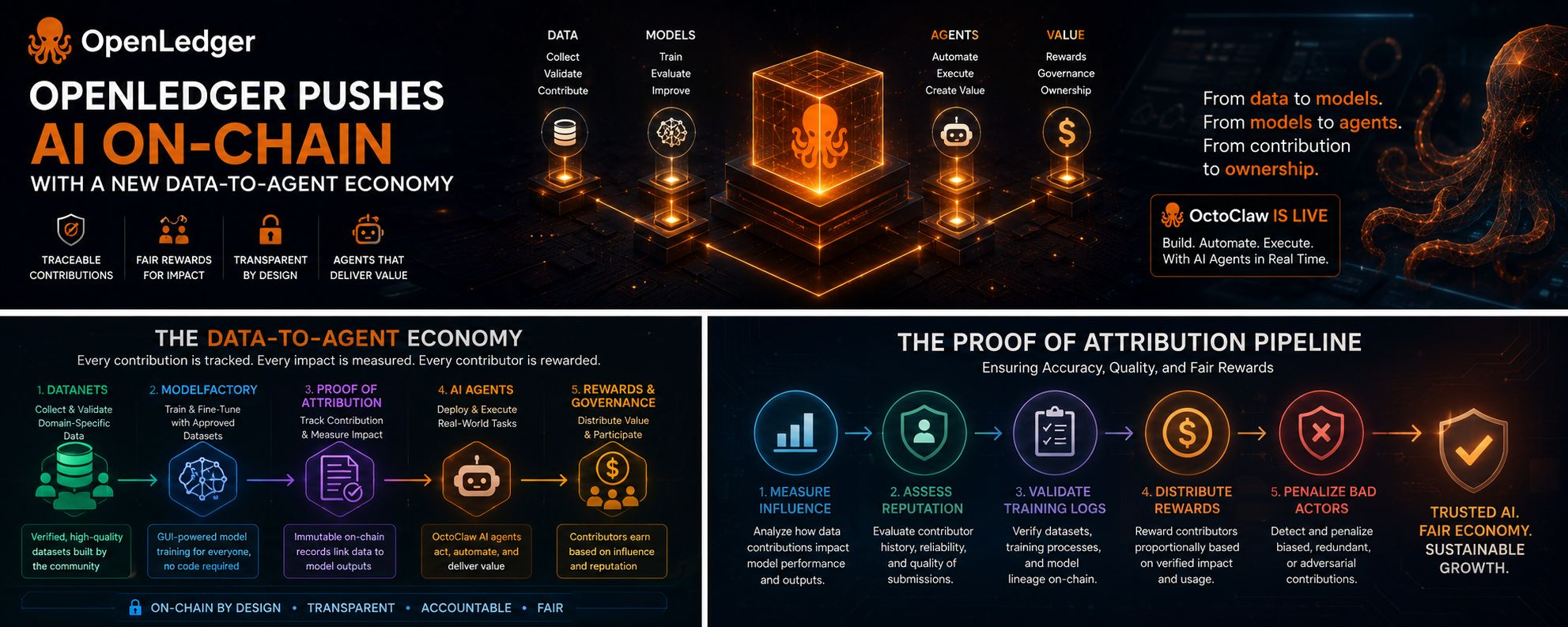
The core idea is simple in plain language. Instead of data disappearing into a model forever, OpenLedger tries to keep a record of contribution. If someone provides useful data, helps improve a dataset, or builds a model that others later use, the system should be able to trace that value. Its Proof of Attribution mechanism is built to link data contributions to AI model outputs, maintain an immutable record, and reward contributors based on the impact of their data.
That may sound technical, but the human point is easy to understand. For years, AI has been trained on enormous pools of information, while many contributors remained invisible. Writers, experts, researchers, communities, and niche data providers often had little say in how their material was used. OpenLedger is not solving that entire global debate overnight, and it would be careless to pretend it is. But it is pointing toward a more structured model where contribution can be tracked, quality can be measured, and value can move back toward the people or groups who helped create it.
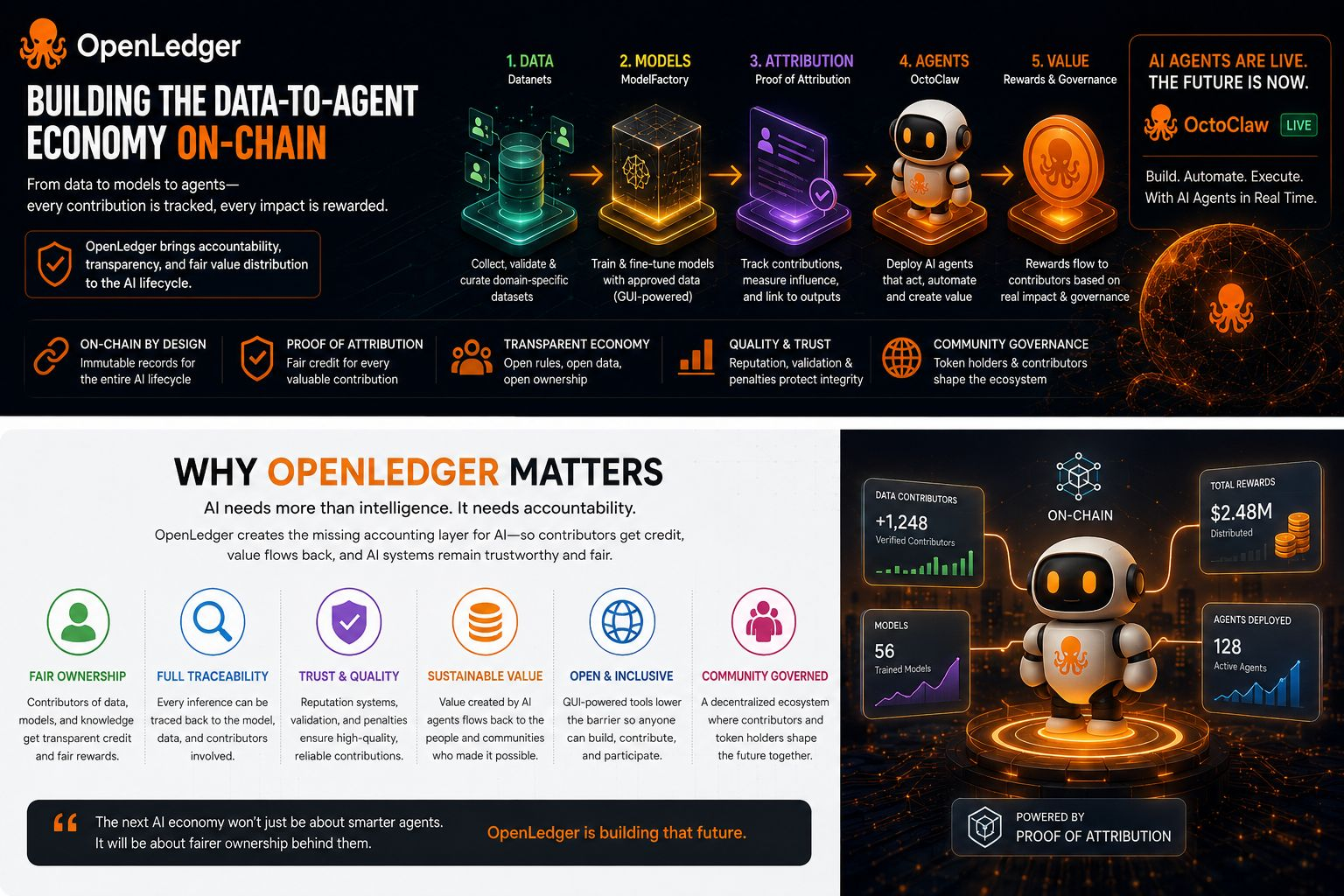
The data-to-agent economy is where this becomes more than storage or attribution. OpenLedger is building a path from data collection to model creation, then from models to agents that can perform tasks. Its documentation describes actions like dataset uploads, model training, reward credits, and governance participation as on-chain activities. It also explains that inference can be traced back to the model used, the data behind it, and the contributors involved.
This is why ModelFactory matters. It gives users a way to fine-tune large language models with approved datasets inside the OpenLedger ecosystem, using a GUI-only experience instead of command-line tools or API-heavy workflows. That small detail is important. If AI ownership is only available to highly technical teams, the economy stays narrow. If more people can create Datanets, contribute data, train models, and publish them with transparent mechanics, the system becomes more open.
The recent agent angle gives the project more relevance. OpenLedger’s site now highlights OctoClaw as live, positioned around building, automating, and executing with AI agents in real time. That shows the project is not only speaking about datasets and models in theory; it is moving toward the layer where AI systems actually do things.
Still, the biggest test is not whether OpenLedger has an appealing narrative. Many AI-crypto projects do. The real test is whether the attribution layer can remain accurate, useful, and hard to manipulate once incentives grow. If rewards are attached to data influence, then low-quality contributors will try to game the system. OpenLedger’s own attribution pipeline mentions measuring influence, using contributor reputation, validating training logs, distributing rewards proportionally, and penalizing biased, redundant, or adversarial contributions.
What I find most grounded about OpenLedger is that it treats AI as an economy, not only as software. Data has value. Models have value. Agents may soon create value by acting across workflows. The missing piece has been a clear way to record who contributed what and how that contribution keeps producing returns. OpenLedger’s push on-chain is an attempt to build that missing accounting layer.
It is still early, and execution will matter more than language. But the direction feels important. If AI is going to become part of daily work, finance, content, research, and automation, then trust cannot stay hidden inside private systems. Someone has to make the trail visible. OpenLedger is betting that the next AI economy will not only be about smarter agents, but about fairer ownership behind them.