
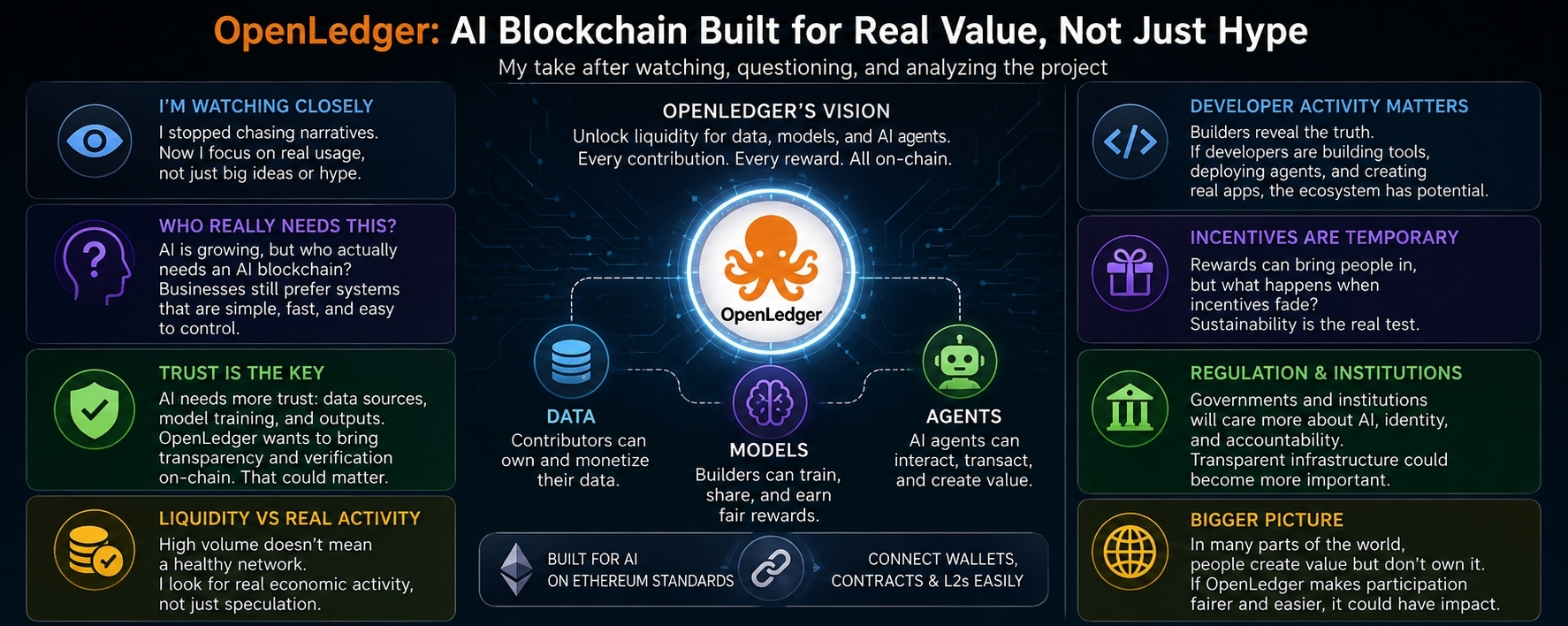
I’m watching OpenLedger with a calm mindset because I’ve learned that in crypto, big ideas are everywhere but real value is much harder to find. OpenLedger talks about becoming an AI blockchain where data, models, and AI agents can interact and create economic activity on-chain, and I find myself trying to understand whether this is a system people will actually depend on or simply another idea arriving at the perfect moment when AI is already attracting attention. I stopped looking at loud narratives a while ago, so now I mostly care about whether a project has a real reason to exist.
When I look at OpenLedger, the first thing I think about is usage. I always ask myself who actually needs this and why. AI is growing quickly, but there are still many unanswered questions around ownership, trust, and incentives. People create valuable data every day, models continue improving, and AI agents are slowly becoming more capable, but the process behind all of it still feels disconnected. OpenLedger seems to be trying to build a system where these pieces can work together in a more transparent and organized way. That sounds useful in theory, but theory alone never means much unless people truly start using it.
I’ve noticed that OpenLedger keeps positioning itself around monetizing data, models, and agents, and that part feels worth paying attention to. One thing I keep thinking about is how much value people create online without really owning any part of it. Data moves through platforms, companies benefit, and users often stay at the edge of the system. If OpenLedger can create an environment where contributors are rewarded more fairly, where AI-related activity becomes easier to track and verify, then maybe there is something meaningful being built here. But I still think the real test is whether people choose to participate naturally instead of only showing up because incentives exist.
Trust is another reason why OpenLedger interests me. AI is becoming more powerful, but trust around AI feels weaker than ever. It is harder to know where information comes from, how models are trained, or whether outputs can actually be trusted. OpenLedger appears to be trying to bring more transparency into that process by putting parts of AI activity on-chain. I can understand the logic behind that because verification and accountability may become more important as AI grows. Still, I wonder how much decentralization people actually want when speed and convenience usually win in technology.
I started paying attention to developer activity a long time ago because builders usually reveal the truth before markets do. With OpenLedger, I think developer interest matters more than price action or online excitement. If people are actively building tools, deploying AI agents, and experimenting with applications inside the ecosystem, that tells me the infrastructure might be useful. But if activity mainly comes from speculation or short-term campaigns, then it becomes harder to separate real adoption from temporary attention.
I also keep thinking about liquidity because crypto often mistakes speculation for strength. Just because a token moves or gains attention does not automatically mean the system underneath is healthy. For OpenLedger to feel sustainable, there has to be real economic activity happening inside the ecosystem. People need reasons to return. Developers need reasons to stay. Businesses or users need something valuable enough that they continue using the system even when market excitement disappears.
What makes me pause and think longer about OpenLedger is the bigger picture around AI itself. Governments are already paying more attention to AI regulation, institutions are trying to understand risks, and companies are competing to build stronger models. If trust, ownership, and identity become bigger concerns in the future, then maybe infrastructure like OpenLedger becomes more relevant. A system that helps coordinate AI activity in a transparent way could eventually matter more than it does today. But I think timing matters. Sometimes projects arrive too early and spend years waiting for the market to catch up.
I remember when I thought every ambitious crypto infrastructure project automatically deserved excitement, but experience changed how I look at things. Now I spend more time asking uncomfortable questions. Does OpenLedger solve a problem people genuinely care about? Is the ecosystem creating real value or only attracting temporary participation? What happens when incentives slow down? Will developers still build? Will users still stay?
I focus on these questions because long-term projects survive through repeated usefulness, not attention. OpenLedger has an idea that feels bigger than a short-term trend, especially because AI will probably continue growing for years. But growth in an industry does not guarantee success for every project connected to it. I’m waiting to see whether OpenLedger becomes something people actually rely on or whether it remains an interesting concept with strong timing.
For now, I’m simply watching OpenLedger carefully, trying to understand if real activity begins to grow around it. I am not rushing to conclusions because I think the strongest conviction usually comes from observation. The projects that last are usually the ones people quietly keep using long after the excitement fades, and I think OpenLedger still has to prove whether it can become one of them.