
I’ve been quietly watching OpenLedger for a while now
At first, I honestly didn’t think much of it. The project felt a bit silent compared to all the loud AI narratives we see everywhere these days.
But over time, something started to change. The updates became more meaningful,
the direction became clearer, and now it actually feels like there’s real building happening behind the scenes instead of just marketing noise.
Right now AI is everywhere.
Every second project is calling itself “AI powered,” but there’s one big problem that still hasn’t been properly solved.
If AI is using data, content, or creative work from the interne .
then where does the original creator stand?
Most of the time, creators don’t get anything. Their content is used to train models, improve systems, and generate output that gets
monetized somewhere else. And honestly, that’s why so many copyright arguments,
takedowns, and lawsuits are increasing day by day. The system is clearly not balanced yet.
This is the part where OpenLedger actually caught my attention
The idea of bringing verification and permission-based content usage into AI systems feels like a step in the right direction.
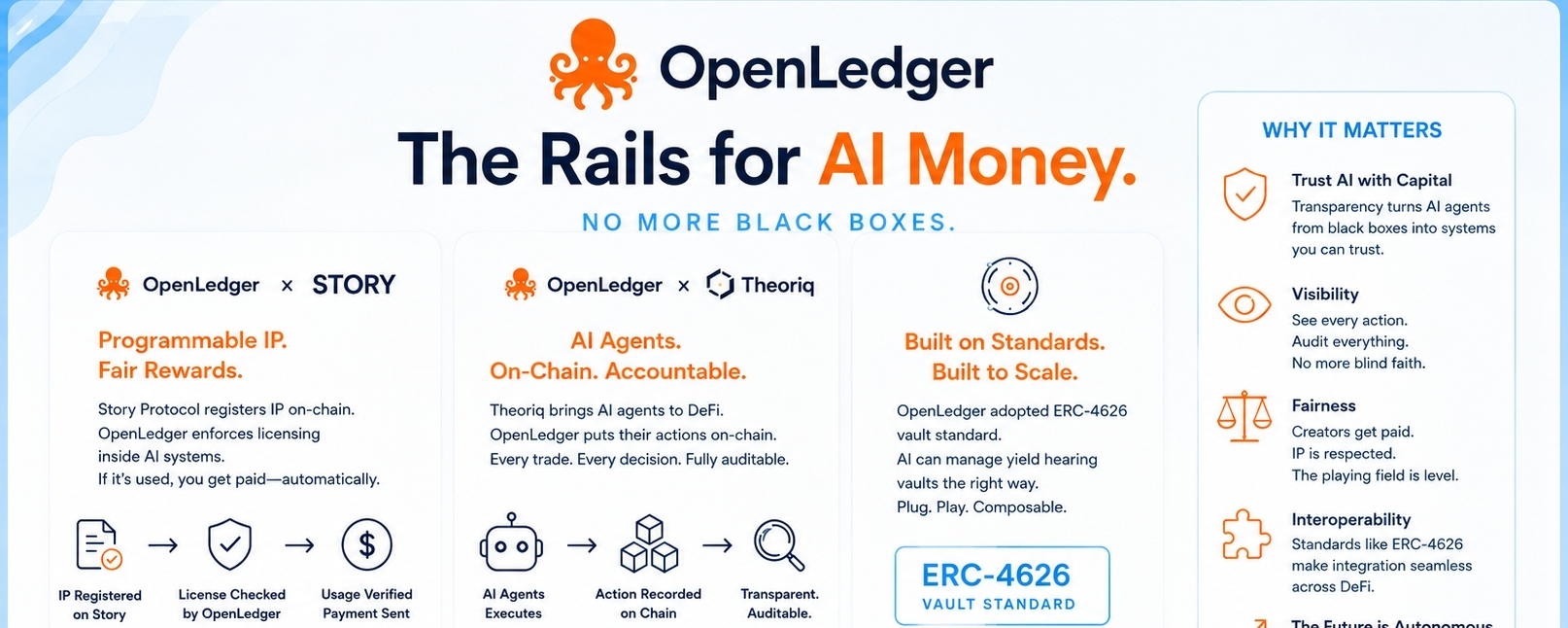
Especially their alignment with Story Protocol makes the concept even more interesting. If AI systems can actually recognize ownership and usage rights before consuming content, then the whole ecosystem becomes much more fair.
And if creators are automatically rewarded when their content is used, that changes everything.
It turns content from something that gets “taken” into something that continuously earns. That’s a big shift in mindset and structure.
It’s not just about technology anymore… it’s about fairness.
Another angle that made me more interested is their direction with Theoriq.
AI agents are slowly entering trading, automation, and decision making roles in
crypto and DeFi. But the biggest issue here is trust.
Most users today don’t really know what these AI bots are doing behind the scenes.
You deposit funds, you follow signals, or you let automation run… but you don’t actually see the decision making process clearly.
That’s risky.
If OpenLedger is really pushing on-chain transparency for AI actions, then that’s a big deal. Because once decisions become
trackable and verifiable, trust doesn’t have to be blind anymore. Users can actually see what happened, when it happened, and why it happened.
And if AI is going to handle serious capital in the future, transparency won’t be optional…
it will be necessary.
Even their adoption of standards like ERC-4626 might sound like a small technical detail, but in reality, these are the kinds of things that quietly shape the future.
Standardization is what makes systems scalable and long-lasting.
Without it, everything becomes fragmented and messy over time.
Right now, OpenLedger isn’t one of those hype driven projects you see trending every day. There’s no constant noise, no forced
narratives… just slow, steady development.
And honestly, that’s what makes it interesting.
Because in crypto, hype is easy. Building something that actually lasts is not.
I don’t know how the short-term market will react, and I’m not trying to predict that.
But from a long-term perspective, the idea they’re working on feels aligned with where AI and digital ownership are heading.
If AI becomes a core part of finance, creativity, and automation in the future, then transparency, ownership,
and accountability won’t just be features… they’ll be requirements.
For now, I’m just observing quietly and letting the story develop.
Feels like something bigger is slowly forming under the surface. OpenLedger