
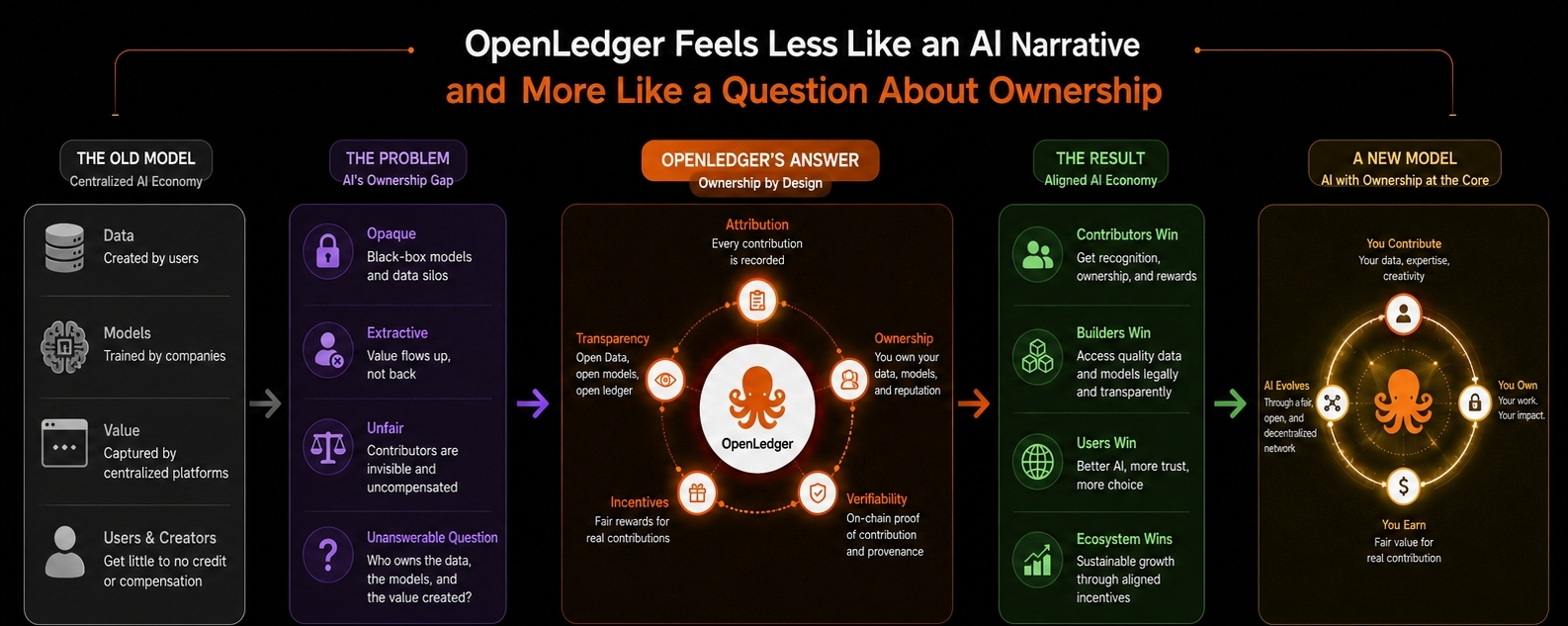

At first, I honestly assumed OpenLedger was going to be another project throwing AI and blockchain into the same sentence because that seems to be the trend now. I skimmed through it expecting the usual oversized promises and futuristic language. But after sitting with it for a while and reading deeper into what they were actually building, I noticed the project kept circling back to one thing — contribution. Not dominance, not disruption, just this quiet idea that the people helping AI systems grow should not become invisible afterward.
That part stayed with me more than I expected. Most conversations around AI make data feel strangely lifeless, like it simply exists waiting to be collected. OpenLedger approaches it differently. The way they talk about Datanets and attribution made me feel like they see data as human effort rather than just fuel for models. I still do not know if that vision can really hold together at scale, but I respected the intention behind it more than I thought I would.
I kept thinking about how much of the internet is built by people who never really own any piece of what they help create. Communities shape knowledge every day. Users unknowingly train systems through interaction, discussion, and behavior, and eventually the value usually concentrates somewhere far above them. OpenLedger feels like it is at least trying to question that pattern instead of accepting it as normal. That alone made the project feel more thoughtful to me than a lot of AI narratives I have seen recently.
The “Proof of Attribution” idea was probably the part I paused on the longest. I like the philosophy behind it more than I trust the mechanics yet. In theory, tracking where intelligence comes from sounds fair, even necessary. But real systems become messy very quickly once layers of models, edits, retraining, and reused data start stacking on top of each other. Attribution sounds clean until you try to measure contribution inside something constantly evolving.
I also noticed something subtle that made the project feel more grounded to me. OpenLedger does not constantly speak like it is trying to announce the future of civilization every five minutes. A lot of AI projects today sound more like movie trailers than infrastructure. Here, I mostly saw discussions around datasets, models, incentives, agents, and coordination. It felt quieter. Maybe that is why I found myself taking it more seriously.
At the same time, I still have questions about how the economics around all this actually play out over time. Reward systems always look balanced when they are explained on paper. Humans rarely behave that cleanly once incentives become real. The moment contribution turns into money, people naturally start optimizing for visibility and rewards instead of meaningful participation. I kept wondering whether attribution itself could eventually become something people learn to manipulate.
There is also a bigger tension underneath the entire idea that I cannot really ignore. AI usually becomes powerful through centralization — huge datasets, huge compute, huge control over infrastructure. Blockchain systems tend to move toward distribution and shared ownership instead. OpenLedger is trying to sit somewhere between those two worlds without collapsing into the weaknesses of either one. I honestly cannot tell yet whether that balance becomes the project’s strength or its hardest challenge.
What keeps me paying attention is not certainty or excitement. It is more that the project seems focused on questions that actually matter and probably will matter even more later. Ownership, attribution, and value distribution inside AI systems still feel unresolved almost everywhere. I do not think OpenLedger has proven anything yet, but I also do not think it is pretending the hard parts are already solved. For now, it just feels like one of those projects I want to keep quietly observing because something about the direction feels important, even if I cannot fully explain why yet.