
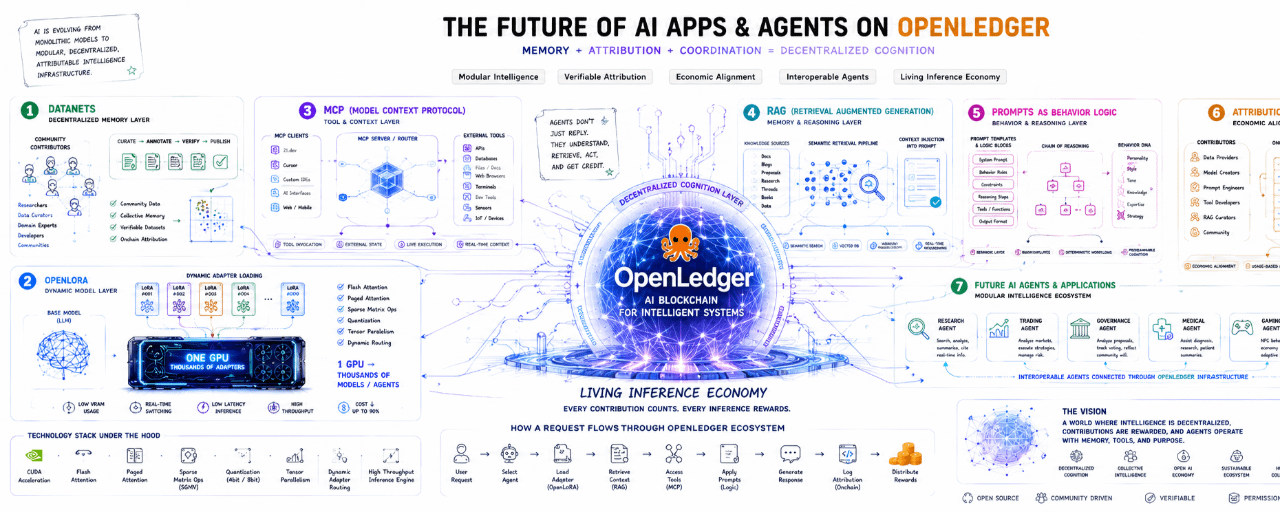
The future of AI apps and agents on openledger may have less to do with building one perfect supermodel and more to do with creating an ecosystem where intelligence behaves like a living network of specialized contributors
i realized this while exploring how openledger structures its ai stack. at first glance the platform looks like another decentralized ai infrastructure project focused on inference optimization and model deployment. but after spending time understanding how datanets rag openlora and attribution systems interact together the architecture started feeling fundamentally different from the direction most ai ecosystems are taking today.
the traditional ai pipeline still follows a rigid sequence. gather massive datasets train giant models centralize deployment monetize access. everything revolves around ownership of the largest model possible. openledger quietly shifts the focus away from model size and toward coordination between smaller intelligent components.
that distinction changes almost everything.
instead of imagining ai as one monolithic brain openledger treats intelligence more like an interconnected economy of memory reasoning retrieval and specialization. datasets become active infrastructure. prompts become reusable behavioral layers. adapters become modular capabilities. inference itself becomes economically traceable.
the clearest example of this philosophy appears inside openlora.
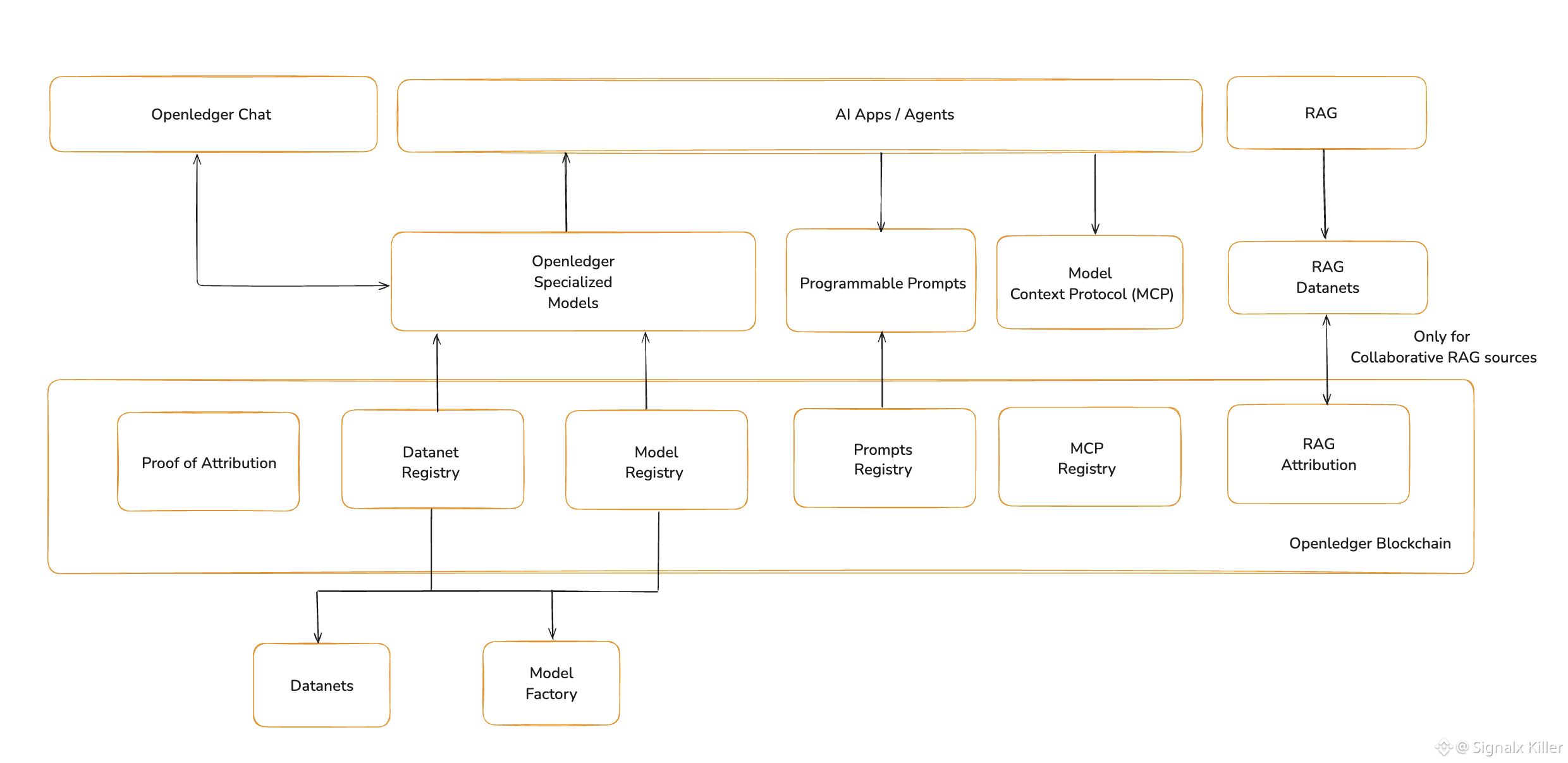
normally serving multiple fine tuned models creates enormous infrastructure overhead. every specialized model consumes memory resources and scaling personalized ai quickly becomes expensive. openlora removes this bottleneck by dynamically loading lora adapters only when inference requests arrive. adapters are merged with the base model in real time and unloaded immediately afterward. this allows thousands of specialized ai behaviors to operate from a single gpu environment without permanently occupying vram.
underneath this process several optimization layers quietly work together. flash attention reduces memory pressure during inference. paged attention improves token handling efficiency. sparse matrix operations accelerate computation paths. quantization lowers hardware requirements while preserving usable performance. individually these technologies are already important across modern ai systems but openledger combines them into a decentralized serving architecture designed specifically for scalable modular intelligence.
the result feels less like switching between separate models and more like activating temporary cognitive skills on demand.
that capability becomes extremely important once ai agents begin fragmenting into highly specialized roles.
the internet is unlikely to be dominated forever by a handful of universal assistants. instead we are moving toward millions of narrow agents optimized for specific environments. governance agents. research agents. gaming agents. legal summarization agents. financial monitoring agents. educational tutors trained on niche datasets. openledger appears designed for this fragmented future where intelligence behaves more like composable software infrastructure than centralized artificial consciousness.
but infrastructure alone is not what makes the ecosystem interesting.
the deeper innovation comes from attribution.
inside most ai systems today contributors disappear once training begins. datasets lose identity. prompt engineers receive no persistent recognition. retrieval systems borrow context invisibly. openledger introduces a framework where every layer of intelligence can remain economically visible during inference itself.
if a rag pipeline retrieves governance information from a datanet the retrieval event can become attributable. if a prompt structure improves reasoning quality its creator can theoretically receive rewards tied to usage frequency. if an mcp integration connects agents to external tools those interactions can remain transparent across the network.
this transforms ai from a closed production pipeline into an open coordination economy.
value no longer belongs exclusively to whoever owns the largest model. instead value flows toward whoever contributes useful context at the exact moment reasoning occurs. knowledge stops behaving like static intellectual property and starts functioning like dynamic infrastructure continuously reused across applications and agents.
that shift could reshape how ai communities organize themselves.
instead of competing to build giant vertically integrated systems smaller groups can specialize deeply. one community may focus entirely on curating medical datasets. another may optimize prompts for autonomous research agents. another may build adapters specialized for governance analysis or defi monitoring. because attribution exists across the stack contributors no longer need ownership of the entire platform to participate economically.
viewed together the architecture starts resembling something biological.

datanets function like distributed memory systems storing collective experience. rag behaves like contextual recall retrieving relevant fragments when needed. mcp acts almost like sensory input connecting agents to external environments and live information sources. prompts shape behavioral tendencies similar to cognitive patterns. openlora dynamically activates specialized capabilities only when required much like a nervous system routing signals through different functional pathways.
individually these components may appear incremental. combined together they begin forming an operating system for decentralized cognition.
that may ultimately become openledger’s strongest advantage.
many ai projects continue optimizing primarily for larger parameter counts and centralized performance benchmarks. openledger seems to optimize for coordination scalability instead. the ecosystem is designed so thousands of contributors can collaboratively build intelligence without disappearing into opaque centralized platforms.
the implications become clearer when imagining future ai applications built on top of this infrastructure.
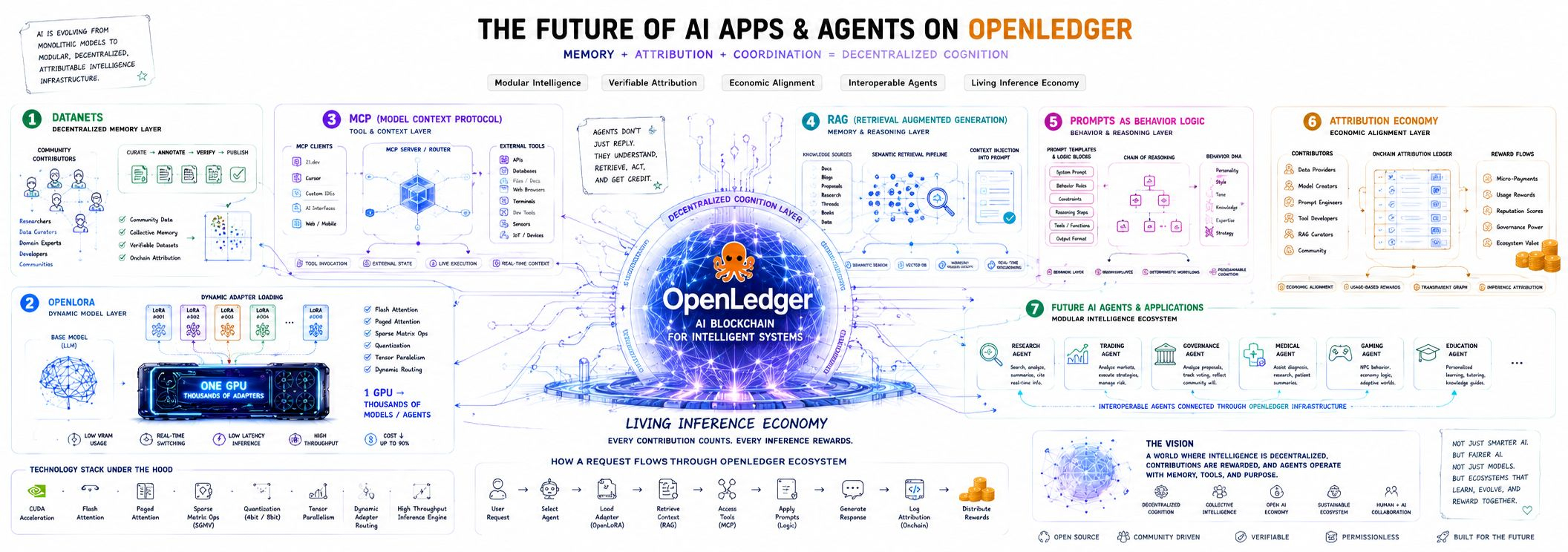
👍a trading agent inside openledger could combine community submitted market analysis historical governance discussions live liquidity feeds and specialized financial adapters simultaneously. rag systems inject contextual memory from datanets. mcp integrations connect the agent to exchanges and external protocols. prompts define behavioral constraints around risk management. openlora dynamically activates specialized reasoning modules depending on market conditions. throughout the entire process attribution remains visible across contributors datasets prompts and tools.
instead of ai becoming another black box controlled by a small number of corporations openledger moves toward something more collaborative where intelligence emerges from continuously coordinated participation across the network.
that may be the real future of ai apps and agents on openledger.
not one dominant machine replacing human contribution but millions of interoperable systems continuously rewarding the people who help them think better.
#openledger $OPEN @OpenLedger $RONIN $LAB