
been thinking about OpenLedger’s EVM compatibility from a boring angle.
not boring in a bad way.
boring as in: this might be the part that actually decides whether developers build on it or just read about it.
Most AI blockchain narratives start too high. data liquidity, model ownership, AI agents, attribution, monetization. all important. but developers usually ask a much more practical question first:
can I build without throwing away everything I already know?
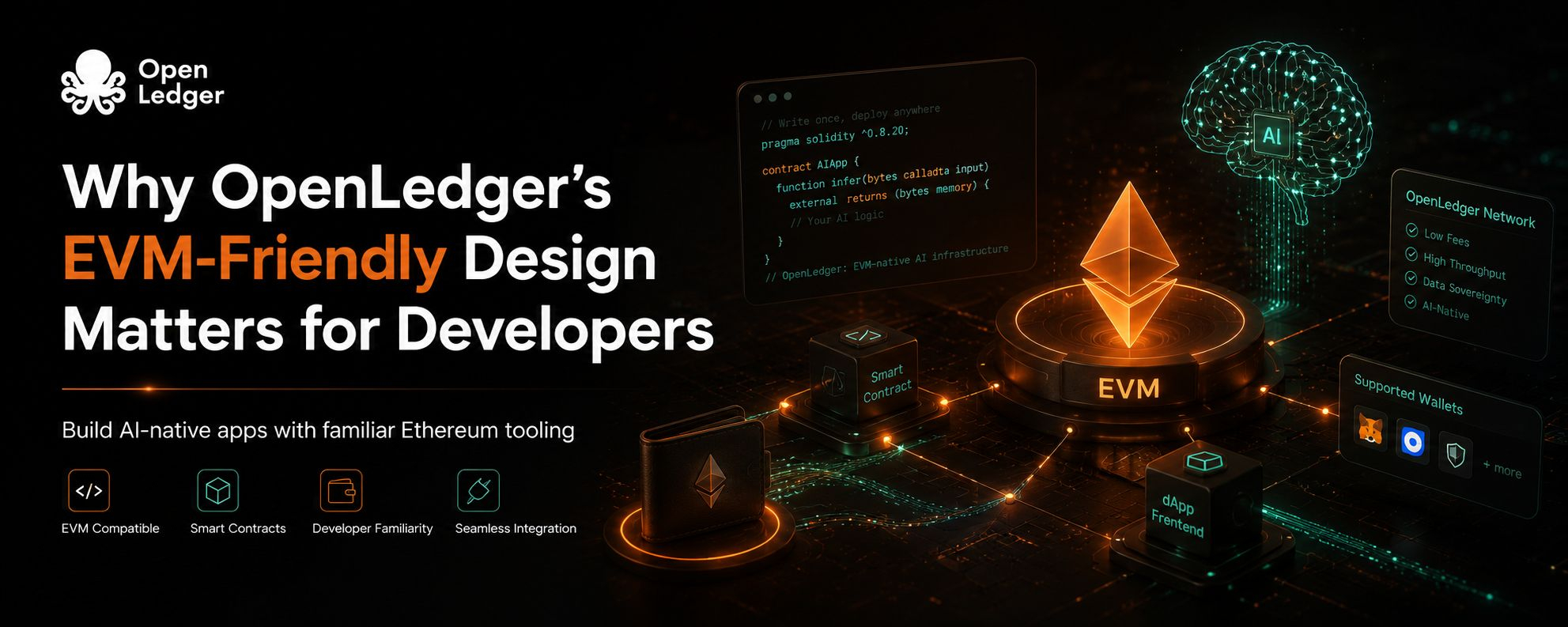
That is where OpenLedger’s EVM-friendly design matters. Its own site says OpenLedger follows Ethereum standards and lets users connect wallets, smart contracts, and L2 ecosystems with “zero friction.” That sounds like a simple compatibility line, but for developers, it is not small at all. It means OpenLedger is not asking builders to enter a totally unfamiliar environment before they can experiment with AI-native apps.
and honestly, that is smart.
because developer attention is expensive now.
A new chain can have a strong idea, but if builders need to learn a new contract language, new wallet flow, new tooling, new deployment logic, new explorer behavior, and new integration pattern, many will just leave. Not because the idea is bad. Because friction quietly kills curiosity.
EVM compatibility lowers that first wall.
Ethereum already has a huge developer surface: smart contracts, accounts, transactions, gas, testing frameworks, contract libraries, block explorers, APIs, analytics tools, storage patterns, bridges, and standards. Ethereum’s own developer docs organize the stack around exactly these building blocks, from smart contracts and development frameworks to JavaScript APIs, JSON-RPC, token standards, rollups, and data availability.
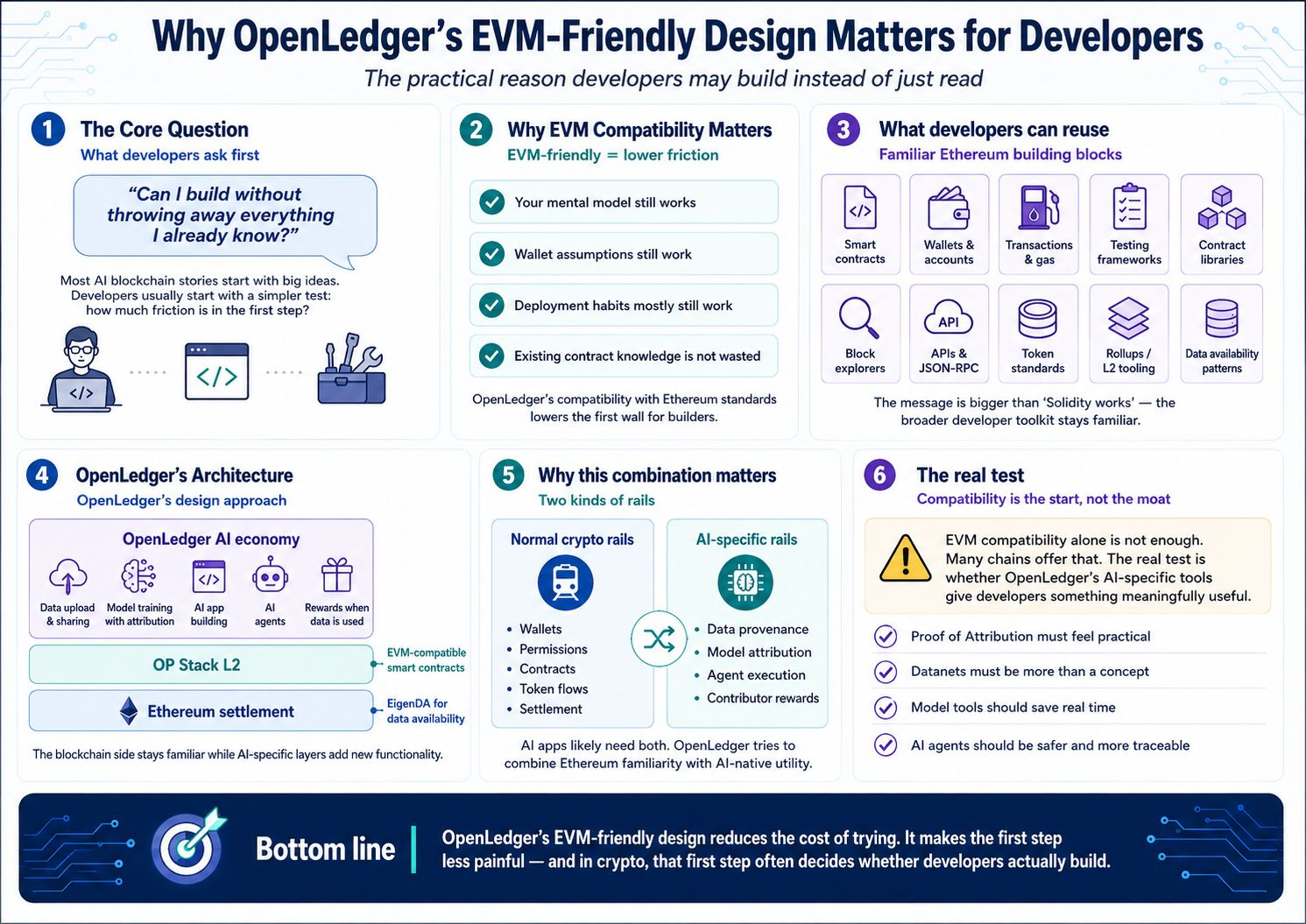
so when OpenLedger says it is EVM-friendly, the real message is not only “Solidity works.”
it is closer to:
your mental model still works.
your wallet assumptions still work.
your deployment habits mostly still work.
your existing contract knowledge is not wasted.
that matters even more because OpenLedger is not trying to be a normal general-purpose chain. Its official blog frames it as an AI blockchain for monetizing data, models, and agents, with tools to upload and share data, train models with attribution, build AI apps, and earn rewards when data is used.
that creates a strange design challenge.
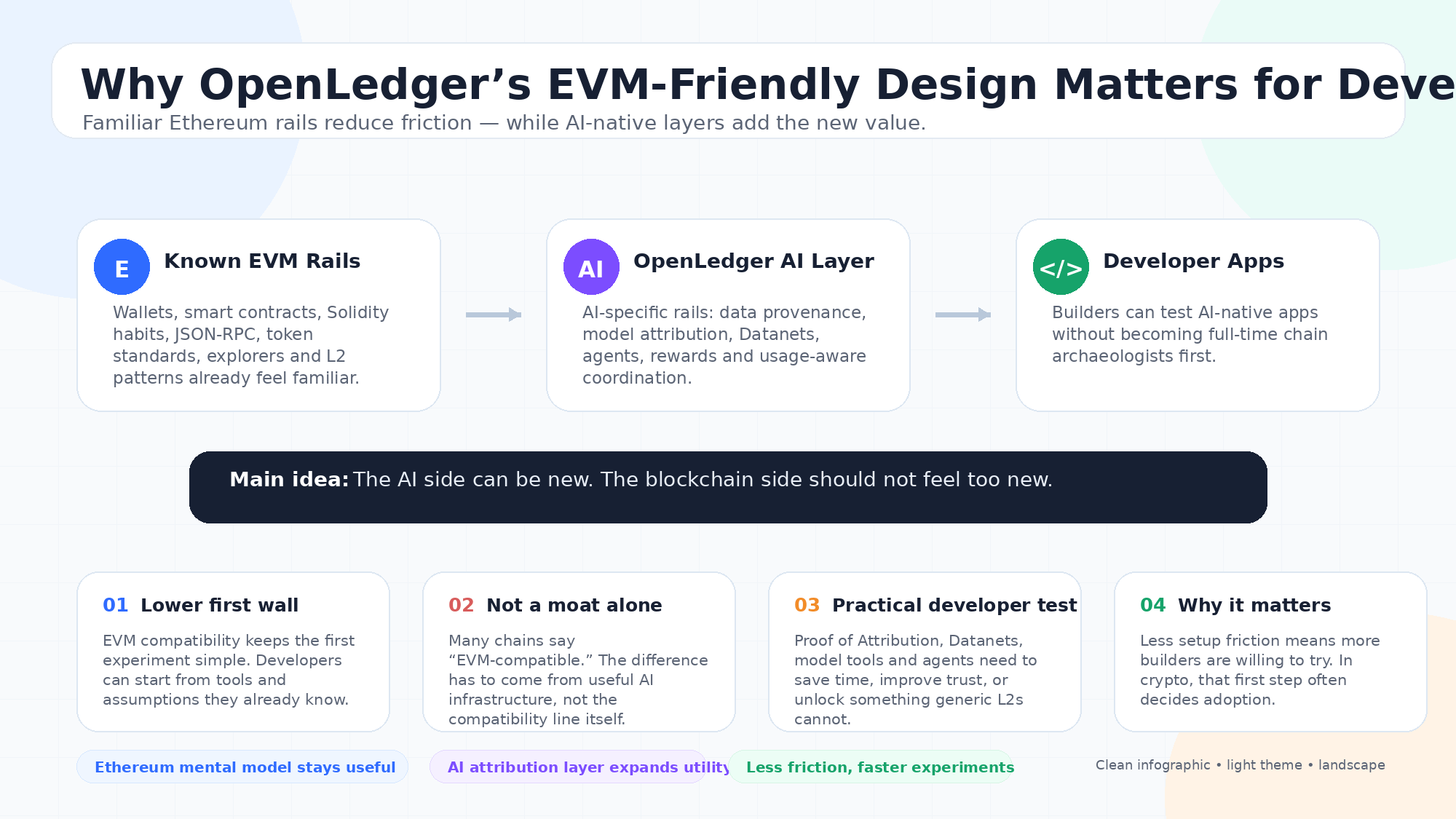
The AI side is new. The blockchain side cannot also feel too new.
If everything is experimental at once, developers hesitate. But if the chain keeps the familiar EVM base while adding AI-specific layers on top, builders can start from what they already understand and then explore the new parts gradually.
That is the overlooked value.
OpenLedger’s GitBook test network overview also describes the network as using L2 scaling built on the OP Stack, settling on Ethereum, supporting Ethereum-based smart contracts, and using EigenDA for data availability. It explicitly lists EVM compatibility as a way to support seamless integration for developers.
so the structure is not random.
OpenLedger is trying to sit inside the Ethereum developer universe while adding a more specialized AI economy around it. That combination is important because AI apps will probably need both sides.
they need normal crypto rails: wallets, permissions, contracts, token flows, settlement.
but they also need AI-specific rails: data provenance, model attribution, agent execution, contributor rewards.
If OpenLedger only focused on AI and ignored developer familiarity, it would become interesting but isolated. If it only copied Ethereum without adding AI-native logic, it would become another chain with a theme. The bet is somewhere between those two.
my concern though:
EVM compatibility is not a moat by itself.
A lot of chains are EVM-compatible. Developers have heard that line too many times. So OpenLedger cannot rely on “Ethereum standards” as the whole pitch. The real test is whether the AI-specific layer gives developers something they cannot easily build on a generic L2.
That means the Proof of Attribution system has to feel useful. Datanets have to be more than a nice concept. Model tools need to save builders real time. AI agents need to interact with contracts in ways that feel safer and more traceable, not just trendier.
because developers are practical.
They may like the narrative, but they stay for working tools.
Still, the EVM-friendly choice feels like the correct starting point. It reduces the cost of trying. A Solidity developer can imagine deploying contracts. A wallet can connect without unusual behavior. An L2 ecosystem can plug in more naturally. AI builders do not have to become full-time chain archaeologists before testing an idea.
that is probably why this design matters.
OpenLedger is not just saying “come build AI on-chain.” It is making the first step less painful.
and in crypto, that first step decides more than people admit.
@OpenLedger #OpenLedger $OPEN $EDEN