
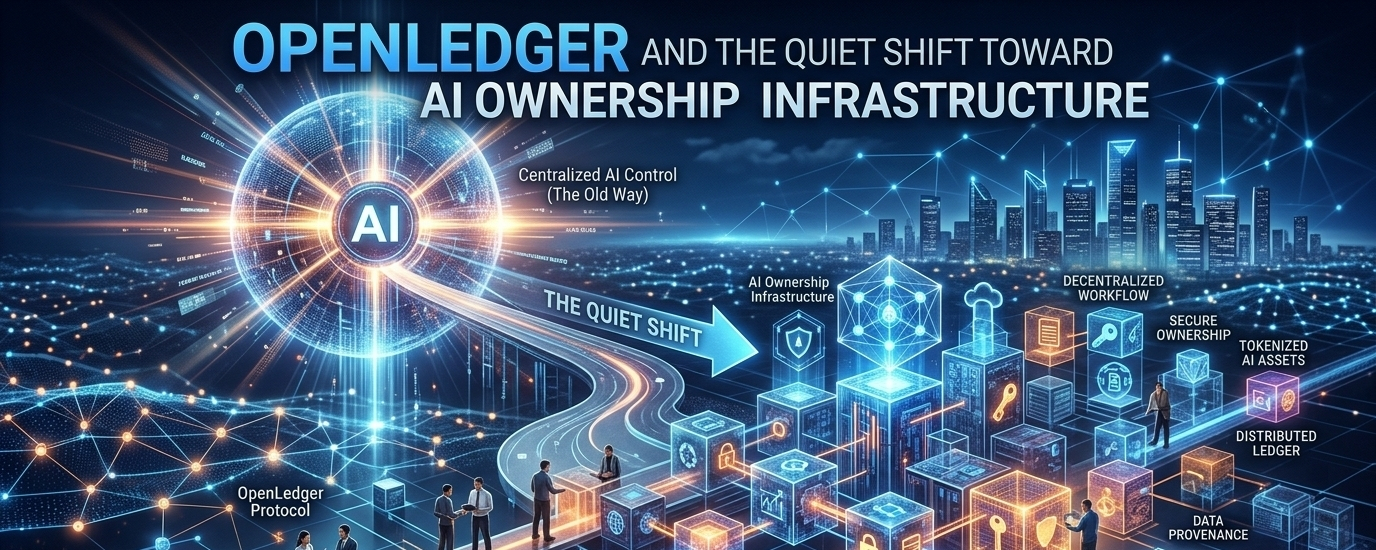

I’ve been thinking a lot about what happens when intelligence becomes something people can trade not in the abstract way tech people like to talk about the future but in a practical almost uncomfortable sense. We’ve spent years treating data as this invisible raw material of the internet something collected quietly in the background and absorbed into systems most people never really see. Then AI arrived and made that hidden layer suddenly visible. Data wasn’t just exhaust from digital activity anymore. It became the thing shaping intelligence itself.
That shift makes projects like OpenLedger hard to ignore.
Not because they offer some neat answer to where AI and blockchain intersect, but because they’re poking at a problem that feels increasingly real: if data and models are becoming valuable assets in their own right, then the infrastructure for owning valuing, and exchanging them is still strangely underdeveloped.
It’s odd when you think about it.
We’ve built highly sophisticated systems for trading money stocks derivatives, and digital collectibles of wildly questionable cultural importance. Entire financial architectures exist to price and move those assets efficiently. But when it comes to datasets that train models or specialized AI models themselves the market still feels fragmented and awkward. Ownership is often blurry. Attribution is messy. Monetization tends to favor whoever controls distribution rather than whoever contributed foundational value.
That’s the tension OpenLedger seems to be working inside.
The idea at least as I understand it is fairly straightforward on paper: create blockchain infrastructure where data and AI models can exist as economically active assets. In other words instead of datasets being passively consumed by centralized systems they become part of a network where their contribution can be tracked validated and potentially monetized.
Simple enough to describe.
Much harder to execute.
The interesting part isn’t really the blockchain itself. We’ve seen enough chains at this point to know that technical novelty alone rarely matters for long. What matters is whether the system solves a coordination problem that couldn’t be solved as cleanly otherwise.
And this is where things get more nuanced.
AI has a contribution problem. Modern models are built on layers of invisible labor and fragmented inputs. Someone curates data. Someone labels it. Someone fine tunes a model. Someone optimizes inference. Someone builds downstream applications that make the whole thing useful. By the time intelligence reaches an end user the value chain behind it has become almost impossible to untangle.
It reminds me a little of global supply chains.
When you buy a smartphone, you rarely think about the dozens of suppliers involved in making that single device. There are chips from one country, minerals from another assembly elsewhere software layered on top. The final product feels unified, but it’s really the result of a vast distributed network.
AI works similarly except the supply chain is informational rather than physical.
OpenLedger seems to be asking whether blockchain can function as the accounting layer for that informational supply chain.
That’s an intriguing proposition because blockchains at their best are really just systems for recording coordination with strong guarantees around visibility and consistency. Strip away all the market noise and speculative excess and that’s still the core innovation.
If applied well it could mean contributors to AI systems become legible in ways they currently aren’t.
But there’s a catch and it’s a significant one.
Contribution in AI is incredibly difficult to measure.
A token transfer is binary. It happened or it didn’t. Ownership is clear. Data contribution is fuzzier. If a dataset improves a model by half a percentage point on a benchmark what is that worth? If ten different datasets overlap, who gets credit? If a model’s value emerges mostly from architecture design rather than raw training data, how should rewards be split?
These aren’t just technical questions. They’re philosophical ones.
They force us to ask what value actually means in systems where outputs emerge from layers of interdependence.
And honestly I’m not sure anyone has a satisfying answer yet.
This is where many blockchain projects drift into overconfidence, pretending messy human coordination problems can be reduced to elegant protocol logic. Usually they can’t. Reality tends to resist clean abstractions.
That doesn’t mean the effort is misguided. It just means the ambition needs to be matched by humility.
What I find refreshing about the broader idea behind OpenLedger is that it doesn’t seem to frame blockchain as the product. It treats blockchain more like infrastructure for a larger economic question: how should machine intelligence be organized when its ingredients are distributed across many contributors?
That feels like a much more serious conversation than the usual AI-meets Web3 narratives.
There’s also something quietly important about liquidity in this context.
People hear that word and immediately think of trading volume or speculative markets. But liquidity in a broader sense, is about making assets usable. It’s about reducing friction between value creation and value exchange.
A house is valuable but illiquid. Cash is liquid because it moves easily.
OpenLedger appears to be applying that idea to data and models. The argument is that these assets are currently valuable but relatively illiquid. They exist but moving them through systems of attribution compensation and reuse is cumbersome.
If that friction could be reduced, entirely new behaviors might emerge.
Researchers could contribute specialized datasets without giving up ownership entirely. Smaller developers might monetize niche models more effectively. AI infrastructure could become less dependent on giant centralized aggregators.
That’s the optimistic view anyway.
The skeptical view is that technical infrastructure often solves only part of the problem. Market behavior has its own gravity. Even if decentralized coordination becomes possible participants may still gravitate toward large centralized platforms simply because convenience tends to win.
History is full of technically superior systems that lost to easier ones.
So maybe the real question isn’t whether OpenLedger can build robust infrastructure. It’s whether enough people will find enough practical reason to use it.
That’s always the harder challenge.
Still I can’t help feeling that projects exploring this territory are asking the right kinds of uncomfortable questions. Web3 has spent years searching for use cases that feel native rather than forced. AI attribution data ownership, and model liquidity might actually be one of those spaces where blockchain’s peculiar design choices make sense.
Or maybe not.
That uncertainty is part of what makes it worth watching.
We’re still in the early stages of defining what ownership looks like in an economy increasingly shaped by machine intelligence. And it’s entirely possible that years from now we’ll look back at experiments like OpenLedger as either foundational infrastructure or thoughtful detours.
Right now it’s hard to tell.
And maybe that’s exactly where the most interesting ideas tend to begin.
