
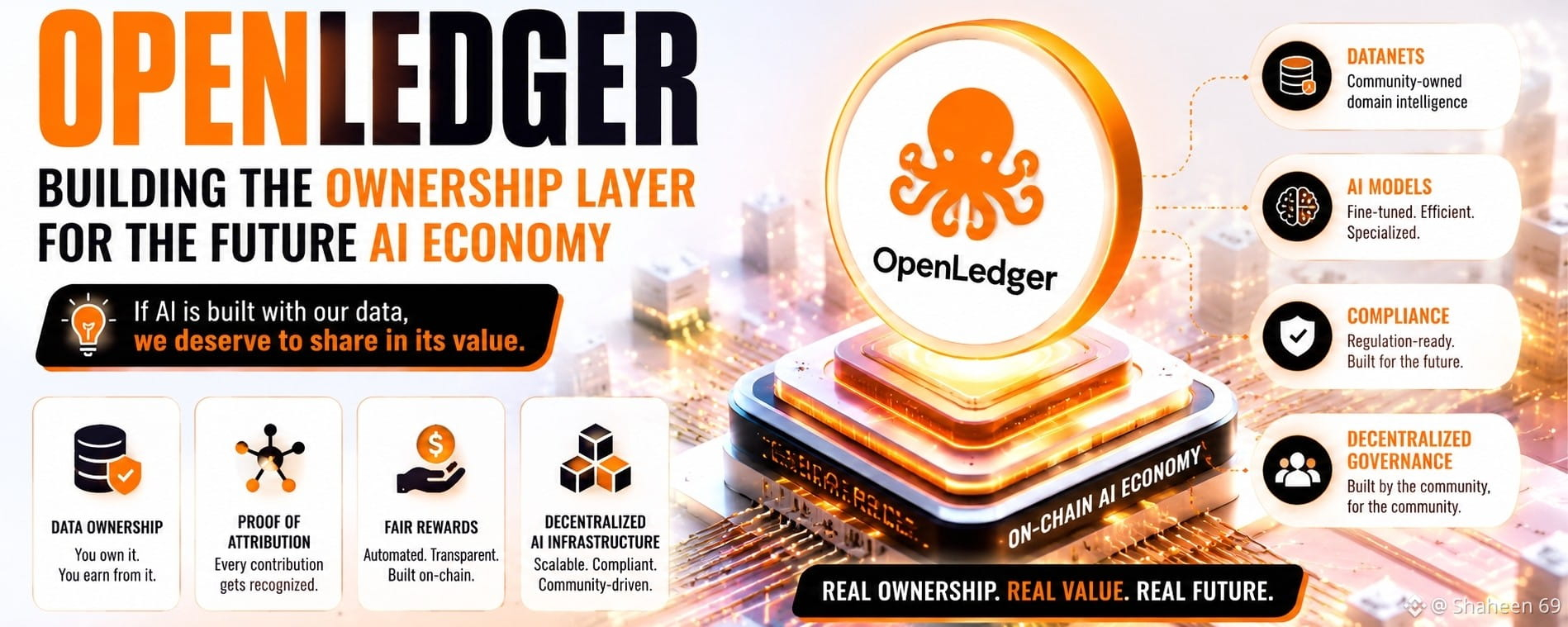

A few nights ago I was about to rotate more funds into $OPEN after reading through OpenLedger’s docs again… then I paused and only opened a small test position instead. Not because the idea looked weak — actually the opposite. Sometimes when a project sounds too ambitious, I get more cautious, not less.
At first I honestly thought OpenLedger was just another “AI + blockchain” narrative. We’ve all seen dozens of those already. But the deeper I went, the more I realized they’re trying to solve something most projects completely ignore: attribution.
That sounds boring until you think about how AI actually works today.

Right now, people contribute data, research, niche knowledge, even training material… yet the value mostly flows toward whoever owns the infrastructure layer. OpenLedger’s thesis is different. Their idea is that if human-generated data trains models, then contributors should eventually participate in the economic output too.
The interesting part isn’t the slogan. It’s the mechanics behind it.
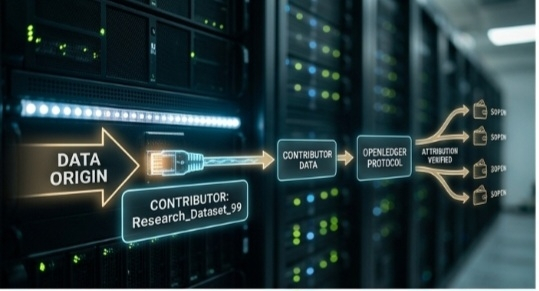
Their Proof of Attribution system is basically attempting to trace which datasets contributed to model outputs and then automate value distribution on the backend. That’s much harder than simply launching an “AI token.” And honestly, this is where I think the real infrastructure debate starts.
Because once enterprise AI becomes mainstream, ownership and compliance will matter just as much as model quality.
I think many crypto people underestimate this part. Enterprises don’t only ask:
“Is the model smart?”
They ask:
Where was the data sourced from?
Was permission granted?
Can this be audited legally later?
Especially with Europe’s AI regulations getting stricter, those questions aren’t theoretical anymore.
That’s also why the Story Protocol partnership caught my attention. It didn’t feel like random ecosystem marketing to me. It looked more like OpenLedger preparing for future compliance pressure before most projects even acknowledge it.
Another thing I found interesting is their Datanets idea. Most people describe it as dataset infrastructure, but I think it’s more about building niche AI economies.
For example, healthcare AI, legal AI, trading AI… these systems won’t run efficiently on one giant generalized model forever. Specialized fine-tuned models are becoming more realistic now because LoRA architectures drastically reduce deployment costs.
That changes the economics completely.
Earlier, building domain-specific AI required massive infrastructure spending. Now smaller specialized ecosystems are actually possible. OpenLedger seems heavily focused on optimizing that layer.

Still… I’m not blindly bullish here.
AI infrastructure is brutally expensive, and crypto narratives alone don’t create sustainable revenue. Enterprise clients care about uptime, latency, reliability, compliance — not just decentralization slogans. That’s probably the biggest challenge ahead for OpenLedger.
The attribution system might work beautifully in demos, but scaling it across a real inference economy is an entirely different problem.
And honestly, that uncertainty is exactly why I only opened a small position instead of aping in.
But even with all the risks, I respect one thing:
they’re at least attacking a real infrastructure problem instead of farming attention with generic “AI agents” buzzwords.
Maybe OpenLedger fails.
Maybe the model changes completely later.
But I don’t think this is one of those empty AI narratives pretending to be deep.
There’s genuine architecture thinking behind it… and lately that’s become surprisingly rare in this space.