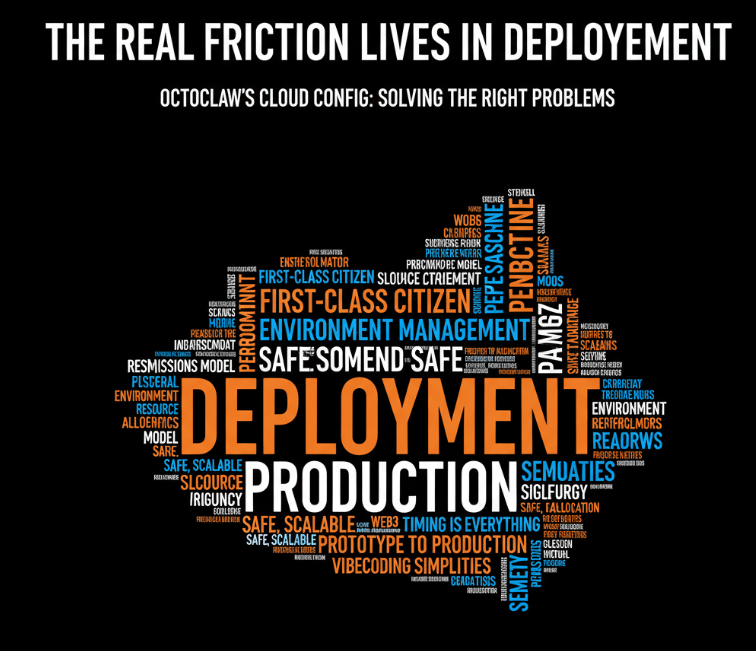


I'll be honest. For a long time I thought the hard part of building AI agents was the model. Pick the right LLM, write decent prompts, handle the edge cases, and you're mostly there. That's what I believed when I started actually trying to build things in this space. And then I ran into deployment and realized I had completely underestimated where the real friction lives.
Deployment is where good ideas go quiet. Not because teams give up, but because the gap between "this works in my test environment" and "this is running reliably in production for real users with real money on the line" is genuinely enormous. I've watched projects with solid underlying concepts just stall out at this stage. The config layer, the environment management, the permissions model, the resource allocation — none of it is glamorous and all of it is load-bearing.
This is why Octoclaw's cloud config approach caught my attention in a way that a lot of other announcements lately haven't. It's not solving the flashy part of the problem. It's solving the part that actually kills projects before anyone outside the team ever hears about them.
What Octoclaw is doing is treating deployment configuration as a first-class citizen in the agent building process rather than an afterthought. Most frameworks let you build the agent and then figure out how it runs. That sounds fine until you realize that "how it runs" determines almost everything about whether it's safe, scalable, and cost-efficient at any meaningful volume. When you design around deployment from the start, you're making very different decisions about architecture. You're thinking about isolation, about resource limits, about how the agent behaves when it hits an unexpected condition instead of just how it behaves in the happy path. Those are infrastructure-level concerns and most agent tooling right now treats them as someone else's problem.
For teams building on Open Ledger, what this practically means is that the gap between prototype and production shrinks considerably. That matters more than it probably sounds. In Web3 specifically, timing is everything. A project that can go from working demo to live product in two weeks has a completely different strategic position than one that takes three months to navigate deployment complexity. The market moves, attention moves, liquidity moves. Speed in this space is not just a nice-to-have.
I've been watching the Open Ledger ecosystem pretty closely and the vibecoding angle connects directly to this. The whole pitch there is that someone with an idea but not a deep infrastructure background can actually get an agent live on-chain without having to become a DevOps expert first. That promise only works if the deployment layer is handled well underneath. Octoclaw's cloud config is a big part of what makes that promise real rather than just marketing language.
There's also something worth saying about what this signals for Open Ledger's direction overall. A lot of projects in the AI plus crypto space are building tools. Apps. Things you use. Open Ledger is increasingly looking like it's building the layer that those things run on. That's a different bet. It's a longer bet. But infrastructure bets age better than application bets in almost every technology cycle I can think of. The apps change. The layer they depend on sticks around.
I keep coming back to how many solid teams I've seen get stuck not because their agent didn't work but because they couldn't get it into production without breaking something or spending more on infrastructure than the whole project was worth at that stage. Octoclaw isn't a complete fix for every deployment problem in existence but it's a serious, considered answer to the specific problem that kills most agent projects before they get to find out if their core idea was actually good.
If you're building anything in the AI agent space right now and you haven't looked seriously at what Open Ledger is putting together around deployment infrastructure, I'd genuinely recommend spending a few hours there. Not because it's perfect, but because it's thinking about the right problems and that's rarer than it should be.