
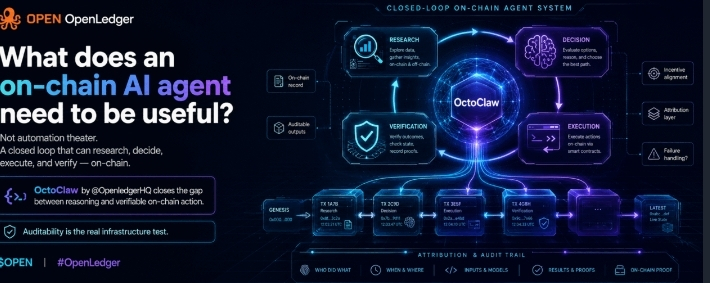
I've been sitting with this question for a while. There's a version of the "AI agent" narrative that's mostly automation theater - systems that look impressive in demos but fall apart in production because the infrastructure can't support real execution. Then there's the version that matters: agents that can research, decide, execute, and verify in a closed loop without a human coordinating between systems.
The distinction seems obvious in theory. In practice, most agent frameworks I've looked at over the past year and a half handle the reasoning layer reasonably well - and fall apart at execution. Specifically at connecting reasoning to verifiable on-chain action without adding new trust assumptions or manual intervention points.
This is the gap @OpenLedgeris trying to close with OctoClaw.
What I find technically interesting about the framing is the unification of four components that usually exist separately: research, execution, generation, and orchestration. In most agent architectures, these are handled by different modules with different interfaces and different failure modes. OctoClaw positions itself as a single environment where all four happen together, on-chain, in real time.
The "on-chain" part is meaningful. When execution is recorded on-chain, verifiability becomes a default property. Every decision an agent makes, every trade it routes, every workflow it triggers — these become auditable events. That's a fundamentally different trust model than running agents in cloud infrastructure where you're relying on the operator to tell you what happened.
I spent some time in early 2024 looking at autonomous agent deployments in institutional DeFi contexts, and the friction point consistently came back to auditability. Not performance. Not cost. Auditability. Compliance teams and treasury managers weren't asking "can it execute faster?" They were asking "can I prove what it did and why?" Most agent frameworks at the time couldn't answer that cleanly.
OpenLedger's architecture treats this as a core infrastructure problem rather than a reporting add-on. The attribution layer — which traces every output back to the model that generated it, the data it was trained on, and the contributor who provided that data — extends naturally into agent workflows. When an agent executes, the execution itself becomes part of the attributable output chain.
That design choice has implications beyond transparency. If every inference and every execution is tied to specific contributors and data sources, you create a foundation for sustainable incentive alignment. The people who built the models that power the agents get compensated each time those agents perform work. That's a different economic model than most AI infrastructure today.
The parts I want to understand better are around failure handling. On-chain execution is transparent, but it's also final. What happens when an agent makes a wrong decision — routes a trade suboptimally, triggers a workflow prematurely? The irreversibility of on-chain actions is a real constraint that systems operating in financial environments need to handle carefully.
OctoClaw is still early. The architecture looks solid on paper, and the direction addresses a real structural gap in on-chain automation. Whether the implementation holds up under adversarial conditions is the open question.#BinanceSquare
Worth watching closely.
$OPEN @OpenLedger #OpenLedger $BTC $ETH


