
A lot of people talk about artificial intelligence like it appeared out of nowhere, but the truth is that AI is built on something deeply human: our words, our images, our code, our conversations, and the endless digital traces we leave behind online. That is what makes the rise of projects like OpenLedger so interesting. OpenLedger is not just another blockchain project trying to ride the AI wave. It is trying to answer a much bigger question: who should actually benefit from the intelligence economy that AI is creating?
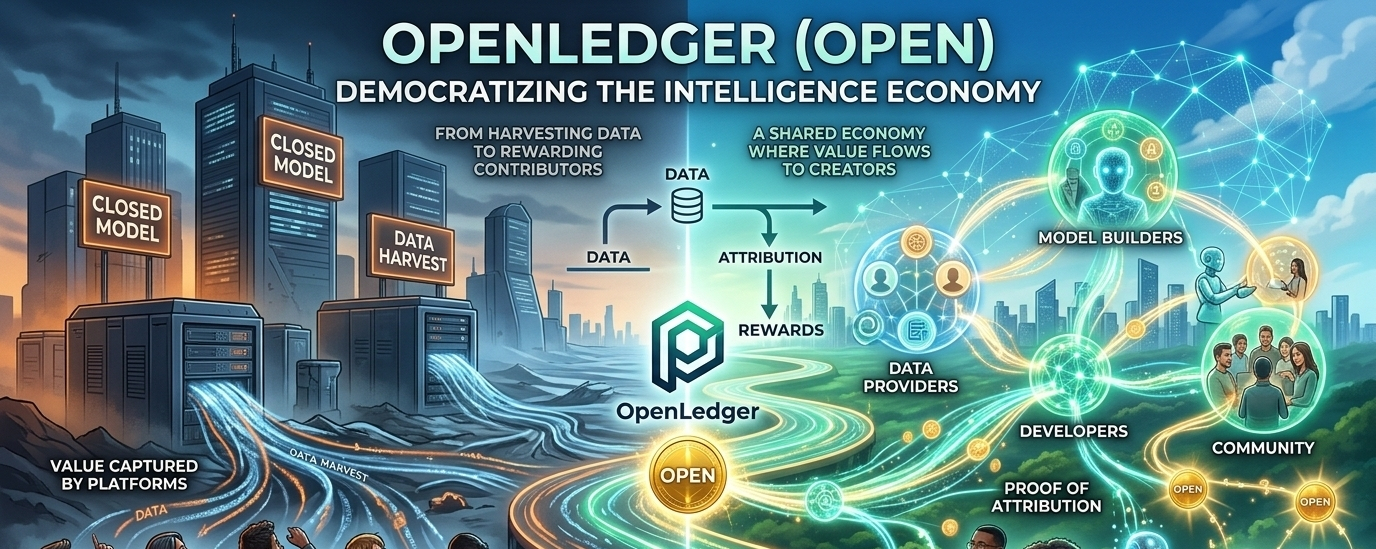
Today, most AI systems are controlled by large companies with huge amounts of data, money, and computing power. They gather information, train models, launch products, and capture most of the value. The people whose work, data, and creativity helped train those systems usually get very little in return. OpenLedger is trying to change that by building an AI-focused blockchain where data, models, and agents can all be tracked, rewarded, and monetized more transparently.
That idea matters because AI is no longer a niche technology. It is becoming part of everyday life. Students use it to study. Developers use it to code faster. Businesses use it to automate tasks. Creators use it to generate ideas and content. As AI becomes more important, the question is no longer whether it will change the world. It is how that value will be distributed, and who gets left out.
OpenLedger’s answer starts with the idea that data should not be treated like invisible fuel. In the traditional internet economy, data is collected quietly in the background. A platform gathers it, uses it, and turns it into a profitable product. The original contributors often never see any of that value again. OpenLedger wants to turn data into something more like a real digital asset, something that can carry ownership, attribution, and economic reward.
At the heart of the project is a concept called Proof of Attribution. In simple terms, this means the network tries to track where data came from and how it contributes to a model. That sounds technical, but the idea is easy to understand. If a dataset helps train an AI model, the people who provided that dataset should be recognized somehow. If a model generates value, the value should not just flow to one company at the top. It should flow back through the network of people who made it possible.
That is a powerful idea because it shifts AI away from being a closed system and toward being a shared economy. Instead of AI being something built behind corporate walls, OpenLedger imagines a system where contributors can participate in the upside. That includes data providers, developers, model builders, and even communities that help shape and improve the network.
The project also tries to make AI development more open and practical. Its ecosystem includes tools for creating datasets, training models, and deploying AI systems. The goal is to lower the barrier to entry so smaller teams do not need the kind of massive infrastructure only the biggest companies can afford. That is important because right now, AI development is still very centralized. The companies that dominate the field have access to huge computing resources, expensive hardware, and large technical teams. OpenLedger is trying to create a space where more people can take part.
The token, OPEN, sits at the center of that economy. It is meant to handle transaction fees, governance, model deployment, inference payments, and contributor rewards. In other words, it is supposed to keep the whole system moving. That gives the network a built-in economic structure rather than relying only on outside funding or one-time participation. If the system works as intended, everyone involved in the network has a reason to keep contributing value.
What makes OpenLedger especially compelling is that it is speaking to a real frustration many people already feel. A lot of the modern internet works on a simple pattern: users create value, platforms capture it. Social media does this with attention. Search engines do it with behavior and content. AI systems do it with data. Most users are not against technology itself. They are against a system where their contribution becomes invisible the moment it is absorbed into a larger product. OpenLedger is trying to build something that feels more fair, more transparent, and more participatory.
Of course, that does not make the project easy. In fact, the hard part is what makes it so interesting. AI attribution is a very difficult problem. Modern models are incredibly complex, and it is not always simple to trace exactly how one dataset affects one specific output. OpenLedger has to prove that its systems can do this reliably if it wants to earn trust. Without that, the promise of fair rewards and transparent ownership becomes much harder to deliver.
There is also the challenge of competing with massive centralized players. Big AI companies already have the advantage when it comes to data, talent, infrastructure, and user adoption. They can move fast and invest heavily. A decentralized project like OpenLedger has to convince people that a more open model is not only better in principle, but actually useful in practice. That is always the real test for any blockchain project.
Still, the reason OpenLedger stands out is that it is asking the right kind of questions at the right time. People are becoming more aware of where AI gets its power from. Artists want to know whether their work is being used fairly. Writers want clarity about how their content is used. Developers and researchers want attribution and compensation for the knowledge they contribute. Governments are starting to think more seriously about transparency and data rights. OpenLedger is trying to build infrastructure that speaks to all of those concerns at once.
It also helps that the idea behind the project feels bigger than crypto hype. A lot of blockchain projects are built around speculation first and utility second. OpenLedger feels different because its core pitch is about structure. It is trying to organize how AI value moves through a system. That gives it a more meaningful story than simply being another token in a crowded market.
At a deeper level, OpenLedger is part of a much larger shift in how people think about digital ownership. For years, the internet has made it easy to share and use information, but not always easy to assign value fairly. AI has made this problem more visible. Since AI systems are built from collective human output, the question of ownership is no longer abstract. It is now one of the central issues of the digital age.
Whether OpenLedger becomes a major part of that future or not, it is pointing toward a direction many people will probably find appealing: a world where data is not just consumed, but valued; where contributors are not just sources, but participants; and where AI is not controlled by a tiny group of companies, but shaped by a wider community.
That is the real promise behind OpenLedger. It is not just about blockchain. It is not just about AI. It is about trying to build a system where intelligence has an economy, and where the people who help create that intelligence can share in the results. In a world that is moving faster toward automation, that idea feels both timely and human.
