
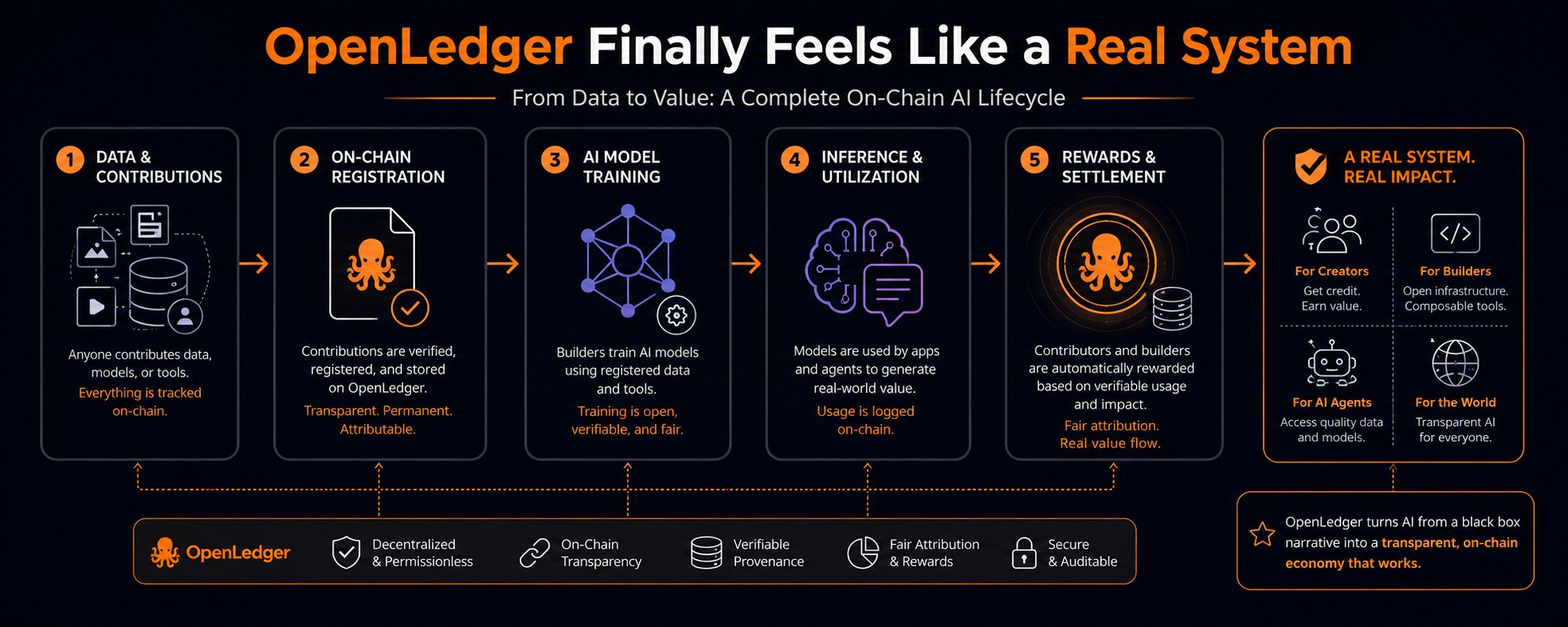
A few months ago, I still couldn’t tell whether OpenLedger was building something genuinely useful or just wrapping familiar crypto mechanics inside the current AI narrative. The ideas always sounded ambitious — data attribution, monetized models, autonomous agents, on-chain accountability — but ambition alone doesn’t really move my view anymore. A lot of projects in this space sound important long before they become usable.
What changed recently is that OpenLedger has finally started moving from conceptual language into systems that people can actually interact with. That doesn’t automatically make it successful, but it does change how I evaluate it. I’m no longer looking at it as a future possibility. I’m starting to look at it as infrastructure that now has to survive real usage, real incentives, and eventually real pressure.
The mainnet launch was probably the first update that made me pause for a second. Before that, most of the discussion around OpenLedger lived in the “this could become important later” category. Now there’s at least a live environment where datasets, attribution, and AI-related payments are supposed to function together instead of existing as isolated ideas.
That matters because live systems expose weaknesses very quickly.
It’s easy to describe transparent attribution in theory. It’s harder when users expect payouts to be accurate, when contributors disagree about ownership, or when model behavior becomes too complex to trace cleanly. AI systems are messy by nature. Training data overlaps constantly, outputs are probabilistic, and influence is rarely simple enough to measure perfectly. So while I think OpenLedger deserves credit for actually pushing attribution into production infrastructure, I still think this is the part that needs the most real-world proof.
Right now, I’m not questioning whether attribution sounds valuable. I’m questioning whether people will trust it once meaningful money, competition, and disputes enter the system.
That’s a completely different test.
I also noticed that the project feels more operational lately and less purely narrative-driven. Earlier on, a lot of the messaging felt centered around the future of decentralized AI as a concept. Recently, the focus seems more tied to actual tooling, integrations, and execution layers. That shift makes the project easier to take seriously because usefulness usually grows from constraints, not from vision decks.
The integration with AI agents caught my attention for that reason. Once OpenLedger started positioning itself around verifiable agents operating in live environments, the conversation changed for me. If autonomous systems are eventually handling transactions, decisions, or financial actions, then auditability stops being a philosophical feature and becomes something practical. Suddenly attribution isn’t just about rewarding contributors — it becomes part of risk management.
But this is also where I think people are getting ahead of themselves a little.
There’s a huge difference between demonstrating AI agents in controlled conditions and operating them in environments where incentives become adversarial. Under real pressure, systems behave differently. Users exploit loopholes. Latency matters. Bad data spreads faster. Attribution becomes harder, not easier. So while I think OpenLedger is heading toward a more meaningful direction than most AI-chain projects, I still see a lot of the current progress as early infrastructure rather than validated adoption.
That distinction matters because crypto is full of systems that looked impressive before scale exposed their weak points.
Another thing I’ve been recalibrating is how I think about the token incentives around the ecosystem. OpenLedger is clearly trying to accelerate participation through rewards, contributor campaigns, and ecosystem activity. I understand why — data networks don’t bootstrap themselves — but I always become more cautious when activity depends heavily on incentives instead of obvious demand.
The important question isn’t whether people contribute while rewards are attractive. The real question is whether the system remains useful after the easy incentives fade and participation becomes more selective.
That’s where long-term reliability gets tested.
I also think OpenLedger is entering a phase where usability matters more than ideology. Earlier-stage projects can survive on broad visions about decentralization and ownership. But once you’re trying to build infrastructure around AI systems, the tolerance for friction becomes very low. Developers won’t stay if tooling becomes annoying. Enterprises won’t care about decentralization if reliability is inconsistent. Contributors won’t keep participating if attribution feels vague or payouts feel symbolic.
And honestly, I think OpenLedger understands this now.
The recent updates feel less focused on storytelling and more focused on making the system interoperable and usable across environments. That’s important because isolated ecosystems almost never win anymore. If AI data, models, and agents are supposed to move across chains and applications, then accessibility matters more than tribal ecosystem loyalty.
At the same time, I still think the project is trying to solve too many coordination problems at once.
Sometimes OpenLedger looks like an attribution layer. Sometimes it looks like AI payment infrastructure. Sometimes it looks like an agent economy. Sometimes it looks like enterprise audit tooling. Maybe all of those pieces connect eventually, but right now I’m still waiting to see what the unavoidable core actually is.
Because infrastructure projects usually become valuable by solving one painful problem extremely well before expanding outward.
That’s probably the biggest thing I’m still watching.
Not whether OpenLedger can keep announcing integrations or partnerships, but whether one part of the system becomes genuinely difficult to replace.
So overall, my confidence level has improved, but in a more grounded way than before. I don’t see OpenLedger as just another AI-themed blockchain anymore. There’s clearly more structure here than that, and some of the recent progress feels materially important rather than cosmetic.
But I also don’t think the hardest questions have been answered yet.
The system still hasn’t proven that attribution remains trustworthy under scale. It hasn’t proven that contributors can earn sustainable value without heavy incentive engineering. It hasn’t proven that developers will consistently choose this infrastructure over simpler centralized alternatives. And it definitely hasn’t proven that autonomous AI systems operating on-chain become more efficient rather than just more complicated.
Those are the things that will decide whether OpenLedger becomes infrastructure or stays an interesting experiment.
The update that would genuinely change my view in a major way wouldn’t be another roadmap expansion or ecosystem announcement. It would be seeing developers repeatedly build on top of the attribution layer because it solves a real coordination problem better than existing systems. It would be contributors earning recurring value without the ecosystem depending heavily on emissions. It would be AI agents operating in production environments where traceability actually reduces risk instead of just adding more blockchain overhead.
That’s the threshold I’m watching now.
For the first time, though, I can at least see a realistic path toward it.
