
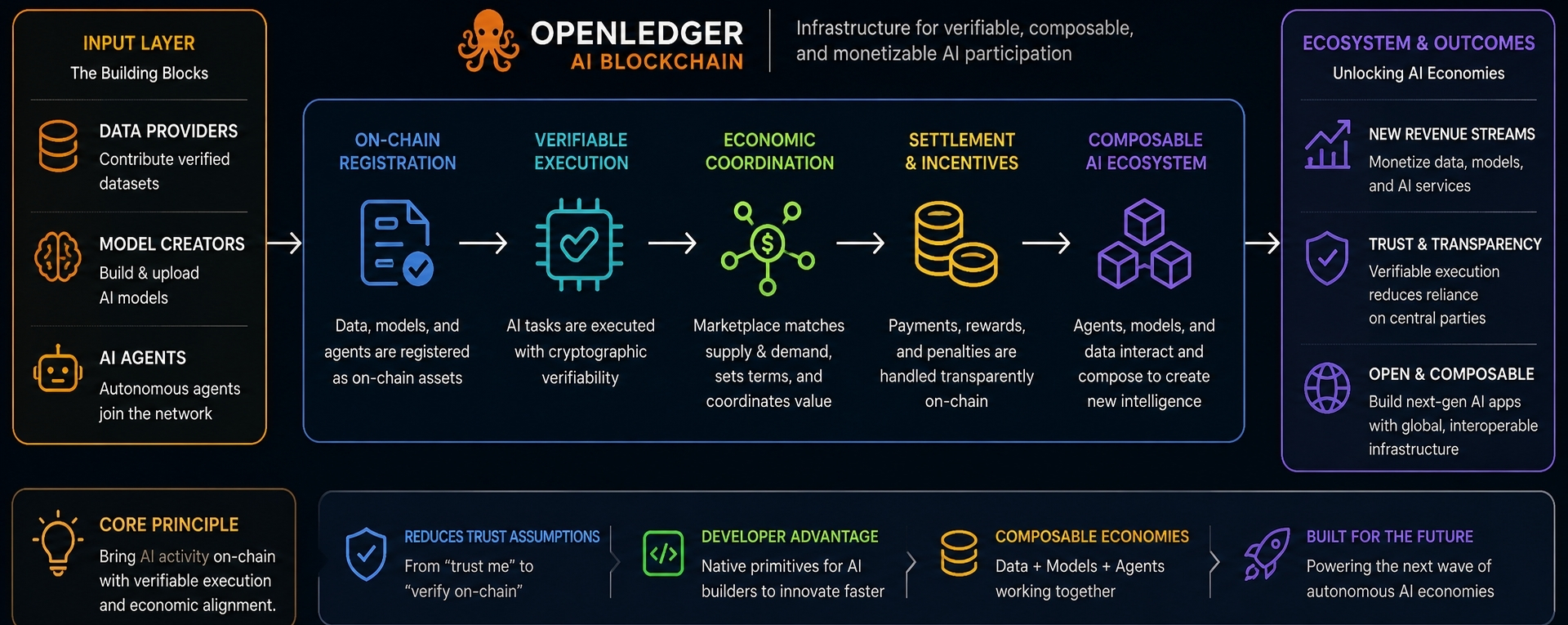
I’ve been thinking about OpenLedger in a way that feels slightly uncomfortable, because it doesn’t fit neatly into how most crypto projects are evaluated. It’s not obvious, it’s not loud, and it doesn’t try to simplify itself for attention. And usually, that’s either a red flag—or a signal that something deeper is being built.
What pulls me in isn’t the idea of “AI on blockchain.” I’ve seen that narrative too many times, and most of it feels like surface-level integration. What’s different here, at least from how I see it, is that OpenLedger seems to be designed around a different assumption entirely—that AI won’t just be a tool people use, but something that participates in systems, economically and autonomously.
That assumption forces a different kind of architecture.
I keep coming back to a simple question: if AI agents, models, and data providers were all acting independently, making decisions and transacting value, where would that actually happen? Today, the answer is mostly inside closed systems. Big platforms own the data, run the models, and decide how everything connects. Even when we “use AI,” we’re still operating inside someone else’s boundaries.
Crypto tried to open up coordination, but it never fully integrated intelligence into its core. So we ended up with two parallel worlds—one with powerful AI but no openness, and one with openness but limited AI capability.
OpenLedger feels like an attempt to collapse that divide.
The way I simplify it in my head is this: instead of building tools around AI, it’s trying to build an environment where AI itself can exist, interact, and create value without relying on external trust. Not perfectly, not magically—but structurally.
That matters more than it sounds.
Right now, most AI systems are black boxes. You don’t really know how a result was produced, and you’re forced to trust whoever runs the system. In finance or simple applications, that might be acceptable. But if AI agents are going to make decisions, move capital, or interact with other systems, that level of opacity becomes a real problem.
So the question becomes: can you create a system where AI actions are not just useful, but verifiable?
That’s where I think OpenLedger is aiming. Instead of running everything off-chain and just anchoring results, it’s trying to bring execution and verification closer to the protocol itself. I don’t think most people fully appreciate how difficult that is. But if it works even partially, it reduces the amount of blind trust required—and that’s where systems start becoming investable, not just interesting.
From a builder’s perspective, this is where things get even more interesting. Today, if you want to build something AI-driven, you’re stitching together APIs, data sources, payment systems, and a lot of invisible assumptions. It works, but it’s fragile. Every layer depends on something you don’t fully control.
If OpenLedger’s model holds up, developers could start building in a more native way—where data, models, and economic incentives all live in the same environment. Instead of forcing coordination, the system provides it. That’s a big shift, but it only matters if developers actually choose to build this way.
And that’s a real uncertainty.
I don’t ignore the risks here. In fact, I think they’re significant. This kind of system is incredibly hard to execute. It requires not just technical success, but behavioral change. Developers need to adopt it. Users need to trust it. And most importantly, there needs to be real activity—not just theoretical use cases.
On the investment side, I try to stay grounded. Tokens like this often carry expectations far ahead of reality. There’s always a period where the idea is valued more than the usage. Supply dynamics, unlock schedules, and market cycles can easily overshadow the fundamentals in the short term.
So I don’t look at something like this and expect immediate validation.
I look at it and ask: if this works, what does it become?
If it doesn’t, the downside is obvious—it fades into a long list of ambitious but unrealized ideas. But if it does work, even partially, it could become a coordination layer for something that doesn’t fully exist yet: an economy where intelligent systems interact, not just serve.
That’s not a guaranteed future. But it’s a plausible one.
My approach to something like OpenLedger is slow and deliberate. I don’t treat it like a trade. I don’t expect quick returns. If anything, I assume the opposite—that progress will be uneven, that attention will come and go, and that most people won’t have the patience to follow it closely.
If I allocate, it’s with the mindset that I’m buying into a direction, not a moment.
Because in my experience, the hardest part isn’t identifying something early. It’s holding onto it while nothing seems to be happening, while the market moves elsewhere, while doubt creeps in.
But that’s usually where the real separation happens.
Not in timing the market, but in understanding what you’re actually holding—and having enough conviction to sit with it while the rest of the world is distracted.