there is a specific kind of attention that comes from reading infrastructure documentation carefully. not excitement. something closer to recognition the feeling of watching a system get built for a problem that hasn't fully arrived yet. that is what reading through openledger's architecture produces. the project is described as an AI blockchain, which is accurate, but it is the wrong frame for understanding what is actually being assembled here.
most people read openledger through the data attribution narrative. a blockchain that tracks which datasets trained which models, routes payments to contributors, and makes AI provenance verifiable on-chain. that reading is correct. proof of attribution does exactly that, recording every dataset and inference trail so contributors receive automated payouts based on actual usage rather than upload volume. the surface case is compelling on its own terms. but it is not the most interesting thing happening in the system.
what openledger is building underneath the data layer is a runtime environment for autonomous agents. not a wallet, not a compute network, not a storage solution a full coordination stack for entities that need to hold identity, execute actions, and be held accountable for outputs without human intervention at every step. the distinction matters more than it seems.
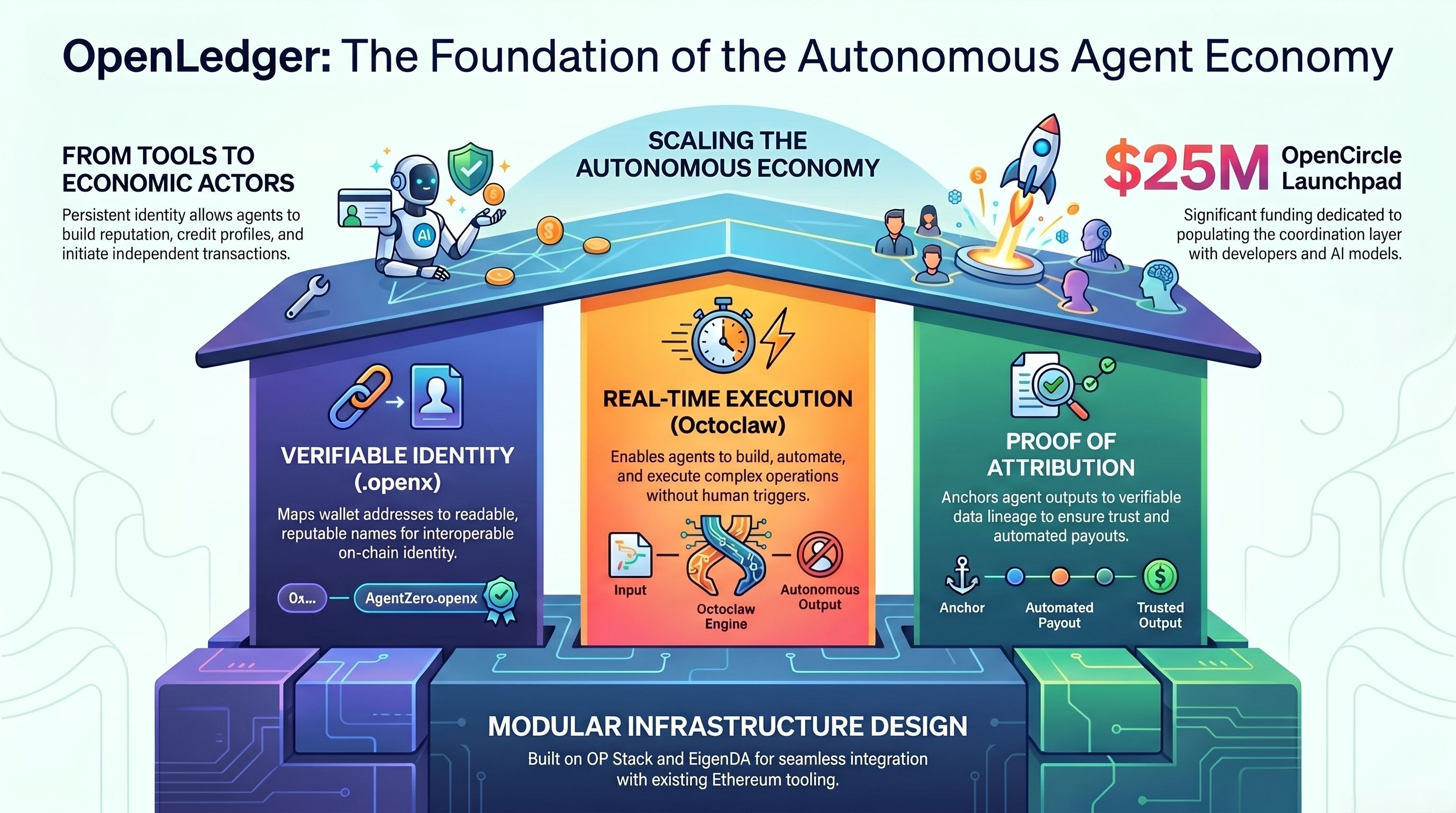
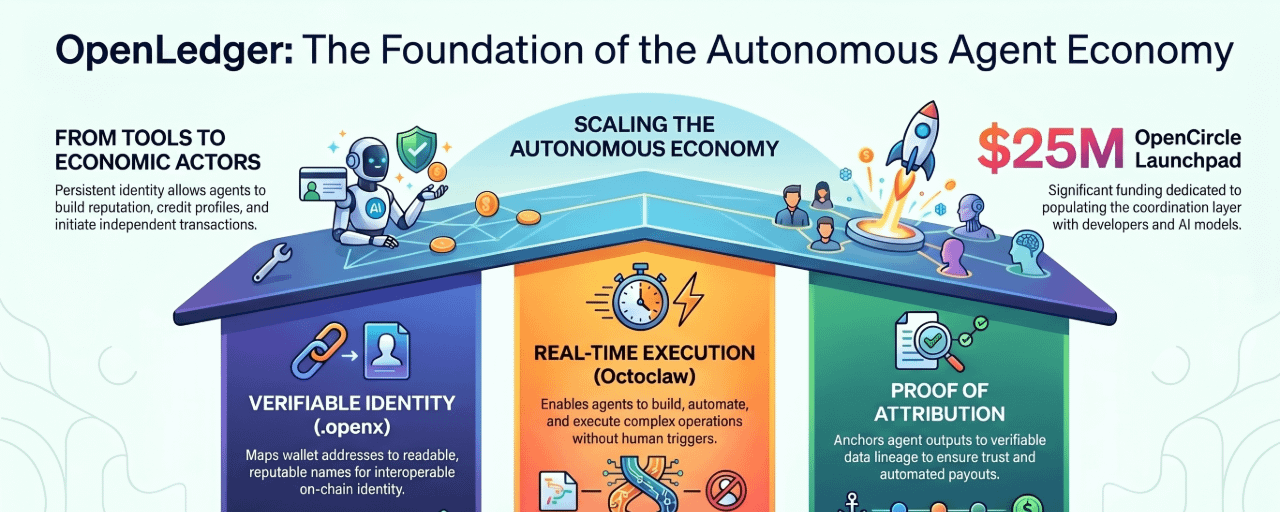
consider what an AI agent actually needs to function as an economic actor on-chain. a persistent, verifiable identity that is not just a key something a counterparty can resolve to a name, a contribution history, a reputation trail. the ability to execute complex operations in real time without waiting for a human trigger. and a mechanism that attributes its outputs back to the data and models that shaped them, so the trust chain doesn't break the moment the agent acts independently. most networks solve one of these. openledger is building all three as distinct protocol layers.
the .openx domain partnership with unstoppable domains addresses identity directly. a wallet address is not identity it is a location. the .openx namespace maps that location to something readable, attributable, and interoperable across 865 applications and exchanges. octoclaw, openledger's live agent execution layer, handles real-time autonomous operation. agents can build, automate, and execute without external orchestration. proof of attribution closes the loop, anchoring every output to a verifiable lineage on-chain.
the second-order consequence of wiring these three layers together is where things get structurally interesting. if agents can hold identity, they can build reputation. if they can build reputation, counterparties can extend trust without human intermediaries. if trust extends to agents programmatically, they stop being tools and start functioning as economic actors initiating transactions, receiving payment, compounding their on-chain history into something resembling a credit profile. the coinbase ceo put it plainly: AI agents will soon outnumber humans in on-chain transactions. the infrastructure question is not whether that is coming. it is which layer captures the coordination cost when it does.
network effects thinking is useful here. compute networks scale with hardware. data networks scale with contributors. but coordination infrastructure scales with the number of distinct agents that can interoperate through it and compounds nonlinearly as those agents transact with each other rather than just with humans. openledger's architecture is not optimized for the data economy it exists in today. it is optimized for the agent economy the stack implies is arriving.
the genuinely interesting design choice is that openledger didn't build a monolithic agent platform. it built modular primitives identity, execution, attribution that developers compose independently on an op stack rollup with eigenda, integrating with existing ethereum tooling without rebuilding their stack. that restraint is architecturally significant. the network doesn't need agents to adopt a new runtime from scratch. it needs them to adopt individual layers that each solve a specific gap. the opencircle launchpad, channeling $25 million toward AI and web3 developers, compounds this the incentive is to populate the coordination layer with enough agents and models that network effects have something to run on before demand peaks.
the question the architecture leaves open isn't technical sufficiency. the components exist, mainnet is live, the identity layer is deployed. the harder question is timing. infrastructure that arrives before its demand has a specific failure mode: it gets used for the wrong applications first, accumulates the wrong reputation, and gets displaced by systems with a cleaner narrative for the moment. openledger is building for an agent economy that is real but not yet the primary market. whether this stack is still the most credible coordination layer when that economy becomes the primary market that is what the next eighteen months are actually deciding.
@OpenLedger $OPEN #OpenLedger $RONIN $BSB