
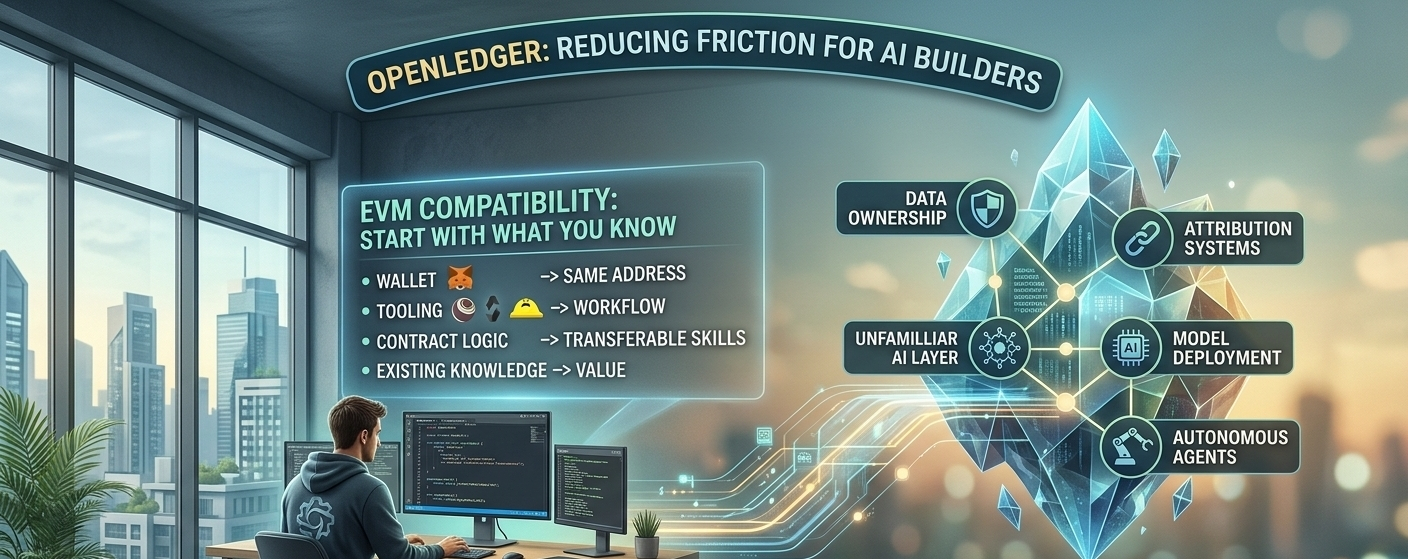
it feels realistic.
Not flashy.
Not the kind of thing that creates huge hype threads overnight.
Just… practical.
And honestly, practical decisions are usually the ones that decide whether developers actually stay long enough to build something real.
Most AI + blockchain conversations start at the highest level possible. People talk about AI agents, decentralized intelligence, model ownership, monetized data, attribution systems, autonomous economies.
But I don’t think builders start there.
I think most developers quietly ask themselves something much simpler first:
“Can I use the tools and workflow I already understand?”
That question matters more than people admit.
Because learning a completely new ecosystem is exhausting. New wallet behavior, unfamiliar tooling, different contract logic, strange deployment flows, custom standards — even if the idea is good, too much friction makes people lose interest fast.
Not because they hate innovation.
Because time and attention are limited.
That’s why OpenLedger choosing an EVM-friendly approach feels smart to me.
The important part isn’t only that Solidity works.
It’s that developers don’t feel like beginners again the moment they enter the ecosystem.
Your wallet still feels familiar.
Your deployment habits still make sense.
Your understanding of contracts, transactions, gas, tooling, and infrastructure still transfers over.
Your existing knowledge still has value.
And I think that matters even more because OpenLedger is trying to build something unfamiliar on top of it — AI-focused infrastructure around data, attribution, models, contributors, and agents.
That’s already a new world for most people.
If the blockchain layer also felt completely alien, it would probably scare a lot of builders away before they even experimented.
So the design choice feels intentional:
keep the foundation familiar
while letting developers slowly explore the AI side.
Of course, EVM compatibility alone is not enough anymore. Almost every chain says it now. Developers have heard the phrase so many times that it barely means anything by itself.
The real test comes later.
Do the AI-specific tools actually make building easier?
Does attribution solve real problems?
Do the workflows save time?
Can developers build things here that feel difficult elsewhere?
Because in the end, builders stay for useful infrastructure, not marketing language.
Still, I think OpenLedger made the right decision by reducing the pain of the first step.
People talk a lot about innovation in crypto.
But sometimes the systems that grow are simply the ones that feel easiest to start using.
