@OpenLedger The more I study the artificial intelligence industry, the more I feel that most people are focusing on the wrong side of the revolution. Everyone is obsessed with faster models, smarter AI agents, automation, and endless discussions about how powerful artificial intelligence could become over the next decade. But underneath all this excitement, there is a much deeper economic shift happening quietly in the background. Human intelligence itself is turning into one of the most valuable resources in the world, and almost nobody is seriously discussing who will ultimately own the value created from it. This is exactly why OpenLedger started standing out to me in a way most AI projects in crypto never did.
At first, I honestly assumed OpenLedger was going to be another typical AI narrative trying to capitalize on market hype. The crypto industry has become flooded with projects promising decentralized intelligence, autonomous systems, AI economies, and futuristic infrastructure. After seeing the same buzzwords repeated over and over again, it becomes difficult to distinguish real architectural thinking from pure marketing. But the deeper I went into OpenLedger’s vision, the more I realized this project appears to be solving a much more serious problem than simply building another AI ecosystem. Instead of only focusing on making AI more powerful, they seem focused on creating an ownership and attribution layer around intelligence itself.
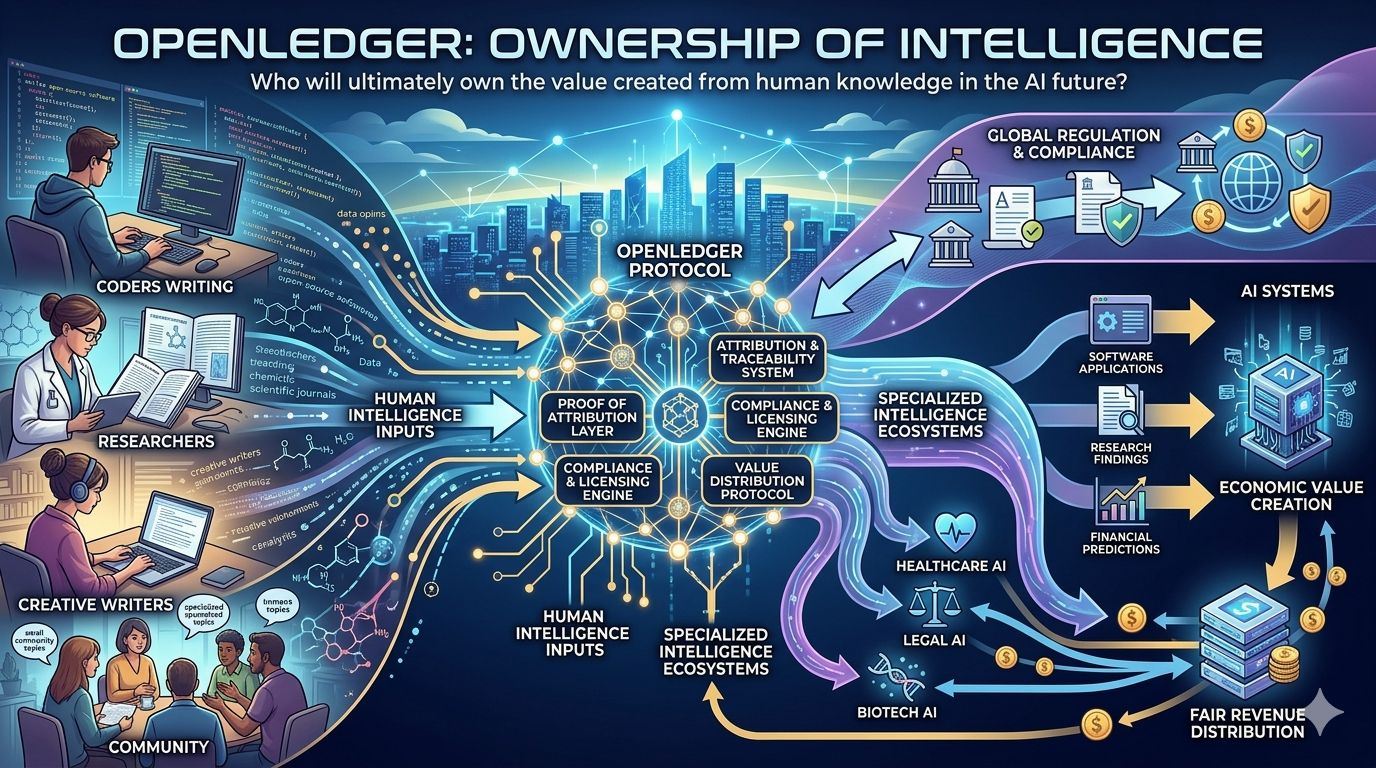
The current structure of the AI economy already feels deeply unbalanced to me. Every single day, millions of people contribute enormous amounts of knowledge to the internet without realizing how valuable that information eventually becomes. Developers contribute open-source software, researchers publish discoveries, creators produce educational content, traders generate market intelligence, communities refine niche expertise, and professionals continuously share highly specialized information online. Modern AI systems absorb all of this human-generated intelligence as training fuel, yet when massive economic value is later created through AI products and services, the people who originally contributed the knowledge usually receive nothing. Most of the financial upside remains concentrated among centralized infrastructure companies that control the models and distribution systems. I genuinely believe this imbalance becomes one of the defining economic tensions of the AI era as artificial intelligence expands deeper into professional industries and intellectual labor markets.
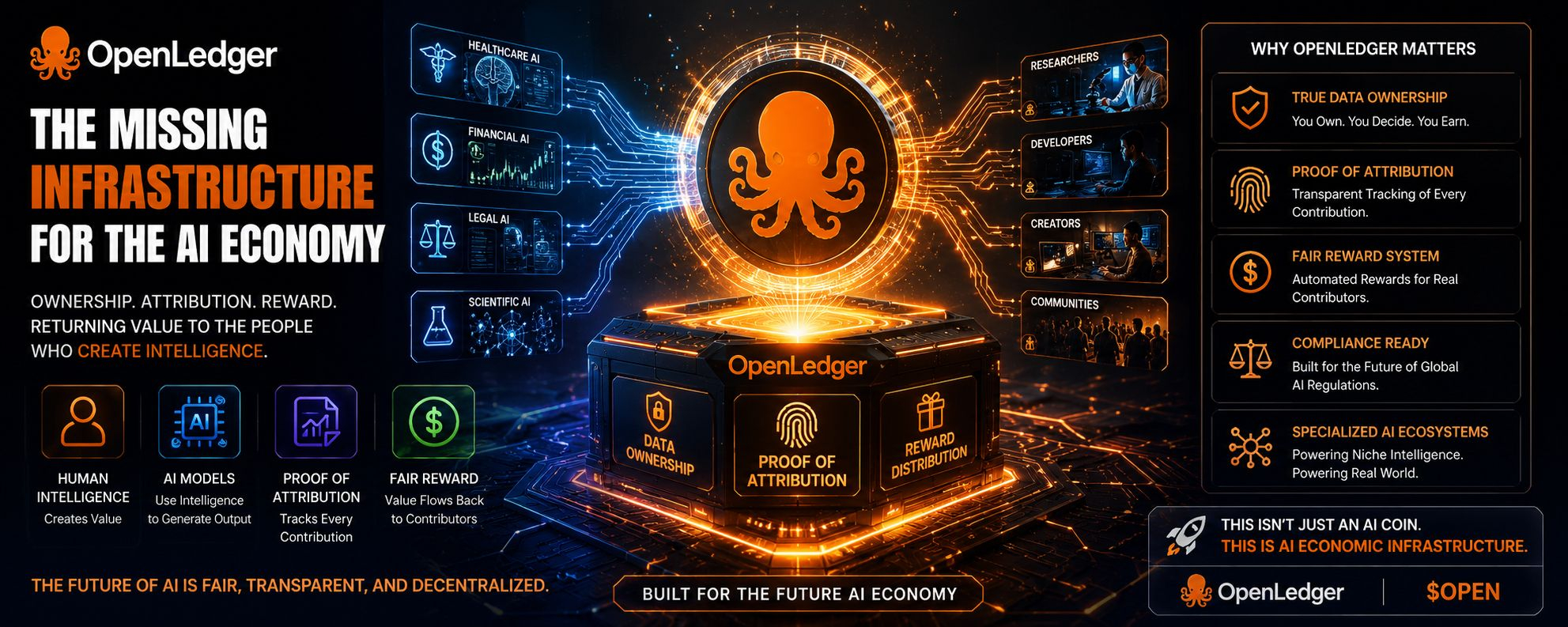
This is where OpenLedger’s thesis started becoming genuinely interesting to me. Their core idea is deceptively simple but extremely ambitious. If human-generated intelligence powers AI systems, then the humans contributing that intelligence should be economically connected to the value those systems create. The concept sounds obvious when explained in one sentence, but the execution behind it is incredibly difficult. Building attribution infrastructure for AI is not the same as simply launching another blockchain or creating another AI application. It requires systems capable of identifying where data originated, understanding which models interacted with that data, determining how outputs relied on it, and eventually distributing rewards fairly across extremely complex environments. This is why I think OpenLedger’s focus on Proof of Attribution could become much more important than many people currently realize. The future AI economy may not only be about who builds the smartest systems, but also about who controls the infrastructure that determines ownership, traceability, and value distribution around intelligence itself.
What makes this even more important is the direction global regulation is already moving toward. Governments, enterprises, and regulators are becoming increasingly aggressive about transparency, licensing, compliance, and accountability inside AI systems. Questions that sounded theoretical only a few years ago are rapidly becoming serious commercial and legal concerns. What datasets were used to train the model? Was permission granted? Can enterprises safely commercialize AI-generated outputs? Who owns the underlying intelligence behind the results? These are no longer niche discussions happening only among researchers. They are becoming foundational infrastructure questions for the future digital economy. This is one reason I believe projects focusing on attribution and ownership may eventually become far more valuable than many speculative AI narratives dominating the market today.
I also think the future of artificial intelligence becomes far more specialized than most people currently expect. A lot of investors still imagine one giant universal AI system controlling everything, but I personally believe the market eventually fragments into highly specialized intelligence ecosystems. Healthcare AI, legal AI, biotech AI, scientific research AI, cybersecurity AI, and financial AI all require extremely deep domain-specific knowledge and highly refined datasets. General-purpose intelligence is powerful, but specialized intelligence creates enormous enterprise value because accuracy and expertise matter much more inside professional industries. OpenLedger’s DataNets concept appears designed around this exact future. They do not seem to view datasets as passive digital files sitting inside storage systems. Instead, they appear to treat knowledge itself as productive economic infrastructure capable of continuously generating value within AI ecosystems. That conceptual shift feels much larger to me than most people currently understand.
At the same time, I think it is important to remain realistic because the AI infrastructure business is brutally difficult. Building narratives during a bull market is easy, but building reliable infrastructure that enterprises trust is one of the hardest challenges in technology. Enterprise adoption requires scalability, uptime, low latency, security, compliance, and sustainable operational economics. OpenLedger still has many things left to prove before it can truly establish itself at that level. Their attribution systems need to function efficiently at large scale, their economic model needs to remain sustainable beyond speculative hype, and enterprises ultimately need reasons to trust decentralized intelligence infrastructure over centralized incumbents with enormous advantages in resources and distribution. These are serious challenges that cannot be ignored simply because the narrative sounds exciting.
Still, despite all those risks and uncertainties, I cannot deny that OpenLedger feels fundamentally different from most AI projects currently circulating throughout crypto markets. Many protocols today focus heavily on futuristic branding while offering very little structural innovation underneath. OpenLedger feels different because there is an actual systems-level vision behind the architecture. Ownership, attribution, compliance, specialized intelligence economies, and revenue-sharing are not temporary hype cycles. They are foundational questions that the AI industry will eventually be forced to confront as artificial intelligence becomes deeply integrated into global economic systems. I honestly do not know whether OpenLedger will ultimately succeed, but I do believe there is a real possibility that projects building attribution infrastructure today could eventually become some of the most important foundations of the future AI economy.