
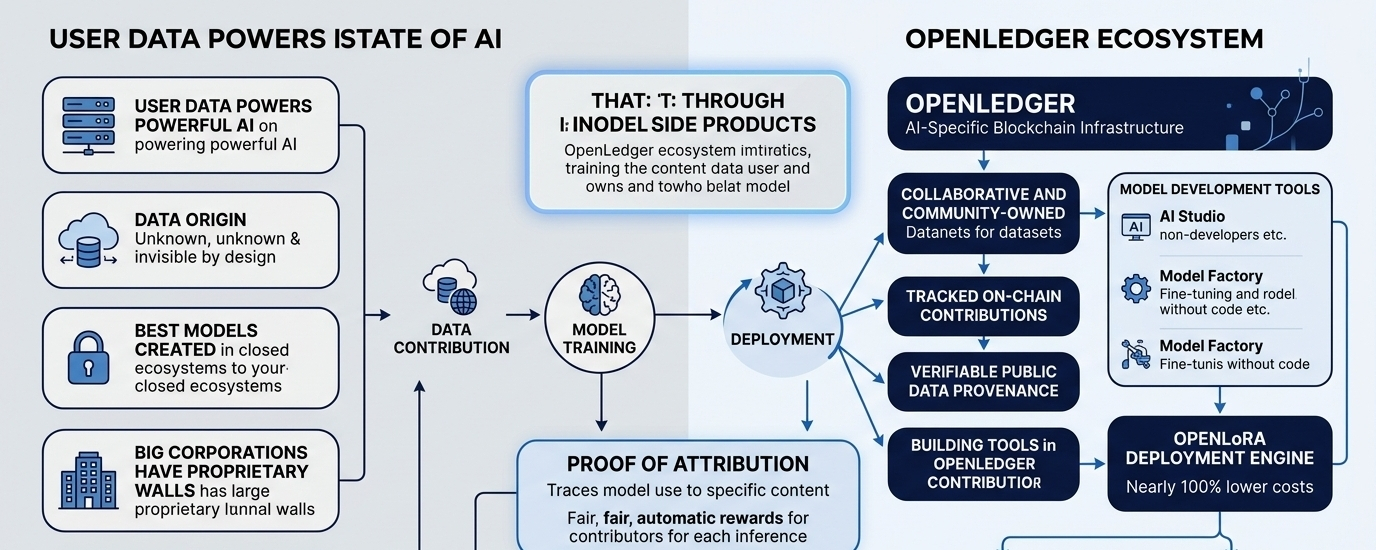
The world's most powerful AI models were built using your data you deserve something back!
AI is used by most people in a day to day basis, but they don't know its origin. They open up an app, type in a question, receive an answer and then they go. What intelligence is behind that answer, what data is behind that answer, what people are behind that answer, who made which decision to make that answer, is all completely invisible. It is not a coincidence that it is invisible. It is the design.
The best AI models of the world have been created within closed ecosystems for years. A few big corporations had access to vast quantities of data, fed models with it, and then ensconced everything within their proprietary walls. The contributors—the human actors whose writing, images, conversations, and behavior enabled those models to be intelligent—got nothing. Not credit. Not compensation. Not even acknowledgment. The value moved in one direction and most people never asked any questions.
This is why OpenLedger was created to challenge it.
OpenLedger is fundamentally an AI-specific blockchain infrastructure. Not for money, not for NFTs, not for being a general purpose chain that does everything and anything. It aims to render the creation, training and utilization of AI models transparent, traceable and profitable for all stakeholders. That's important because the problems they are addressing aren't generic. They are accurate, they are ingrained in the business of the AI sector as it stands today and they are largely overlooked by traditional blockchain solutions.
The beginning is data. With any AI model that is going to be intelligent, it must have data, lots of data, and relevant data that is carefully organized. On OpenLedger, it's done via a mechanism known as Datanets. Consider a Datanet as a space for collaborative and community-owned datasets, for training AI models. The main difference is that any contribution is tracked on-chain. Who did what and how much and when: All verifiable, all permanent, all public. This is no trivial matter. Today, data provenance is virtually undecipherable in the context of AI. It's essential on OpenLedger.
Then the platform offers tools to construct upon that data. The sole purpose of the AI Studio is to be OpenLedger's end-to-end model development environment, which it is indeed accessible to non-developers. There's a Model Factory, too, where users can use Datanets' data to fine-tune the AI models without writing any code. There's OpenLoRA, an engine for deployment that brings “nearly 100% lower deployment costs” than traditional deployment infrastructure, according to the company. These aren't theoretical characteristics. Instead, they are real tools that are user-friendly and can reduce the friction of building with AI in meaningful ways.
However, the most important mechanism on the OpenLedger is called Proof of Attribution. Here's where the platform stands out from the rest in the space. Each use of an AI model on OpenLedger, every inference, every output, every API call leaves a record of precisely which model made the call, what content was used to train the model, and who contributed to its creation. That contribution is then fairly rewarded and automatically paid according to a record that is transparent and verifiable by anyone. That is, if your data can make a model smarter, and that model is used a thousand times today, you are paid for all a thousand times. Not as an exchange of one-off payments. As a continuous percentage of what you created;
It's a completely new economic approach to AI. It moves the debate from "who owns the model?" to "who built the model and deserves to reap the benefits? The transition isn't just a matter of concept; it also has economic consequences for those willing to get involved early in the platform.
Governance is also a topic. The OPEN token is more than just a medium of exchange for OpenLedger; it is also a tool for collective decision-making. Voters of the tokens decide the protocol direction, the quality standard of the models, and changes to the system. This is a decentralized approach to something other than a financial protocol. The real power involved there is a real control over the AI tools that communities help develop, and that's more important than it sounds when you consider where AI is going.
The latest product, OctoClaw, takes this a step further by allowing users to create, automate and run tasks in real time with the help of AI agents. While it's still early, it's a glimpse into the future of OpenLedger: not only a place to track AI actions, but a platform for deploying AI that can operate independently on behalf of its users.
The truth is that what OpenLedger is is an attempt to answer the question of what is a structure problem that most people haven't yet formulated. The AI industry is huge and has been created by uncompensated contributions. OpenLedger is working on changing that little by little, on-chain, one attribution at a time. As a developer, a data contributor, or a user of AI who began questioning who is benefiting from it, the answer is becoming more clear: platforms like this one. Closed doors are beginning to open.