
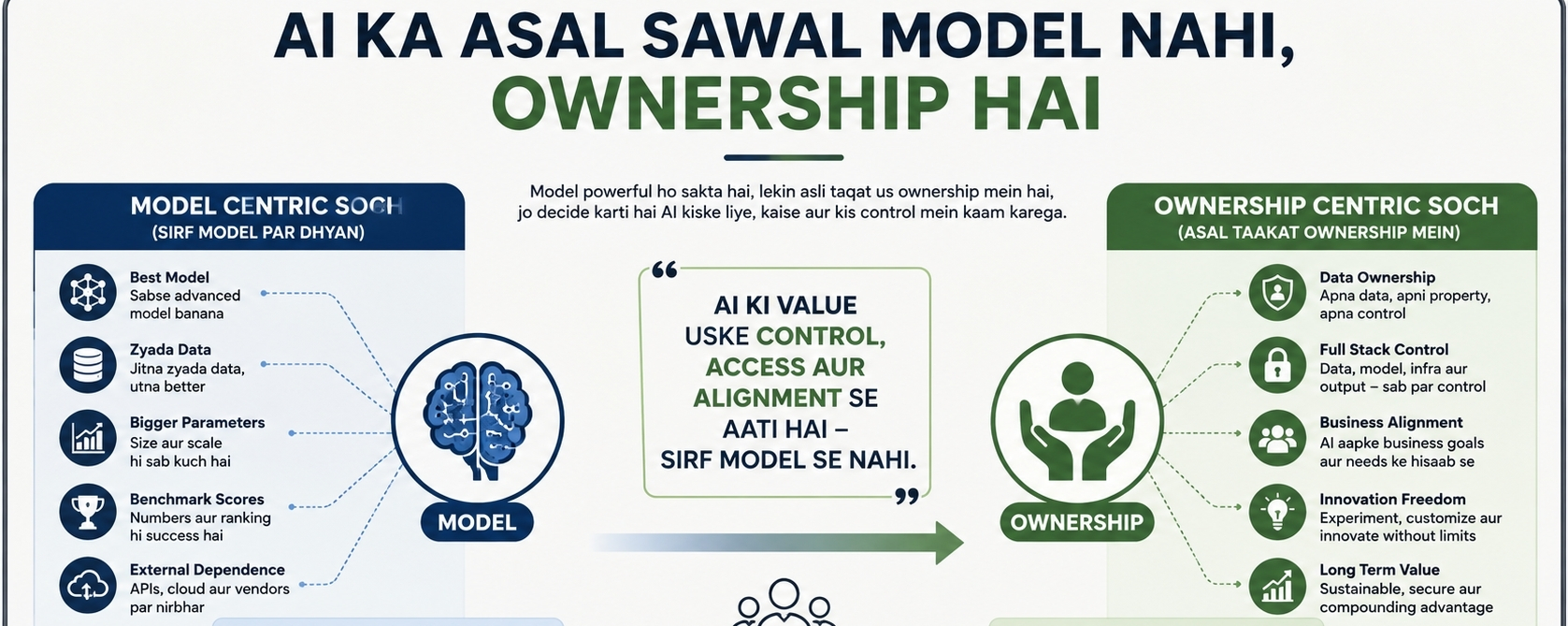
I’ve been thinking about how weird this whole AI conversation has become.
Everyone keeps staring at the final output.
The chatbot reply. The generated image. The agent doing some task in the background. The model that feels smarter than last month’s model. That is where all the attention goes.
But I keep looking at the stuff behind it.
The data. The small decisions. The patterns inside companies. The work people have been doing for years without calling it “AI infrastructure.” Customer behavior. Internal documents. Research notes. Business logic. Training sets. Feedback loops. Little pieces of knowledge sitting inside teams, waiting for someone bigger to extract them.
And the strange part is, most of that value still gets treated like it belongs to nobody.
Or worse, like it belongs to whoever captures it first.
That does not sit right with me.
Because AI is not magic. It is not some clean machine floating above the world. It is built from the world. From people. From businesses. From builders who know one specific problem better than any giant model ever will.
Yet the system still tells them to contribute first and monetize later.
Maybe.
That is the part people do not like saying out loud.
A lot of the AI economy is still built like the old internet. Users create value. Platforms collect it. Builders bring the substance. Someone else owns the rails. Then everyone gets told this is progress.
I am not saying progress is fake.
I am saying the ownership model is broken.
That is why OpenLedger feels interesting to me. Not in a loud way. Not in the usual hype-cycle way. More like, okay, someone is actually looking at the uncomfortable part.
Data, models, and agents are not just tools anymore. They are assets. Real ones. A useful dataset can change a business. A specialized model can save thousands of hours. An agent that understands a real workflow can create serious value.
But if those things cannot be owned properly, tracked properly, or monetized properly, then the same pattern repeats.
The people closest to the value get pushed furthest from the reward.
OpenLedger seems to be trying to change that. To make intelligence more liquid. To give data, models, and agents a place to move, earn, and prove their worth without disappearing into someone else’s closed system.
That sounds simple, but it is not small.
Because the future of AI will not only be about who has the biggest model.
It will be about who controls the layers beneath it.
Who owns the data. Who gets paid for the model. Who benefits when an agent performs real work in the real world.
And I think that is the conversation more people need to have.
Not later.
Now.
So no, I do not see OpenLedger as just another AI blockchain name passing through the feed.
I see it as a quiet bet on a future where intelligence has ownership, value has movement, and the people building the raw material of AI are not treated like background noise.
That is the part I am watching.
