
Most people never think about how a supermarket keeps its shelves full. We notice the products when they are there and complain when they are not, but the actual system behind it is far more fragile than it appears. A store depends on suppliers, warehouses, trucking networks, inventory software, pricing systems, and human coordination all functioning together at the same time. If one part fails — inaccurate data, delayed shipments, manipulated reporting, or poor incentives — the entire chain becomes unreliable very quickly. The shelves may still look organized for a while, but underneath, the system starts losing trust.
I think about projects like OpenLedger in a similar way. The interesting question is not whether the idea sounds ambitious. Most infrastructure ideas do. The real question is whether the coordination problem underneath can actually work under pressure, with real participants acting in their own self-interest.
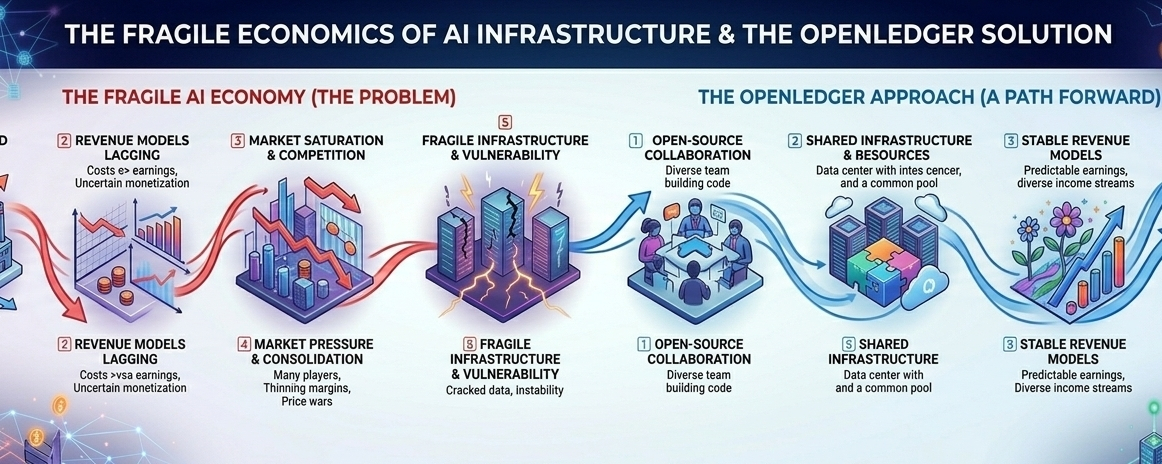
OpenLedger presents itself as an AI-focused blockchain designed to unlock liquidity around data, models, and AI agents. That sounds straightforward at first, but the deeper implication is much more complex. The project is essentially attempting to build an economic coordination layer for AI resources — a system where datasets, models, inference outputs, and autonomous agents can be exchanged, monetized, verified, and potentially reused across different participants. In theory, this could reduce friction in AI development by making valuable resources more accessible and tradable.
But systems like this rarely fail because the concept is impossible. They fail because verification becomes expensive, incentives drift apart, and operational reality becomes harder than architectural diagrams suggest.
Data marketplaces have existed for years in different forms, yet most remain fragmented or limited in usefulness. The reason is simple: data quality is difficult to verify consistently. A dataset may appear valuable until it is outdated, duplicated, manipulated, incomplete, or legally questionable. AI models face a similar issue. A model can perform well in controlled demonstrations while failing under real-world edge cases. Once financial incentives enter the picture, participants naturally optimize for extraction rather than long-term ecosystem health unless the system creates strong counterbalances.
This is where OpenLedger becomes interesting to analyze. Its success depends less on blockchain mechanics and more on whether it can establish credible trust layers around AI outputs and digital resources. In practical terms, the network has to answer uncomfortable questions. Who verifies that a dataset is genuinely useful? How are model contributions measured fairly? What prevents low-quality or synthetic spam from flooding the system once rewards exist? How are disputes resolved when outputs are wrong, biased, or manipulated?
Traditional industries already struggle with these problems. Logistics companies deal with shipment fraud. Financial institutions spend enormous amounts on compliance and auditing. Manufacturing systems rely on layered quality control because a single unnoticed defect can scale into massive failure. OpenLedger is stepping into a similar environment, except the assets being exchanged are often harder to inspect than physical goods.
The phrase “unlocking liquidity” also deserves closer examination. Liquidity sounds attractive because it implies efficiency and movement, but liquidity without reliable valuation mechanisms can create distortion instead of productivity. In financial systems, assets become liquid only when markets trust pricing, settlement, and enforcement mechanisms. AI resources are far less standardized than commodities or securities. Two datasets with similar sizes may have radically different usefulness. Two AI agents may behave unpredictably under different contexts. Creating a marketplace is easier than creating dependable pricing signals.
This becomes even more important once autonomous agents enter the discussion. AI agents are often presented as scalable digital workers capable of handling tasks independently. But real operational environments punish inconsistency. Businesses care less about whether an agent works 80% of the time and more about what happens during the remaining 20%. One unreliable action in accounting, healthcare, logistics, or legal workflows can create disproportionate consequences. That means adoption depends heavily on accountability systems, auditability, and clear responsibility structures.
Blockchain systems can help with transparency in some areas, particularly around tracking transactions and attribution. But transparency alone does not solve the harder issue of truthfulness. A transparent record of bad data is still bad data. An immutable ledger recording unreliable outputs does not automatically create trust. In many ways, OpenLedger’s challenge resembles industrial infrastructure more than software development. It must maintain reliability not only during ideal conditions, but during adversarial conditions where participants actively attempt to exploit loopholes.
I also think the broader AI environment creates both opportunity and pressure for systems like this. AI development is increasingly centralized around companies with large computational resources, proprietary datasets, and distribution advantages. Open networks naturally position themselves as alternatives to that concentration. The appeal is understandable. Open systems can sometimes innovate faster because they allow broader participation. But decentralization also introduces coordination costs that centralized systems avoid through direct control.
That tradeoff matters. Centralized AI platforms can enforce standards quickly, remove abuse rapidly, and maintain consistent operational rules. Open systems depend more heavily on economic alignment and governance structures. If incentives weaken or verification becomes too expensive, fragmentation can grow faster than utility.
This is why measurable outcomes matter more than narratives. I would pay closer attention to practical indicators than ecosystem announcements. Are developers repeatedly using the network for actual workloads? Are businesses integrating the infrastructure into production environments? Can the system maintain quality when scaled beyond early adopters? Does the economic model still function once speculative interest fades? These questions are far more important than market excitement because infrastructure proves itself through sustained reliability, not temporary attention.
There is also the question of sustainability. Many blockchain ecosystems initially attract participation through token incentives, but incentives can temporarily mask weak organic demand. A transportation network subsidized heavily may appear efficient until subsidies disappear. The same principle applies here. If participants primarily engage because rewards are attractive rather than because the infrastructure genuinely reduces operational friction, long-term stability becomes uncertain.
What makes OpenLedger worth watching is not that it promises to merge AI and blockchain. Many projects attempt that. What makes it interesting is that it touches a real coordination problem that genuinely exists in the AI economy: how to organize ownership, contribution, attribution, and access around digital intelligence systems that are becoming increasingly valuable and increasingly difficult to govern.
Still, I remain cautious about how difficult these systems become once they encounter scale, manipulation, and conflicting incentives. Real infrastructure is tested by stress, not vision. Ports prove themselves during congestion. Power grids prove themselves during extreme demand. Financial systems prove themselves during panic. OpenLedger will eventually face similar moments where theoretical alignment meets operational reality.
My own view is that OpenLedger is less interesting as a speculative asset and more interesting as an experiment in institutional design for AI infrastructure. The core idea addresses a legitimate problem, but legitimacy of the problem does not guarantee viability of the solution. The real measure will be whether the network can create durable trust around data, models, and agents without collapsing under the economic pressures that usually distort open systems. Until that becomes visible through measurable usage and resilience, I see it as a thoughtful but still unproven attempt to solve a very real coordination challenge in the emerging AI economy.
Maybe that is the deeper tension inside OpenLedger: the system is not only trying to organize technology, but also human incentives at machine scale
