
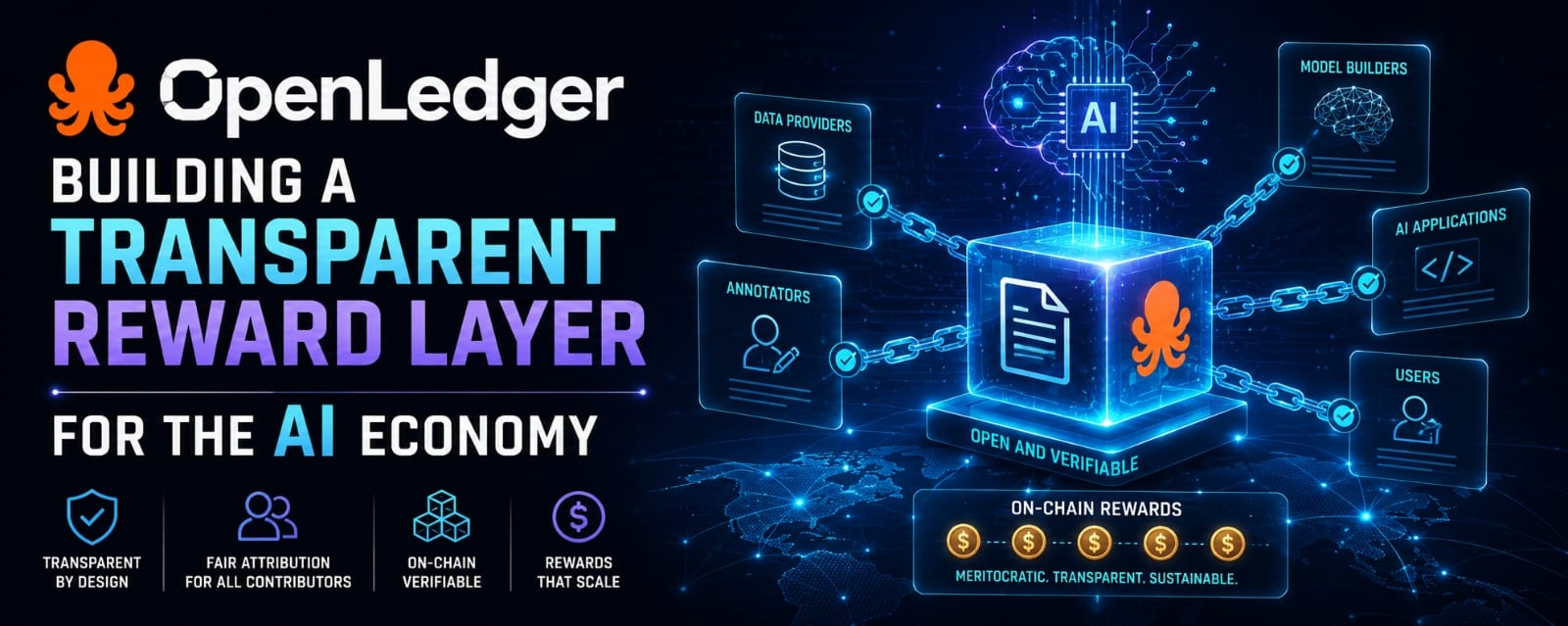
Artificial intelligence is moving fast, but one big problem is still sitting in the background. Most AI systems are built in closed environments, and normal users rarely know where the data came from, who helped improve the model, or who actually deserves credit when that AI creates value. This is where OpenLedger becomes interesting. It is not just another project trying to attach blockchain to AI for attention. Its main idea is much more practical: make AI contributions visible, trackable, and rewardable on-chain.
OpenLedger is an AI-focused blockchain project that wants to unlock value across data, models, applications, and AI agents. In simple words, it is trying to build a system where the people who contribute to AI can be recognized properly. That contribution could be data, model improvement, infrastructure, or other work that helps an AI system become more useful. Instead of allowing all that value to disappear inside closed platforms, OpenLedger wants to create a transparent record of it.
The problem it is solving is easy to understand. AI depends heavily on data, but the people or communities behind that data usually do not get enough recognition. A model may become powerful because of many different inputs, yet only a small group may benefit from the final product. This creates an unfair system. If contributors cannot prove their role, they cannot be rewarded fairly. OpenLedger tries to fix this by bringing attribution and ownership into the AI process through blockchain.
One of the project’s strongest ideas is that AI contributions should not stay hidden. If someone provides useful data, improves a model, or helps an AI agent become more effective, there should be a clear way to track that value. Blockchain makes this possible because it can create transparent and verifiable records. OpenLedger uses this idea to support a more open AI economy, where contribution history matters and rewards can be connected to real participation.
This is important because the future of AI will not only depend on large companies. Developers, researchers, communities, and data providers will also play a big role. OpenLedger gives these participants a possible way to take part in the value they help create. For developers, it may offer infrastructure to build AI-related applications. For users, it can bring more trust and transparency. For data contributors, it creates a path where their input can become more than just a free resource.
The project also focuses on specialized AI models. This matters a lot. Not every industry needs a general AI model that knows a little about everything. Some sectors need models trained on specific, high-quality data. Finance, healthcare, gaming, education, research, and Web3 can all benefit from AI that understands a focused area more deeply. OpenLedger’s approach could support these kinds of models by helping organize, track, and reward the data and contributions behind them.
What makes OpenLedger different is its focus on attribution. Many blockchain projects talk about decentralization, but OpenLedger is going deeper into the AI value chain. It is asking a simple but powerful question: who helped create this intelligence, and how should they be rewarded? That question will become more important as AI agents, models, and datasets become digital assets with real economic value.
Still, the project is not without challenges.
AI and blockchain are both difficult spaces. Combining them sounds powerful, but execution is everything. OpenLedger must prove that its system can work at scale, attract real developers, and bring useful datasets into its ecosystem. It also needs to show that its reward model is fair and practical, not just an idea that looks good on paper. Data quality will be another major challenge, because even the most transparent system is not valuable if the data inside it is weak or unreliable.
Competition is also growing. Many projects are now working around decentralized AI, data ownership, AI agents, and model infrastructure. OpenLedger will need to stand out through real adoption, strong technology, and clear utility. Regulation may also become a factor, especially around AI training data, privacy, and token-based incentives.
Even with these risks, the future potential is strong. If OpenLedger can build a real ecosystem where contributors, developers, users, and AI builders all benefit, it could become an important part of the AI blockchain sector. The idea is not only about making AI more open. It is also about making the value behind AI easier to prove and share.
In the end, OpenLedger matters because it focuses on one of the most important questions in AI: who gets credit? As AI continues to grow, contribution tracking will become more important, not less. Data, models, and agents will keep creating value, and people will want fairer ways to participate in that value. OpenLedger is trying to build that layer.
Its success will depend on execution, adoption, and trust. But the direction is meaningful. If it works, OpenLedger could help move AI from a closed system controlled by a few players toward a more transparent, contribution-based economy where value is easier to see, prove, and reward.
