
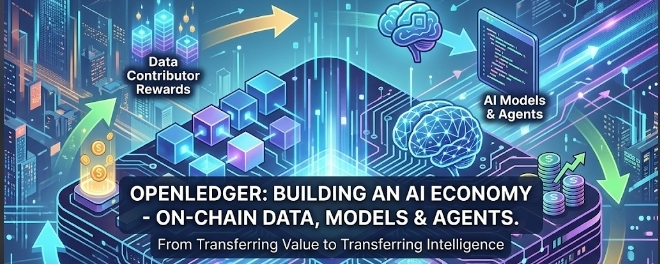
Honestly, most projects today use the word “AI” just to follow hype, but OpenLedger caught my attention because it’s actually trying to build a blockchain around AI itself, not just attach AI as marketing. That’s a big difference.
OpenLedger is being described as an AI blockchain because its entire idea revolves around turning AI-related assets like data, models, and agents into something that can be owned, monetized, and coordinated on-chain. I think many people still don’t fully understand how important that could become in the future.
Right now, the AI industry is heavily centralized. Big companies collect user data, train models using that data, improve their systems continuously, and generate massive revenue from it. But the people who actually create the data usually get nothing back. That imbalance is becoming more obvious every year.
This is where OpenLedger becomes interesting.
Instead of treating blockchain only as a payment system, OpenLedger seems focused on building an economy around intelligence itself. The idea is simple but powerful: if data helps train AI, then data should have value. If developers create useful AI models, they should be able to monetize them openly. If AI agents eventually perform tasks across digital economies, they need infrastructure that allows transparent coordination and ownership.
That’s why it’s called an AI blockchain.
The blockchain layer is not there just for transactions. It acts as the coordination system for AI assets. Ownership, incentives, rewards, transparency, and liquidity can all exist directly on-chain instead of remaining locked inside centralized ecosystems.
What I personally find important is the liquidity narrative behind OpenLedger. Most AI assets today are isolated. Valuable datasets sit privately inside companies. Models are locked behind APIs. Smaller developers struggle to compete because access to infrastructure is controlled by a few dominant players.
OpenLedger is trying to create an open environment where these AI resources can actually move, interact, and generate value more freely.
I think the market may still be underestimating how big decentralized AI could become over the next few years. AI is already transforming industries globally, while blockchain solves coordination, transparency, and digital ownership. Combining both technologies creates a completely different type of ecosystem compared to traditional crypto projects.
And this is where AI blockchains become important.
Traditional blockchains mainly focus on transferring value.
AI blockchains may eventually focus on transferring intelligence.
That changes the entire conversation.
Imagine a future where AI agents execute automated tasks on-chain, where developers earn directly from their models, where data contributors are rewarded transparently, and where intelligence becomes a digital asset class of its own. That future sounds far more realistic today than it did even two years ago.
Of course, there are still risks. AI infrastructure is technically difficult, competition is intense, and many projects will fail trying to capture this narrative. But I believe projects building at the intersection of AI and blockchain are entering one of the strongest long-term sectors in crypto.
OpenLedger stands out because it is not only talking about AI tools. It is trying to build an AI economy.
And in my view, that’s exactly why people are starting to pay attention to AI blockchains in the first place.
