
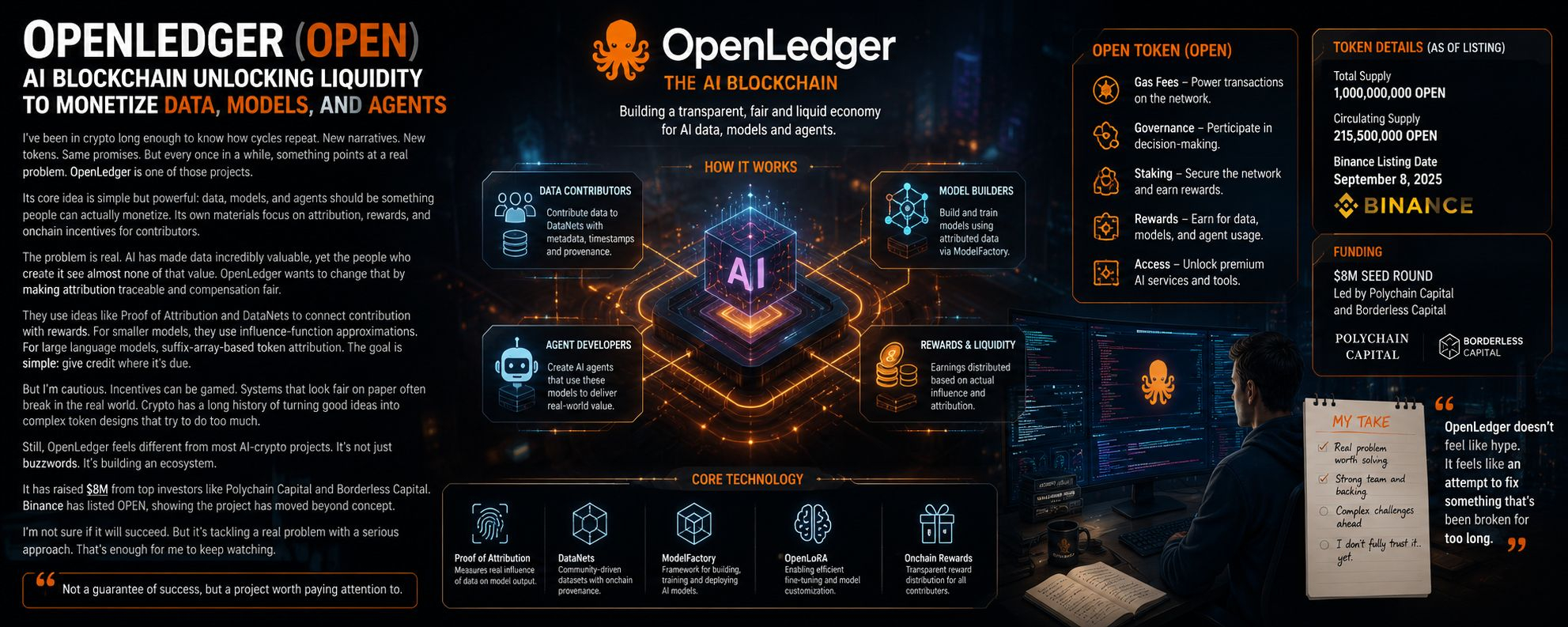

I’ve been around this market long enough to know how quickly a good idea can get buried under bad packaging. Most days, crypto feels like the same story in a different font: a new narrative, a new token, a new promise that this time the incentives finally make sense. Usually they do not. Usually the thing sounds smarter than it is. But OpenLedger is one of those projects I keep coming back to, not because I fully trust it, but because it seems to be circling a problem that actually exists. Its core pitch is that data, models, and agents should be something people can really monetize, and its own materials center on attribution, rewards, and onchain incentives for contributors. That is at least a real problem to wrestle with, even if the answer is still very much a work in progress.
What makes me cautious is the same thing that usually makes me cautious in crypto: once a project starts talking about unlocking value, I immediately wonder who gets paid, who does the work, and who ends up holding the bag when the system gets messy. OpenLedger says it uses ideas like Proof of Attribution and DataNets to track contribution and reward people more directly for the data that helps train models. On paper, that sounds clean. In practice, every system like this ends up fighting the same battles against gaming, noise, and the simple fact that value is much harder to measure once real users start pushing on the edges.
I do like that this one feels more concrete than a lot of AI-crypto projects. It is not just waving its hands at “decentralized intelligence” and hoping nobody asks follow-up questions. The whitepaper gets into attribution methods, including influence-function approximations for smaller models and suffix-array-based token attribution for large language models. That tells me the team is at least trying to make the mechanism legible, not just inspirational. Still, I’ve seen enough of these things to know that a system can be elegant on paper and brittle the moment people start using it for something they actually care about.
The token side makes me even more careful. Binance Academy describes OPEN as being used for gas, governance, staking, rewards, and access to AI services, which is the kind of multipurpose design that always sounds efficient until you watch it in the wild. I’ve seen tokens try to do too much before. The result is often not flexibility, but confusion. When one asset is asked to serve as payment rail, incentive engine, access key, and governance tool all at once, the cracks usually show up later, when people realize the system depends on everyone behaving better than they usually do. Binance also announced OPEN’s listing and token details in 2025, which tells me the project has moved beyond pure concept stage, but not beyond doubt.
What keeps me from dismissing it is that the complaint behind it is real. AI has made data more valuable, but the people closest to the raw material usually do not see much of that value come back to them. That part has bothered me for a while. The internet got very good at collecting contribution and very bad at paying for it. Crypto likes to claim it can fix that kind of mismatch, but most of the time it only renames the problem. OpenLedger at least seems to understand that the issue is not just ownership in the abstract; it is attribution, traceability, and whether people can be compensated in a way that feels tied to actual usefulness rather than speculation.
I’m still not sure it will work. That is the honest place to stand. The market is full of projects that start with a genuine frustration and end with an overstated solution. This could easily be one of them. But it does not read to me like pure vapor either. It feels like an attempt to build something around a problem that the industry keeps talking about but rarely solves in a way that survives contact with reality. That is enough for me to keep paying attention, even if only cautiously. I don’t trust easy endings in crypto anymore. I trust the projects that admit, even indirectly, that the hard part is not explaining the idea. The hard part is making the incentives behave when the crowd shows up.
