Lately I’ve been noticing that most AI conversations in crypto still revolve around the same cycle.
A new AI token trends.
People start talking about agents.
Everyone gets excited about automation.
Then the timeline fills up with hype about “the future.”
But very few people actually stop and ask a more important question:
What kind of infrastructure is all of this supposed to run on long term?
That’s honestly why @OpenLedger started standing out to me recently.
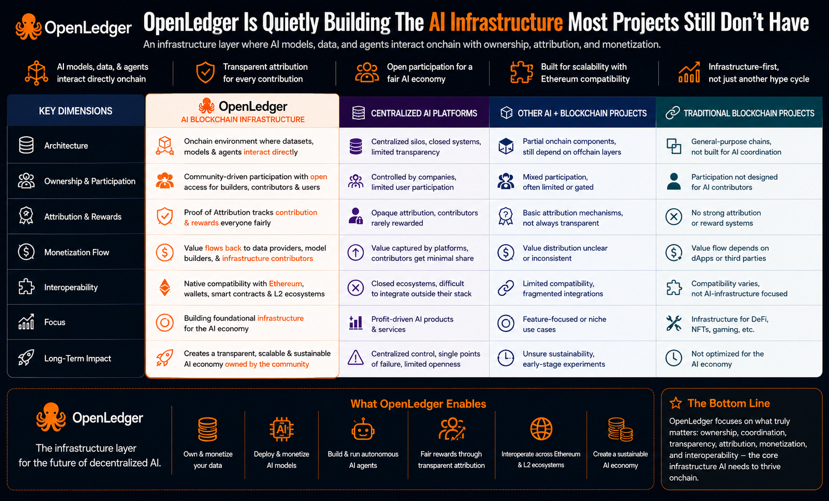
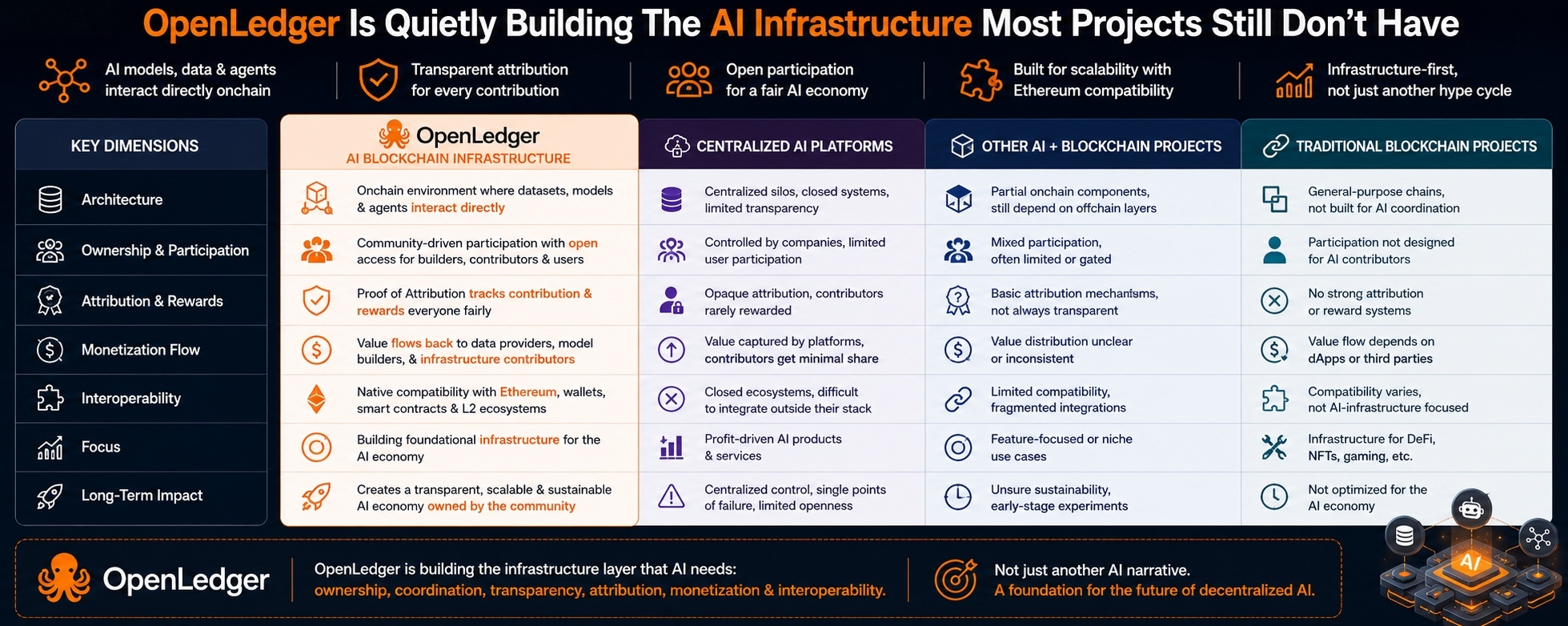
The interesting part isn’t just the “AI + blockchain” angle. We’ve already seen plenty of projects try to market that narrative before. What caught my attention here is the focus on building infrastructure specifically designed for AI participation itself.
And I think that difference matters a lot more than people realize right now.
When you look at the current AI landscape, almost everything still feels fragmented behind the scenes. Data gets collected by one company, models get trained somewhere else, inference happens on another layer, and monetization usually flows back toward centralized platforms controlling distribution.
The people actually contributing to these systems rarely capture much of the value they help create.
That’s where OpenLedger feels different to me.
The project is trying to create an environment where datasets, AI models, and autonomous agents can all interact directly onchain instead of depending on disconnected offchain systems behind the scenes.
In simple terms, the idea is making AI participation itself transparent, traceable, and monetizable.
And honestly, that feels like a much bigger narrative than people currently understand.
One thing I keep thinking about is attribution.
As AI becomes more powerful, this question only gets bigger:
Who actually deserves value when AI systems generate economic activity?
The people providing datasets?
The developers training models?
The infrastructure layers supporting execution?
The builders creating autonomous agents?
Right now most centralized AI ecosystems don’t really answer that transparently. Value tends to stay concentrated around the platforms controlling access and distribution.
OpenLedger seems much more focused on creating coordination layers where contribution itself can be tracked and rewarded directly onchain instead of disappearing into closed systems.
And personally, I think that becomes one of the biggest infrastructure conversations in AI over the next few years.
Because eventually AI stops being just about intelligence.
It becomes about ownership too.
The broader AI market is already moving incredibly fast. Autonomous agents are improving every month. AI-generated content is exploding across the internet. More applications are becoming AI-native. Entire sectors are starting to experiment with AI-driven systems.
But infrastructure still feels incomplete.
Most projects are still competing over narratives while very few are seriously building systems that can coordinate ownership, monetization, and interaction between AI participants at scale.
That’s why infrastructure-focused projects stand out more to me lately.
I also think the Ethereum compatibility side of OpenLedger is underrated.
A lot of developers already operate inside Ethereum ecosystems using existing wallets, smart contracts, and Layer 2 infrastructure. If AI systems can integrate directly into those environments without forcing developers to rebuild everything from scratch, adoption becomes much easier later on.
That kind of interoperability matters more than people think.
Especially if decentralized AI economies continue growing over the next few years.
Another thing I find interesting is the broader direction around open participation. Instead of building AI entirely inside closed corporate ecosystems, OpenLedger seems more focused on creating environments where models, data, and agents can interact more openly through transparent coordination layers.
That aligns with where I think the AI conversation eventually moves.
Because long term, AI probably won’t just be about having the smartest model.
It’ll also be about:
ownership,
coordination,
transparency,
attribution,
interoperability,
and sustainable monetization.
Whichever infrastructure layer solves those problems best could end up becoming extremely important later.
Obviously it’s still early.
The decentralized AI sector is getting crowded fast and execution will matter a lot from here. Plenty of projects are entering the AI infrastructure race now, and not all of them will survive once narratives cool down.
But compared to most AI discussions happening across crypto today, OpenLedger feels much more focused on foundational systems instead of simply chasing short-term hype cycles.
And personally, I think that’s where the more interesting long-term opportunities usually exist.
Most projects are talking about AI.
Very few are seriously building the infrastructure layer underneath it.
That’s the part that keeps making me watch @OpenLedger more closely lately.