
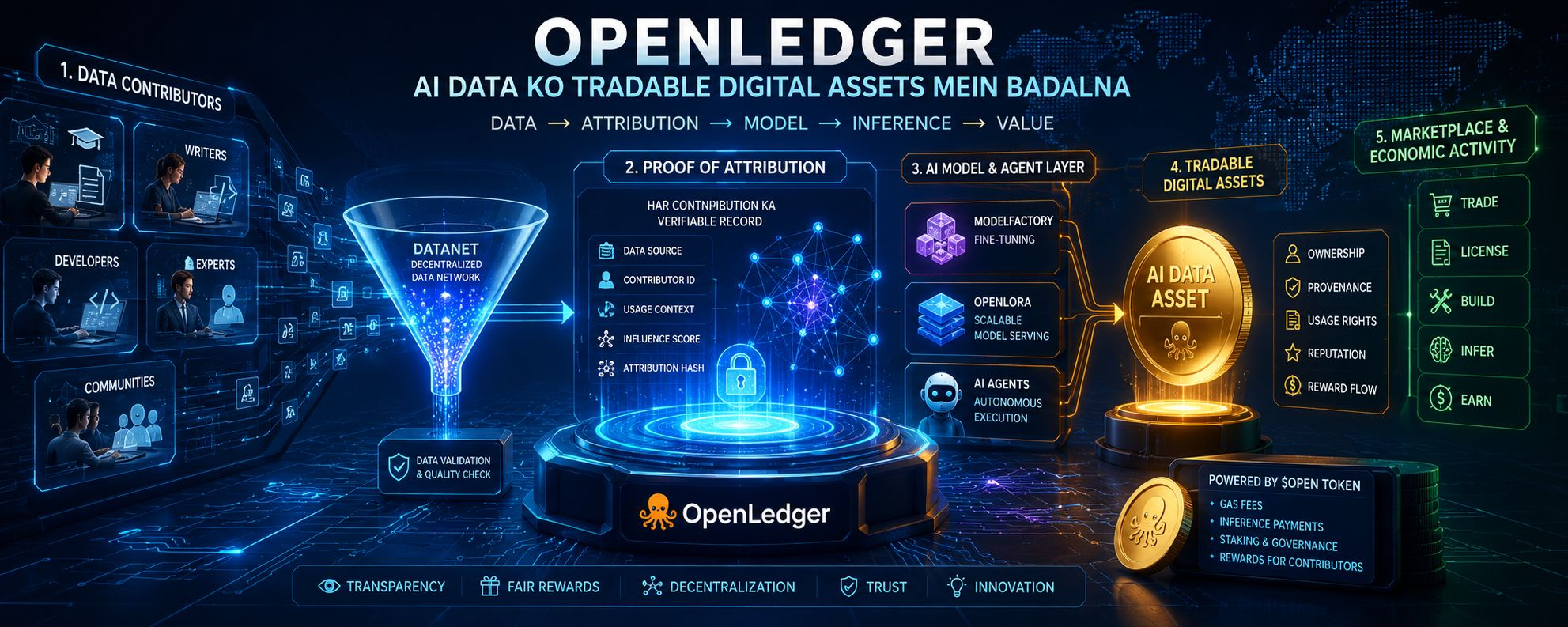
I see OpenLedger as one of the more interesting attempts to connect artificial intelligence with blockchain in a practical way. It’s not just trying to create another crypto network or another AI tool. The bigger idea is that AI data, models, and contributions shouldn’t stay hidden inside closed systems. They should be traceable, usable, rewardable, and even tradable as digital assets. In simple words, OpenLedger is trying to turn the raw material of AI into something people can own, verify, use, and earn from.
In today’s AI world, data is extremely valuable, but the people who create or provide that data often don’t get much recognition. AI models are trained on massive amounts of information, including text, images, code, research, conversations, and expert knowledge. But once that data becomes part of a model, it usually disappears into the background. We don’t always know where it came from, who contributed it, whether it was high quality, or whether the original contributor received anything in return. That’s the gap OpenLedger is trying to solve.
My own observation is that OpenLedger is not only about storing data on a blockchain. That would be too simple. Its real goal is to create an economic system around AI contributions. It wants to answer a difficult question: if someone’s data helps an AI model produce better results, how can that person be credited and rewarded? This is important because AI is becoming more powerful, and the value of specialized data is increasing. General data is everywhere, but high-quality domain-specific data is much harder to find. That’s where OpenLedger’s approach becomes meaningful.
The project introduces the idea of Datanets. A Datanet is basically a decentralized data network built around a specific topic, industry, or use case. Instead of throwing all data into one large pool, OpenLedger organizes data into focused networks. For example, there could be Datanets for healthcare, finance, gaming, law, coding, education, or scientific research. Each Datanet can collect useful information from contributors and make it available for AI model training in a more structured and transparent way.
I think this is important because AI models are only as good as the data behind them. If the data is weak, outdated, biased, or messy, the model’s output will also be weak. A specialized AI model needs specialized data. A legal AI assistant needs legal documents and expert legal knowledge. A medical AI tool needs accurate medical information. A financial AI agent needs market data, risk models, and trading-related knowledge. OpenLedger’s Datanet system tries to make these data sources more organized, more accountable, and more valuable.
Another major part of OpenLedger is Proof of Attribution. This is one of the most important ideas in the whole system. Proof of Attribution is designed to track which data contributed to a model’s performance or output. In normal AI systems, attribution is usually unclear. Once a model is trained, it’s hard to know exactly which data influenced a particular answer. OpenLedger wants to make that relationship more visible. It tries to connect the data contributor, the dataset, the model, and the final AI output.
This matters because attribution creates the foundation for rewards. If a dataset helps improve a model, the contributor should have a way to benefit. If a model uses certain data during training or inference, the system should be able to record that connection. That record can then be used to distribute rewards, build reputation, and create trust. In my view, this is where OpenLedger turns AI data from a passive resource into an active digital asset.
A digital asset has value because it can be owned, verified, transferred, or monetized. OpenLedger applies this logic to AI data. When someone contributes data to the network, that data can be recorded with metadata, ownership information, usage rights, and attribution history. If the data later helps train a model or supports an AI application, the contributor can potentially earn rewards. This makes data more than just a file. It becomes part of a live economic system.
I also think OpenLedger’s model is useful because it addresses one of the biggest debates in AI: who should benefit from AI-generated value? Right now, large AI companies often capture most of the value. Users provide feedback, creators publish content, researchers share knowledge, and communities generate useful information, but the financial rewards usually flow upward to the companies that control the models. OpenLedger is trying to change that by creating a more open reward system.
The OPEN token plays a central role in this economy. It is used as the native token of the OpenLedger network. It can be used for gas fees, inference payments, model-building fees, staking, governance, and rewards for data contributors. This means the token is not just there for speculation. It’s designed to support the activity inside the network. When people use AI models, build applications, contribute data, or participate in governance, OPEN becomes the economic layer connecting those actions.
Of course, this also creates challenges. A system like OpenLedger depends heavily on trust, quality control, and accurate attribution. If poor-quality data enters the network, it could damage model performance. If attribution is not measured correctly, contributors may feel unfairly rewarded. If rewards are too low, people may not want to contribute valuable data. If rewards are too easy to manipulate, bad actors may try to game the system. So, OpenLedger’s success depends not only on its idea, but also on how well it handles verification, reputation, penalties, and incentives.
One thing I find interesting is that OpenLedger doesn’t stop at data. It also focuses on models, model fine-tuning, and AI agents. Through tools like ModelFactory, users can fine-tune AI models using approved and permissioned datasets. This is important because not every user is a technical expert. A visual or no-code style interface can make model development easier for more people. If OpenLedger wants to build a real AI economy, it has to make participation simple enough for contributors, developers, and businesses.
OpenLoRA is another useful part of the ecosystem. It helps serve many fine-tuned models more efficiently. This matters because specialized models can become expensive to run. If every small model needs separate infrastructure, the cost becomes too high. OpenLoRA tries to reduce this problem by allowing many fine-tuned LoRA models to run efficiently. In my opinion, this makes the OpenLedger system more practical because it supports the deployment of many niche AI models without making costs impossible.
OpenLedger also connects this system with AI agents. AI agents are becoming a major trend because they don’t just answer questions; they can perform tasks. They can research, trade, automate workflows, interact with apps, and make decisions based on instructions. If agents are connected to verified data and attributed models, their actions become easier to audit. That’s useful because as AI agents become more powerful, people will want to know what data they used, which model made the decision, and who should be rewarded when value is created.
From my point of view, OpenLedger is trying to build something like a marketplace for AI intelligence. But instead of only selling finished models, it breaks intelligence into smaller valuable parts: datasets, training contributions, fine-tuned models, inference activity, agents, and reputation. Each part can have its own value. This is different from the traditional AI business model, where most of the value is locked inside one company’s private system.
The most powerful part of OpenLedger’s idea is liquidity. Data usually has value, but it is not always liquid. A person may own a useful dataset, but they may not know how to sell it, license it, or prove its usefulness. OpenLedger tries to make that data usable in a market. If data can be attributed and connected to model performance, then it can be priced more fairly. A high-quality dataset that improves AI outputs should be more valuable than random low-quality data. That creates a better incentive for people to contribute useful information.
Still, I don’t think OpenLedger’s mission is easy. AI attribution is technically difficult. Measuring exactly how much one dataset contributed to a model’s answer is not simple. There can be overlapping data, similar sources, and complex model behavior. Also, blockchain systems must balance transparency with privacy. Some data should not be fully public, especially in fields like healthcare, finance, or legal services. OpenLedger will need strong privacy controls, permission systems, and governance rules to handle sensitive information responsibly.
Another challenge is adoption. For OpenLedger to succeed, developers need to build real AI applications on it. Data contributors need to believe they can earn fairly. Businesses need to trust the infrastructure. Users need to see better AI products, not just blockchain promises. The project’s value will depend on whether it can attract useful datasets, strong models, active developers, and real demand for AI inference.
In my observation, OpenLedger’s biggest strength is that it focuses on a real problem in AI. Data ownership, attribution, and compensation are not small issues. They are becoming central questions as AI becomes more important in business, education, media, finance, and daily life. If AI keeps growing without fair attribution, many contributors may feel exploited. OpenLedger’s approach gives them a possible way to participate in the upside.
OpenLedger turns AI data into tradable digital assets by giving data a clear identity, ownership trail, usage record, and reward mechanism. It takes something that was once hidden inside AI training pipelines and brings it into an open economic structure. It uses Datanets to organize data, Proof of Attribution to track contributions, OPEN to power incentives, and model tools to turn datasets into useful AI systems. The final goal is not just to tokenize data, but to create a fairer AI economy where contributors, builders, users, and agents can all interact transparently.
I think the project’s success will depend on execution, not only vision. If OpenLedger can prove that attribution works, that rewards are fair, and that developers can build useful AI products on top of it, then it could become an important part of the AI and blockchain space. It’s trying to make AI data more than fuel for centralized models. It’s trying to make it an ownable, traceable, and income-generating asset in a decentralized digital economy.