
A lot of crypto projects try to look important before they're actually useful.
That’s probably why OpenLedger feels different when you look at how it's being designed.
The interesting part is not the AI narrative around it.
Honestly that narrative is everywhere now.
Every second project claims to be "AI infrastructure."
Most of them just attach a chatbot to a token. Hope the market stays distracted.
What caught my attention with OpenLedger is something
They seem to understand that data itself is becoming the bottleneck.
Not computers, not models, not distribution. Data.
More specifically who owns it who verifies it who profits from it and whether AI systems can actually trust it.
That sounds obvious.
But the more you watch the AI market the stranger it becomes.
Large models are trained in environments nobody can audit.
Data sources are messy.
Ownership is unclear.
Rewards are concentrated.
The internet is filling with AI content generated by other AI systems.
That creates a loop where future models may train on machine output instead of real human information.
You can already feel this happening.
Search quality feels different.
Social platforms are flooded with engagement farming.
Even crypto research threads look partially machine-generated.
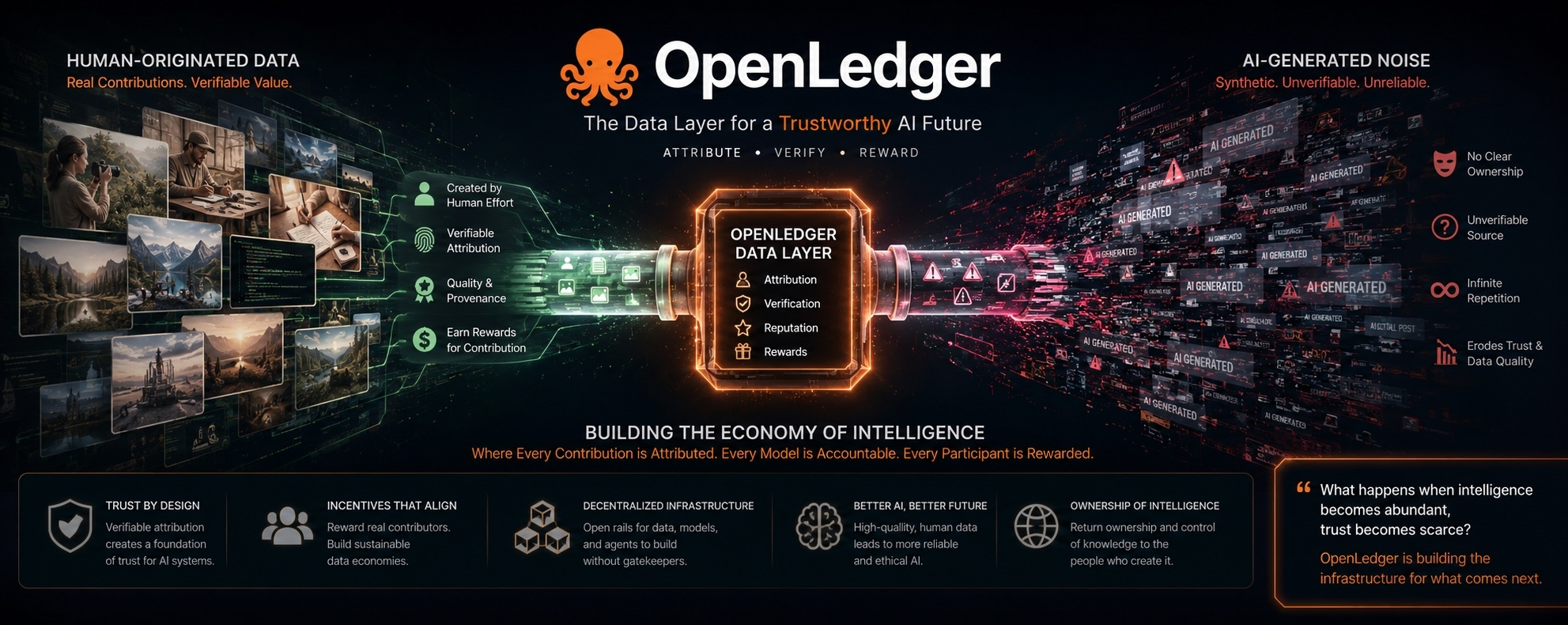
So when OpenLedger talks about " data" and rewarding contributors I think the bigger question is whether this becomes necessary.
Because if AI keeps scaling while trust keeps collapsing someone has to build systems that separate human-originated data from synthetic noise.
That’s where OpenLedger starts becoming more interesting.
The design feels practical.
Of building one giant consumer product the system focuses on creating rails around data attribution and specialized AI models.
Infrastructure projects usually survive longer than projects.
Quiet infrastructure rarely gets attention early. It matters later if adoption happens.
There are uncomfortable questions.
Do people actually want decentralized AI systems convenience becomes involved?
Most users say they care about openness and ownership until centralized systems become faster and easier.
That pattern happens in crypto.
People talk about decentralization while trading on exchanges.
People talk about privacy while giving every app permissions.
So OpenLedger may be directionally correct but struggle against human behavior.
Another thing that feels uncertain is incentive quality.
Crypto ecosystems are good at attracting short-term participation. Bad at maintaining long-term meaningful contribution.
If contributors are rewarded for datasets what stops low-quality spam submissions?
What happens when financial incentives corrupt the quality of information?
We saw issues with play-to-earn gaming systems.
Once rewards dominate behavior ecosystems become extraction machines of productive networks.
OpenLedger talks about verification layers and reputation mechanisms.
Reputation systems are hard to maintain at scale especially with money involved.
Honestly this is where the project either succeeds or breaks.
Not because of price but because of data integrity.
The weird thing is that crypto people often underestimate how hard coordination problems are.
Building a blockchain is hard.
Building incentives is harder.
Building incentives may be hardest of all.
That’s why I pay attention to the structure behind projects of market excitement.
Anyone can launch incentives announce partnerships or create activity.
Systems behave differently after six months of stress.
One thing I respect about OpenLedger is that it doesn’t feel obsessed with becoming another AI super app."
The project seems focused on the layer underneath. The pipes, attribution and flow of information.
That approach feels less exciting in the term but more realistic.
AI probably doesn’t need another interface.
It may need incentives.
Maybe that’s the bigger shift people are missing.
For years crypto tried to tokenize finance.
Now projects try to tokenize intelligence itself.
That changes the type of problems networks must solve.
Not just transactions anymore. Trust, authenticity, contribution and ownership of knowledge.
Those are systems than moving coins between wallets.
I was thinking about this while watching AI-generated content spread through crypto Twitter.
Half the threads look now. Cleaner grammar, better formatting and better hooks.
Somehow less human.
You start reading and feel empty underneath.
No lived experience.
No uncertainty.
No rough edges.
Just optimized output.
Maybe that’s why projects like OpenLedger appear now.
Because the internet is entering a phase where proving something came from human effort may become economically valuable.
Not valuable. Economically valuable.
That’s an idea.
Still too early to know if OpenLedger becomes part of that future or just another cycle narrative attached to AI momentum.
I think the core question behind the project is more serious than people realize.
What happens when intelligence becomes abundant. Trust becomes scarce?
What kind of networks survive in that environment?