

I’ll be honest.
For a long time, whenever I saw the phrase “AI agent,” I immediately expected disappointment.
Because most of the time, it was just a chatbot with a more expensive name. It could summarize a PDF, write a caption, maybe tell me to drink water. Amazing. Humanity saved.
But the real question was always simple.
Can it actually do something?
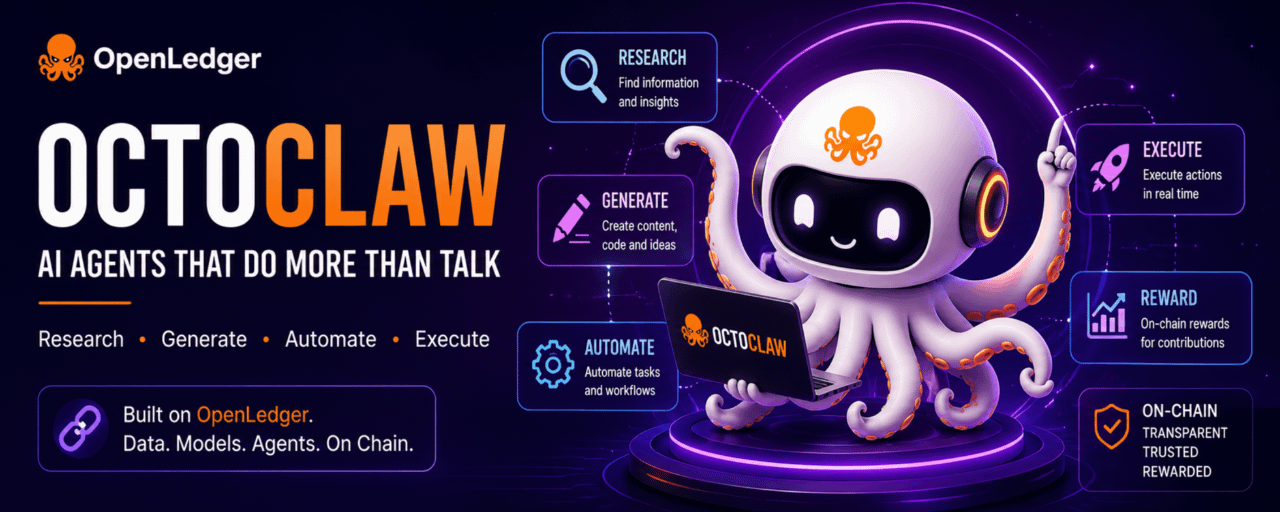
That is why OpenLedger’s OctoClaw caught my attention.
OpenLedger is already positioning itself as an AI blockchain for data, models, and agents. That part is important. Because it is not only trying to build around AI hype. It is trying to create an ecosystem where AI components can be used, tracked, rewarded, and monetized.
Now OctoClaw adds another layer to that story.
Instead of AI just sitting there and answering questions like a very confident intern, OctoClaw is about action. Build, automate, and execute with AI agents in real time. That sounds much closer to what people actually wanted from AI agents in the first place.
Not more talking.
More doing.
And that difference matters.
Because the AI market is already full of tools that can “assist” you. Some of them assist so much that you still end up doing everything manually. Very generous of them.
But an agent that can research, generate, automate, and execute has a different kind of value. It starts becoming part of a workflow. It can help users move from idea to task completion. That is where the real agent economy starts to make sense.
For OpenLedger, this is interesting because agents do not exist alone.
They need data.
They need models.
They need tools.
They need execution.
They need trust.
And if those parts can be connected on-chain, then the agent is not just a random bot floating in the internet. It becomes part of a bigger system where AI work can be recorded, verified, and potentially monetized.
That is the real narrative I see here.
OpenLedger is not only saying, “Here is an AI chain.”
It is saying, “Here is a place where data, models, and agents can work together.”
OctoClaw fits that story because it gives the agent side something more visible. Something people can actually understand. Because let’s be honest, explaining AI data attribution to normal people is not exactly dinner-table entertainment.
But saying, “AI agents that can actually execute tasks”?
That hits faster.
This is also why I think the agent narrative may become stronger than the usual AI-token narrative.
A token narrative alone can get attention.
But a working agent ecosystem can keep attention.
Big difference.
If OpenLedger can make agents useful, accessible, and connected with its wider AI blockchain infrastructure, then OctoClaw may become more than just another product launch. It could become one of the easiest ways for people to understand what OpenLedger is trying to build.
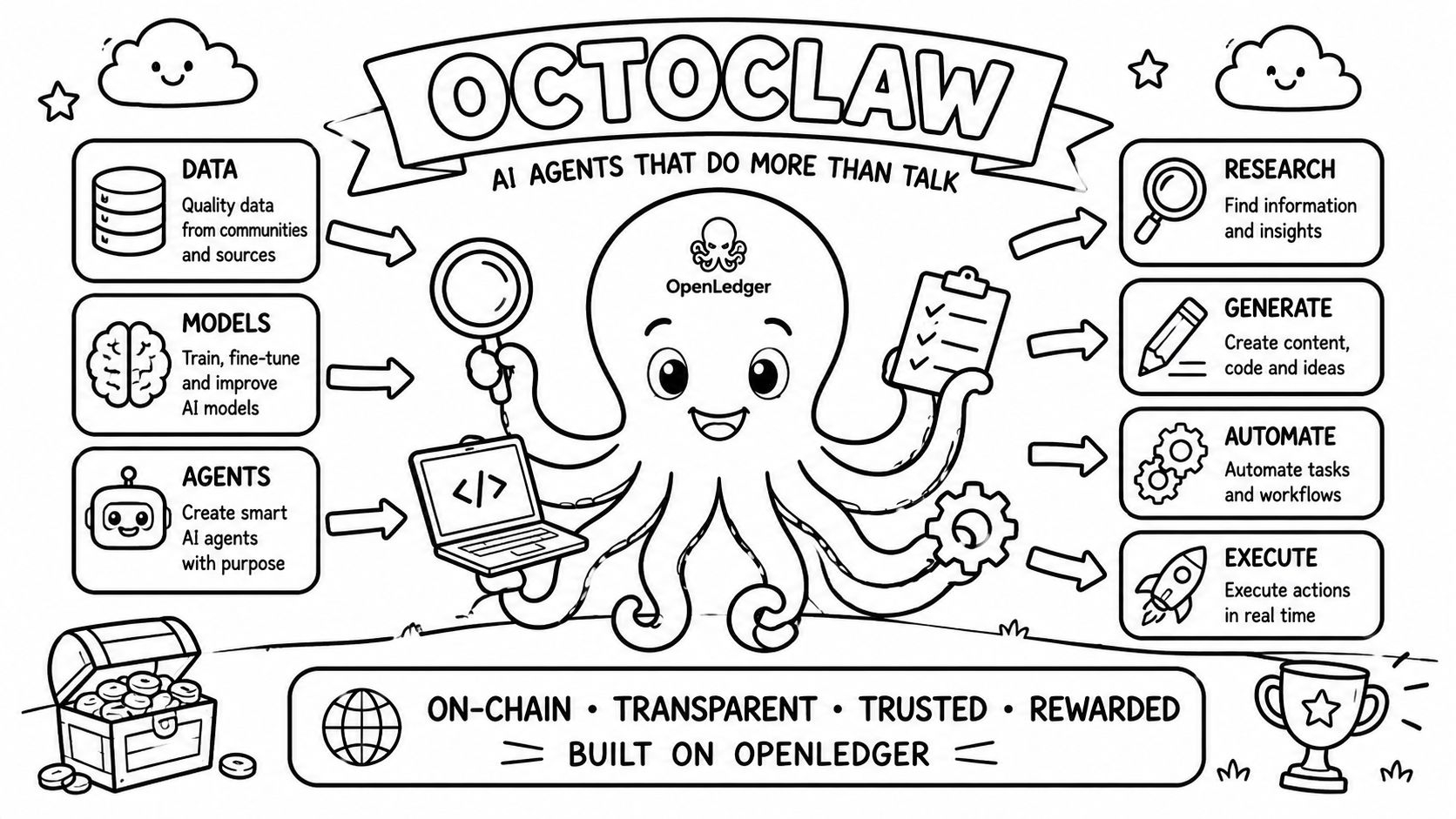
Data is the fuel.
Models are the brain.
Agents are the hands.
And OctoClaw is basically OpenLedger saying, “Okay, enough theory. Let’s make the AI actually move.”
Will it be easy? Obviously not.
AI agents still have problems. They can break, misunderstand instructions, overcomplicate simple things, or act like they just discovered chaos as a lifestyle. So yes, execution matters. Safety matters. Real use cases matter.
But the direction is clear.
The next phase of AI will not only be about smarter answers.
It will be about useful actions.
And if OpenLedger can connect those actions with data, models, ownership, and monetization, then OctoClaw becomes a very important part of the story.
Because in the end, nobody wants another AI tool that only talks nicely.
We already have enough of those.
I want the one that actually gets things done.