
After spending years watching both crypto and AI evolve, I’ve noticed something strange. The industries love talking about the future, but they rarely talk honestly about the systems they are actually creating. Everything becomes a slogan. Every new project claims to be revolutionary. Every token becomes “the next big thing.” And eventually the entire space starts feeling like a marketplace of recycled ambition where hype moves faster than reality ever can.
That is exactly why I became skeptical when AI and crypto started merging together.
For a while, almost every project sounded identical. Some promised decentralized AI agents. Others promised autonomous economies powered by tokens. A few claimed they would replace traditional companies entirely. But if you looked closely, many of them were simply rebuilding the same speculative structures with new terminology attached to them. The technology sounded futuristic, but the business model often depended more on attention than utility.
That’s why OpenLedger caught my attention differently.
Not because I believe it has solved the industry’s problems. And definitely not because I think the project is immune to the same risks that affect every crypto ecosystem. What interested me was the direction of the question it seems to be asking.
Who actually benefits from the AI economy?
That question matters more than most people realize.
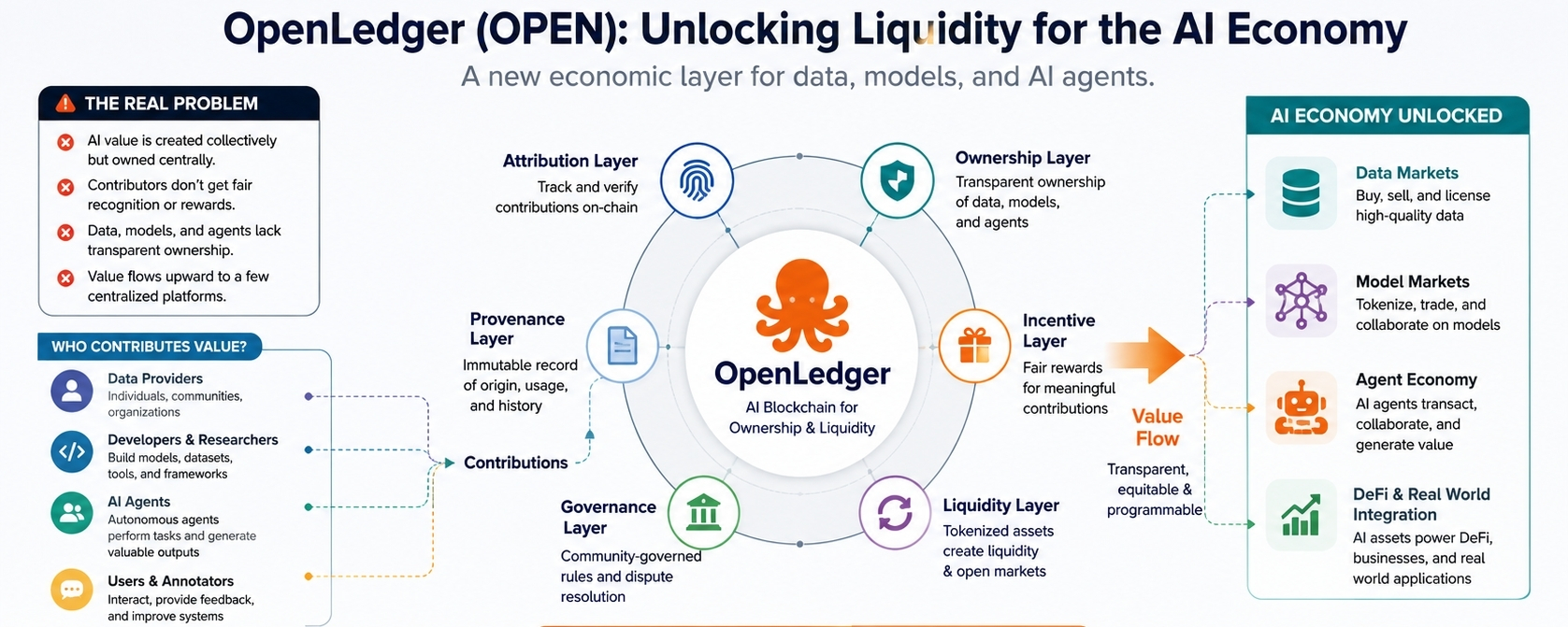
Right now, artificial intelligence is being built on top of enormous amounts of human contribution. Every dataset, every feedback loop, every refinement process, every interaction — all of it comes from people, communities, developers, researchers, and users spread across the internet. AI systems grow stronger because millions of individuals unknowingly participate in improving them every single day.
But when value is created, the rewards rarely flow back to the people helping generate it.
Instead, ownership becomes concentrated.
A small number of companies now control most of the advanced AI infrastructure. They own the compute power, the largest models, the distribution channels, and increasingly the commercial ecosystems surrounding AI itself. Meanwhile, the broader internet continues feeding these systems with information and engagement without receiving proportional economic participation.
To me, this is where OpenLedger becomes more interesting than the average AI-crypto narrative.
The project seems built around the idea that AI is not only a technological layer anymore — it is becoming an economic layer. Data has value. Models have value. Autonomous agents may eventually have value as well. And if all of these things are contributing to future digital economies, then the next logical question becomes whether ownership inside those economies can remain permanently centralized.
That feels like a real conversation.
Crypto, at its core, was originally supposed to challenge concentration of power. The early philosophy behind blockchain technology was never just about tokens or trading. It was about creating systems where participation and ownership could exist together. Somewhere along the way, though, much of the industry lost that focus. Markets became obsessed with speculation. Projects optimized for hype cycles. Entire ecosystems were built around narrative momentum instead of durable infrastructure.
The AI boom accelerated this behavior even further.
Suddenly every project became “AI-powered.” Every whitepaper included autonomous agents. Every token somehow claimed to be connected to the future of intelligence. Most of it felt shallow. Not necessarily fake, but incomplete. The industry was chasing excitement faster than understanding.
OpenLedger feels slightly different because it appears more focused on the economic mechanics beneath AI rather than simply using AI as branding.
Still, this is where realism becomes important.
Building a system that fairly monetizes contributions inside AI ecosystems is extraordinarily difficult. In theory, decentralization sounds elegant. In practice, coordination becomes messy very quickly. How do you measure the value of a dataset accurately? How do you verify meaningful contribution? How do you stop low-quality participation from flooding incentive systems once rewards become financial?
These are not simple technical problems. They are economic and behavioral problems too.
And history shows that crypto ecosystems often struggle once incentives become distorted.
That’s why I remain cautious about every project in this sector, including OpenLedger. Experience teaches you that good narratives and sustainable systems are not the same thing. Many blockchain projects identify real issues but underestimate how difficult execution becomes once speculation, governance, and scaling pressures enter the equation.
There is also the uncomfortable truth that centralized AI companies currently operate with massive advantages. They have funding, infrastructure, speed, and control over distribution. Open decentralized systems sound attractive philosophically, but competing against highly centralized organizations is incredibly difficult in reality.
So no, I don’t think projects like OpenLedger automatically change the future.
But I do think they reflect an important shift happening in the industry.
People are slowly realizing that the biggest questions around AI are no longer just about intelligence itself. The deeper issue is ownership. Who controls the systems? Who captures the economic value? Who participates in the upside when AI becomes deeply integrated into everyday life?
Right now, those answers remain heavily centralized.
And maybe that remains the final outcome. Maybe AI ultimately becomes controlled by a small group of dominant corporations because centralization simply scales more efficiently. That possibility is very real.
But even then, projects like OpenLedger matter because they force the industry to confront uncomfortable questions instead of hiding behind marketing language.
Personally, I find that more valuable than another project promising instant revolution.
At this stage, I’m less interested in bold predictions and more interested in whether a project is at least trying to solve a problem that genuinely exists. OpenLedger may succeed, or it may become another ambitious experiment swallowed by market cycles and technical realities. Crypto history is full of both outcomes.
But the imbalance it points toward is undeniable.
AI is rapidly becoming one of the most powerful economic systems on earth, yet the structure around ownership still feels narrow, closed, and increasingly concentrated. Whether blockchain-based systems can realistically improve that situation is still uncertain.
What’s certain, though is that the conversation itself is becoming impossible to avoid
