
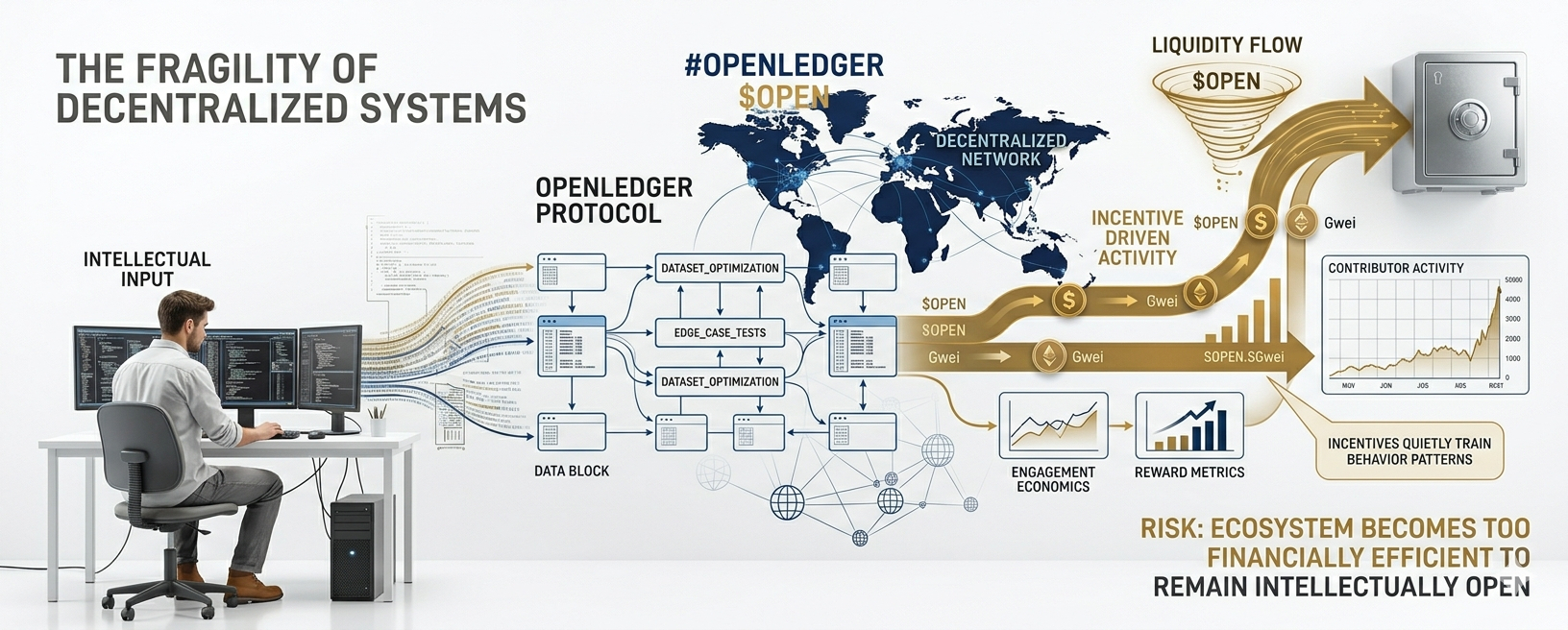


Somebody I follow quietly stopped contributing to one OpenLedger dataset last week.
No announcement. No drama. They just redirected their activity somewhere else right after another platform increased contributor rewards. I only noticed because their update frequency used to be almost obsessive. Same hour every day. Then suddenly nothing.
Been sitting with that for a while.
Most people talk about decentralized AI economies like they naturally resist centralization if enough participants exist. But honestly, when I watch contributor behavior closely, the system feels more fragile than the narrative around it.
Because loyalty in these ecosystems rarely comes from ideology.
It usually comes from incentives.
And incentives move fast.
If a competing protocol offers higher payouts, faster visibility, or better liquidity access, why would contributors stay loyal long term? Especially smaller contributors who are already operating on thin margins. What I keep noticing is that contributors often behave less like community members and more like adaptive market actors constantly recalculating where their effort gets priced highest.
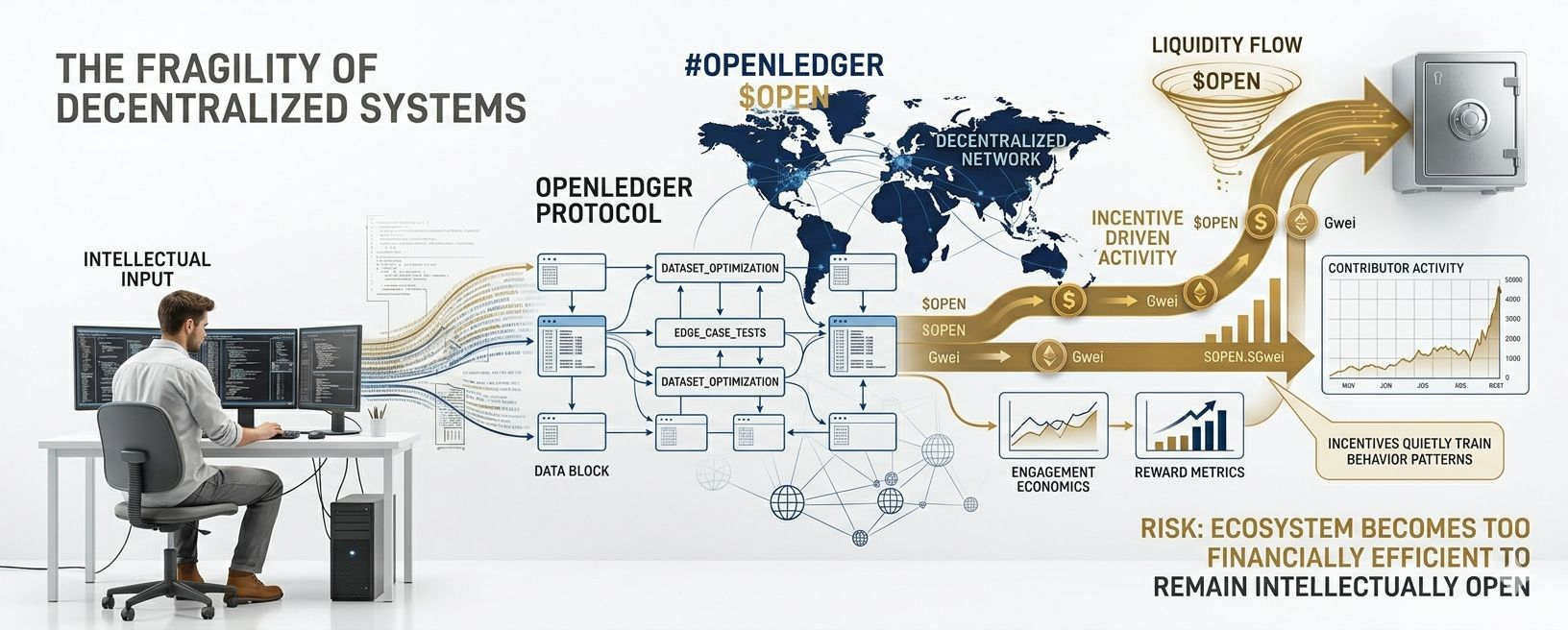
That changes governance too.
Open systems sound decentralized until dominant narratives gain enough economic momentum to shape voting outcomes indirectly. The wallets with the largest influence do not always need to control governance openly. Sometimes they just control attention, liquidity flow, or ecosystem direction through coordination advantages.
The tension here is subtle.
Technical contributors might spend months refining datasets, improving model quality, or testing edge cases nobody else notices. Meanwhile financial participants can gain disproportionate influence simply by accelerating capital deployment at the right moment. Over time the protocol risks rewarding positioning more than contribution itself.
I also keep thinking about liquidity expansion.
At first it looks healthy. More users, more datasets, more activity. But there is this strange behavioral shift that happens once incentives become large enough. Contributors stop optimizing for authenticity and start optimizing for whatever metric the reward system measures.
You can already see hints of it in smaller ecosystems.
People fragment datasets into multiple submissions because engagement metrics reward volume. Others recycle slight variations of existing data because maintaining visibility matters more than originality. Activity increases, but meaningful innovation becomes harder to measure underneath the noise.
And honestly, that might be the hardest problem here.
How does OpenLedger determine whether incentives are producing actual intelligence growth instead of just performance theater? Metrics can track participation. They can track transactions. But intelligence itself is harder to quantify without reducing it into engagement economics.
What I kept coming back to is how ecosystem growth can sometimes hide structural fragility rather than solve it.
Governance eventually starts favoring stability because stability protects existing capital allocation. Riskier experimentation becomes harder to justify. The system slowly optimizes for preserving itself.
Not because anyone planned it that way.
Just because incentives quietly trained everyone toward similar behavior patterns.
Which makes me wonder whether the biggest threat to decentralized AI is not external competition at all.
Maybe the real risk is the ecosystem becoming too financially efficient to remain intellectually open.
