

I keep thinking about how strange the AI market structure still feels.
Everyone focuses on the models. Better outputs, faster inference, smarter agents. But what keeps standing out to me is how little attention goes toward the economic layer underneath all of it.
Who actually captures value once AI activity scales?
That part still feels unresolved.
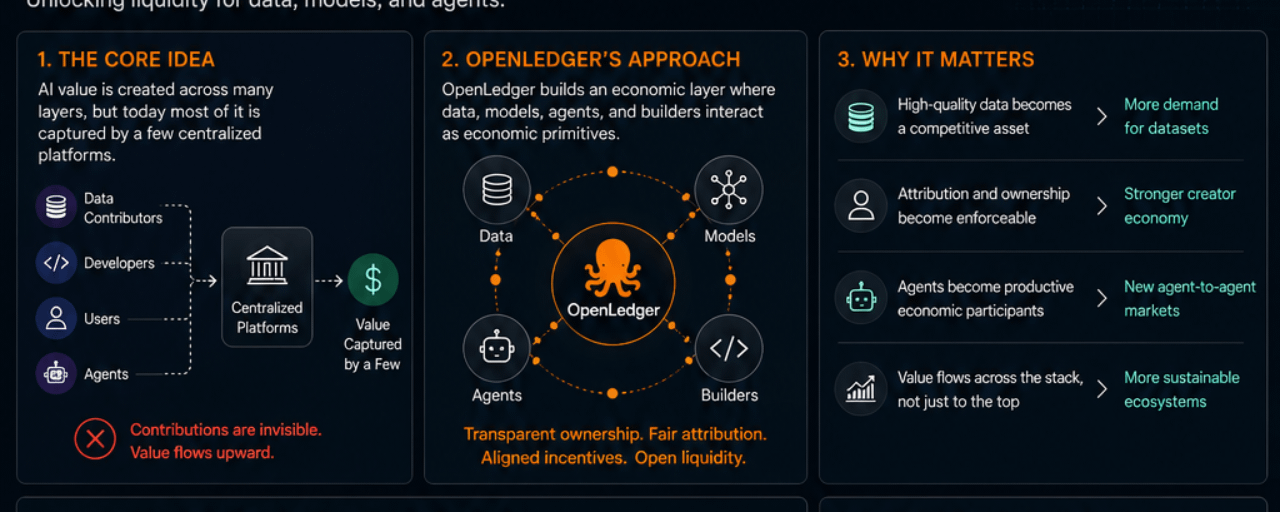
A lot of AI today depends on invisible contributions. Data gets generated constantly. Users refine systems without realizing it. Developers improve tools inside ecosystems they don’t fully own. Even agents themselves are starting to behave like productive digital labor.
But the economic coordination around those contributions still feels primitive.
That’s partly why @OpenLedger caught my attention.
Not because it’s another “AI blockchain” narrative. honestly that category is already crowded enough. Most projects there seem focused on visibility first and sustainability later.
What interests me more is the possibility that OpenLedger is approaching AI from the liquidity side rather than the intelligence side.
And I don’t mean liquidity in the usual trading sense.
I mean liquidity around participation itself.
because once AI ecosystems become large enough, the real bottleneck may not be model quality alone. It may be whether contributors, datasets, agents, and builders can actually interact inside a system where value moves transparently.
That changes the conversation completely.
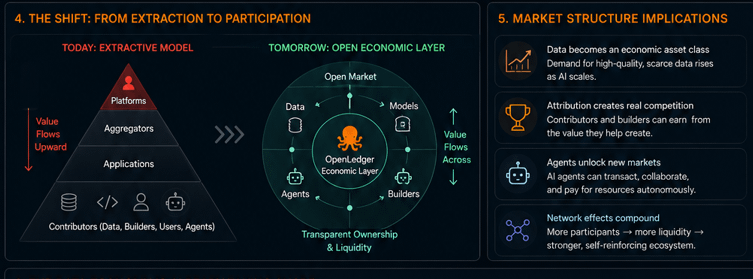
Right now most AI ecosystems feel extractive by default. Platforms aggregate value. Contributors remain fragmented. Smaller builders often depend on centralized distribution even when their work becomes meaningful to the network itself.
Over time that creates imbalance.
The bigger question is whether AI eventually needs native economic infrastructure instead of simply better applications layered on top.
maybe that sounds too early right now. But crypto markets usually start pricing these shifts long before they fully materialize.
We saw similar patterns in early DeFi infrastructure.
At first people focused on the visible products — exchanges, yield platforms, trading interfaces. Later the market realized the deeper value often sat underneath in the systems coordinating liquidity, incentives, and participation itself.
AI might follow a similar path.
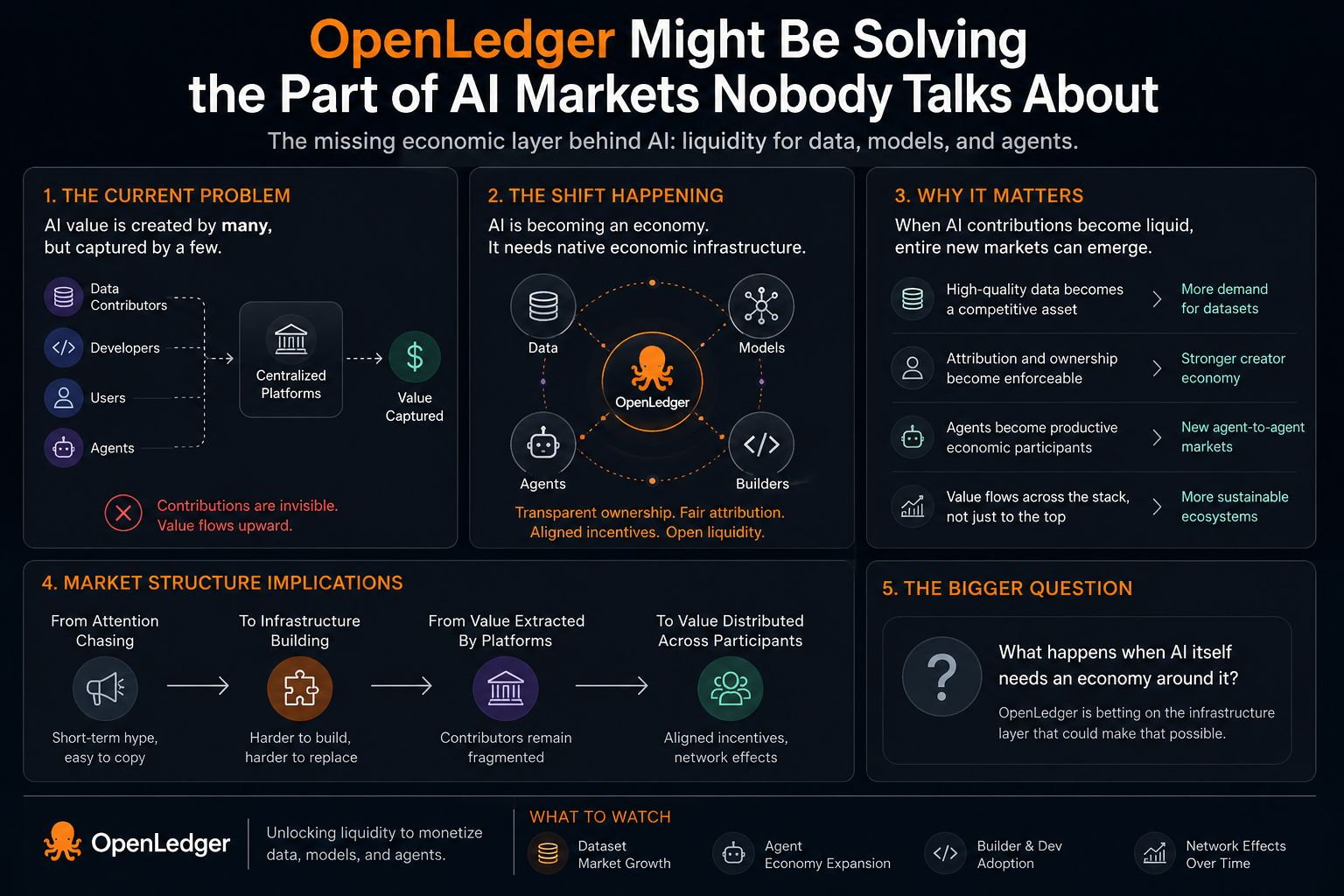
That’s why I think @OpenLedger feels less like a traditional AI project and more like an attempt to financialize AI contribution layers before the market fully understands their importance.
That distinction matters.
because if AI agents become economically useful over time, then high-quality data stops being background infrastructure and starts becoming a competitive asset. Once that happens, attribution matters more. Ownership matters more. Reward distribution matters more too.
And most current AI systems still handle those areas poorly.
From a trader’s perspective, this creates a different type of thesis entirely.
You stop looking only at short-term attention cycles and start asking whether the network structure itself becomes harder to replace over time.
That’s a slower thesis though.
Less exciting in the short term. Harder to market. Harder to value.
And honestly, crypto markets usually prefer immediacy over structural depth.
That’s why I’m still cautious.
A strong narrative alone doesn’t guarantee adoption. We’ve already seen sectors where the concept made sense years before actual market demand arrived. Infrastructure projects especially tend to suffer from timing mismatches because they’re building for behaviors that don’t fully exist yet.
AI could easily go through the same phase.
Still, what keeps standing out to me is that OpenLedger seems to be asking a more durable question than most projects in this sector are asking right now.
Not “how do we launch another AI product?”
But:
what happens when AI itself becomes an economy with participants competing over data, models, agents, and coordination?
Because if that transition actually happens, the projects building incentive structures underneath AI activity may end up mattering more than the ones simply chasing visibility on top of it.
maybe we’re still early to know which direction wins.
But I don’t think the market has fully understood that shift yet.
