

A lot of people still think the biggest challenge in decentralized AI is building smarter models.
I don’t think that’s true anymore.
The real challenge is whether these ecosystems can survive economically once the hype phase ends.
Because AI infrastructure is expensive at every layer.
Training models costs millions. Inference costs scale aggressively with usage. Storage infrastructure keeps expanding. GPU demand continues rising globally.
And unlike normal Web3 applications, AI systems don’t become cheaper simply because they move on-chain.
That’s why I’ve been paying closer attention to OpenLedger recently.
Not because it’s marketing itself as another “AI revolution.”
But because the project seems focused on something many others ignore: how to make decentralized AI economically sustainable before scaling becomes destructive.
To me, that’s a much more important conversation.
Take a simple example.
If a decentralized AI platform suddenly attracts 5 million users generating prompts every day, the infrastructure demand becomes enormous almost immediately.
Now imagine:
inference requests running continuously
AI agents operating 24/7
datasets updating in real time
contributors expecting rewards
validators processing attribution systems
Who absorbs those costs?
Most projects answer this problem with token emissions.
But crypto has already shown us how dangerous that model can become.
We saw it during the play-to-earn era.
Projects attracted huge growth through aggressive incentives, but once rewards slowed down, activity collapsed because the underlying economy wasn’t self-sustaining.
Even some AI ecosystems today are quietly repeating the same pattern.
High engagement. Low retention. Temporary participation. Speculative activity disguised as adoption.
That’s why OpenLedger’s direction feels more calculated to me.
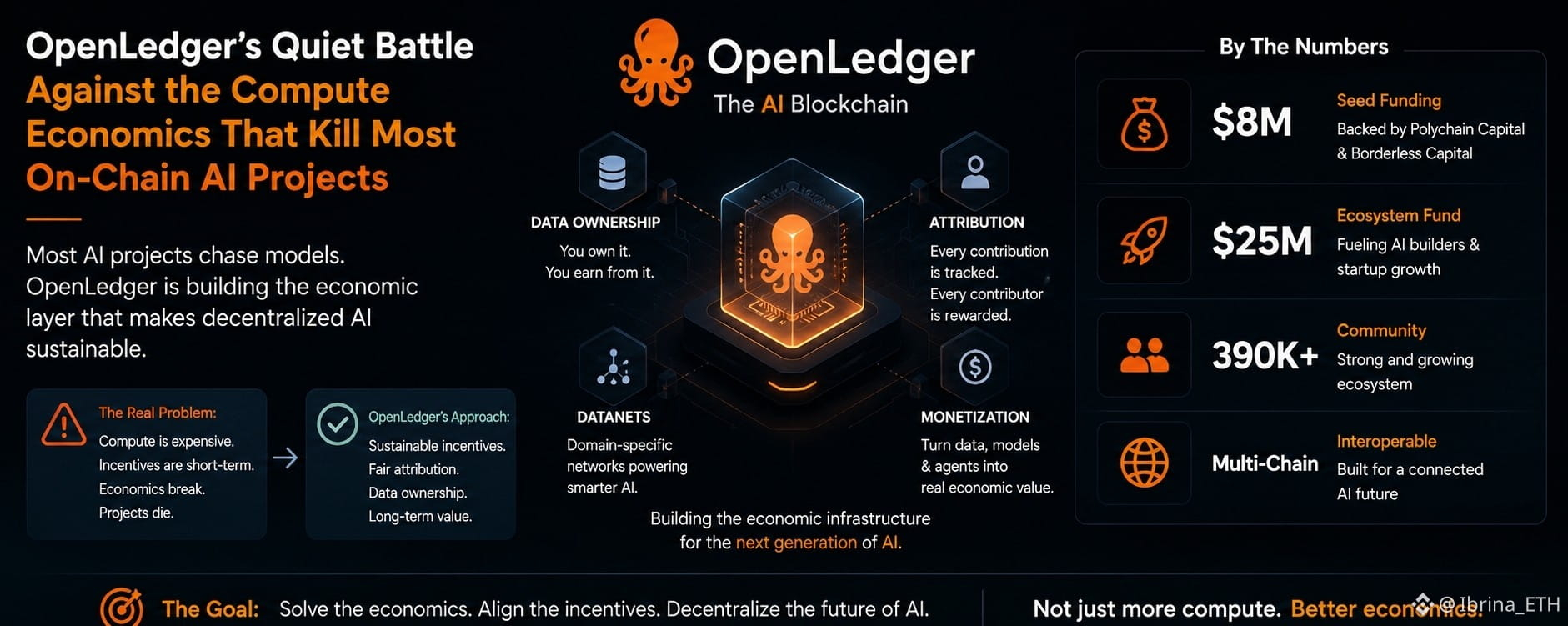
Instead of competing directly against companies like OpenAI or Google on pure compute power, OpenLedger appears to be focusing on value coordination.
And honestly, that might be the smarter long-term strategy.
Because centralized AI companies already dominate compute infrastructure.
For example:
Microsoft reportedly invested billions into AI infrastructure expansion tied to OpenAI
NVIDIA’s AI chip demand pushed the company beyond trillion-dollar valuation territory
Large-scale training runs now require enormous energy and GPU access
Most decentralized projects simply cannot outspend that system.
So trying to win through raw infrastructure alone may be unrealistic.
OpenLedger seems to understand this.
Its focus on attribution and datanets suggests the project believes the next major AI opportunity is not only about intelligence generation — but about ownership and incentive alignment.
That distinction matters.
Right now, countless contributors across the internet provide valuable:
datasets
labeling work
fine-tuning inputs
domain expertise
behavioral information
Yet most of the economic upside remains concentrated within centralized AI platforms.
OpenLedger appears to be building around a different idea: what if contributors could actually capture value proportional to the intelligence they help create?
That changes the economics entirely.
For example, imagine:
a healthcare datanet rewarding medical researchers for verified datasets
a legal AI ecosystem compensating professionals for domain-specific training inputs
financial analysts contributing market intelligence into AI systems with transparent attribution tracking
Those systems become much more interesting than simply launching another AI chatbot token.
And I think that’s where OpenLedger’s thesis becomes stronger.
The project is not only thinking about compute.
It’s thinking about incentive architecture.
That’s important because poorly aligned incentives quietly destroy most decentralized ecosystems over time.
We’ve already seen this happen across crypto multiple times:
unsustainable yield farming
inflation-heavy token rewards
fake ecosystem activity
mercenary users chasing emissions
Short-term growth looks impressive. Long-term retention disappears.
OpenLedger’s ecosystem expansion strategy also reflects this larger vision.
The project has reportedly secured around $8M in funding support from firms like Polychain Capital and Borderless Capital while continuing to push ecosystem growth initiatives tied to AI builders and decentralized contribution systems.
That level of backing matters because AI infrastructure projects burn capital aggressively during early expansion phases.
The reported $25M ecosystem initiative is another interesting signal.
Because it shows the team understands something critical: infrastructure alone is not enough.
Without developers, contributors, and sustainable participation loops, decentralized AI ecosystems struggle to maintain relevance.
And honestly, this is where I think the market still underestimates the difficulty ahead.
Building decentralized AI is not only a technical challenge.
It’s an economic coordination challenge at scale.
Can contributors remain incentivized long term? Can attribution systems stay accurate? Can decentralized infrastructure remain cost efficient? Can token incentives avoid becoming extractive? Can real demand exist beyond speculation?
Those questions matter far more than temporary AI hype cycles.
Personally, I think OpenLedger stands out because it’s at least trying to address those structural problems directly instead of pretending they don’t exist.
And in a market filled with projects chasing attention through narratives alone, that approach feels much more grounded in reality.
Because eventually, the AI sector may stop rewarding projects that simply promise more intelligence.
The real winners could be the ecosystems that figure out how intelligence, ownership, and incentives can actually work together sustainably.