
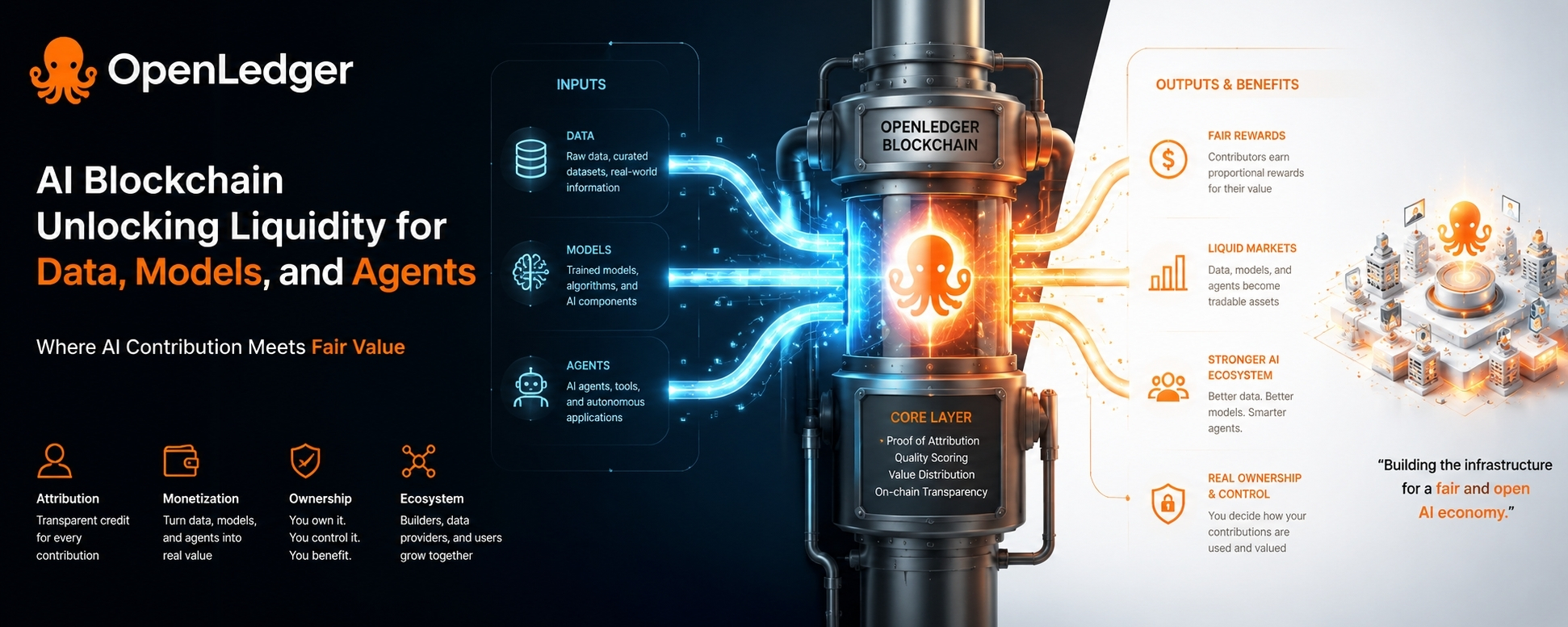

OpenLedger is one of those projects I don’t want to overpraise, because crypto has made that feel embarrassing. But I also don’t want to dismiss it too quickly. The idea is sitting in a part of the market that actually has pain behind it: AI needs data, models need inputs, agents need something useful to work with, and almost nobody who contributes to that machine gets paid properly.
Look, we’ve all seen this movie.
A project says it will reward contributors. Then the farmers arrive.
Wallets multiply. Bots show up. Fake activity looks real for a few months. People do tasks they don’t care about for points they hope turn into tokens. The actual users get buried under noise, and by the time the token launches, everyone is arguing about allocations instead of the product.
That is the trauma.
So when OpenLedger talks about monetizing data, models, and agents, my first thought is not “wow.”
My first thought is: can this survive crypto behavior?
Because the idea itself makes sense. AI is hungry. It eats data, structure, feedback, models, prompts, behavior, and whatever else people throw into the machine. But value does not flow back cleanly. Most contributors disappear into the background. Their work becomes part of something bigger, then someone else captures the upside.
That feels wrong.
And it is not some imaginary Web3 problem. It is real.
The thing is, fixing it is ugly.
OpenLedger seems to be trying to build the plumbing for that. Not the shiny part. Not the influencer part. The under-the-hood layer where contributions can be tracked, priced, and rewarded. Data has value. Models have value. Agents may have value too, if they stop being glorified bots with fancy names.
But proving who created value is the hard part.
Honestly, that is where I get stuck.
AI attribution sounds nice until you think about how messy models actually are. A model does not always use one clean piece of data and produce one clean result. It absorbs patterns. It blends inputs. It gets better or worse in ways that are not always easy to measure. So if OpenLedger wants to reward contributors fairly, it has to deal with a nasty question: who actually mattered?
Not who uploaded the most.
Not who farmed the hardest.
Who mattered.
That is a brutal thing to measure.
And crypto usually measures the easy stuff. Transactions. Volume. Wallets. Tasks completed. Bridges used. Quests clicked. We already know how that ends. Fake users everywhere. Inflated numbers. Dashboards full of activity that disappears the moment rewards slow down.
So OpenLedger has to avoid becoming another reward machine dressed up as infrastructure.
That’s the part that worries me.
But there is something here.
The AI world is getting more closed. More controlled. More centralized. Big companies have the models, the data, the compute, the users, and the distribution. Smaller contributors can help build the system and still end up invisible. That is not sustainable forever. At some point, people will ask why their data, work, or models are feeding someone else’s machine without any real ownership.
OpenLedger is trying to answer that.
Maybe not perfectly.
Maybe not soon.
But the question is worth asking.
I don’t think the interesting part is “AI blockchain.” That phrase is already tired. The interesting part is whether OpenLedger can make contribution less invisible. Whether it can turn the hidden work behind AI into something trackable enough to reward. Whether it can make data and models part of an actual economy instead of just raw material for whoever has the biggest server bill.
That would matter.
But it has to work in the real world.
Not just in diagrams.
Not just in docs.
Not just during token hype.
The token also has to earn its place. OPEN cannot just be there because every crypto system needs a coin attached to it. If it is used for fees, rewards, access, or coordination, fine. But those things only matter if the network itself becomes useful. Otherwise, it becomes another token with “utility” written beside it while everyone quietly treats it like a bet.
We’ve seen that too many times.
Utility on paper is cheap.
Demand is hard.
The user experience has to be simple enough that builders don’t hate it. Data contributors need to believe they are being treated fairly. Model builders need a reason to plug in. AI users need to get something better out of it, not just a more complicated version of what already exists.
Because nobody cares about infrastructure until it breaks.
That’s the truth.
People care when gas is insane. When bridges fail. When airdrops reward bots. When real users get nothing. When systems feel rigged. When the backend mess starts hurting the front-end experience.
OpenLedger is dealing with one of those backend messes.
AI value is being created in unclear ways, by unclear contributors, with unclear rewards.
Messy.
But important.
And maybe that is why I can take OpenLedger more seriously than the average AI token trying to sound intelligent. It is not just saying “agents” and expecting applause. It is touching the boring layer that decides who gets credit, who gets paid, and whether the AI economy becomes even more extractive than the current internet.
Still, I would not call it safe.
It is hard to build.
It might take time.
It might attract the wrong users first.
It might struggle to prove real adoption beyond incentives. It might face the same problem every crypto network faces: too many people chasing rewards, not enough people creating lasting value.
That is the risk.
But at least the risk is attached to a real problem.
OpenLedger feels like one of those projects where the idea is easy to respect, but the execution has to be watched closely. If it becomes useful plumbing for AI data, models, and agents, then it could matter. Quietly. Slowly. Without needing to scream about changing the world.
If it becomes another farm, then it will fade like the rest.
Look, maybe it works, maybe it doesn’t.
But I understand why it exists.
And in this market, that is already more than I can say for a lot of things.