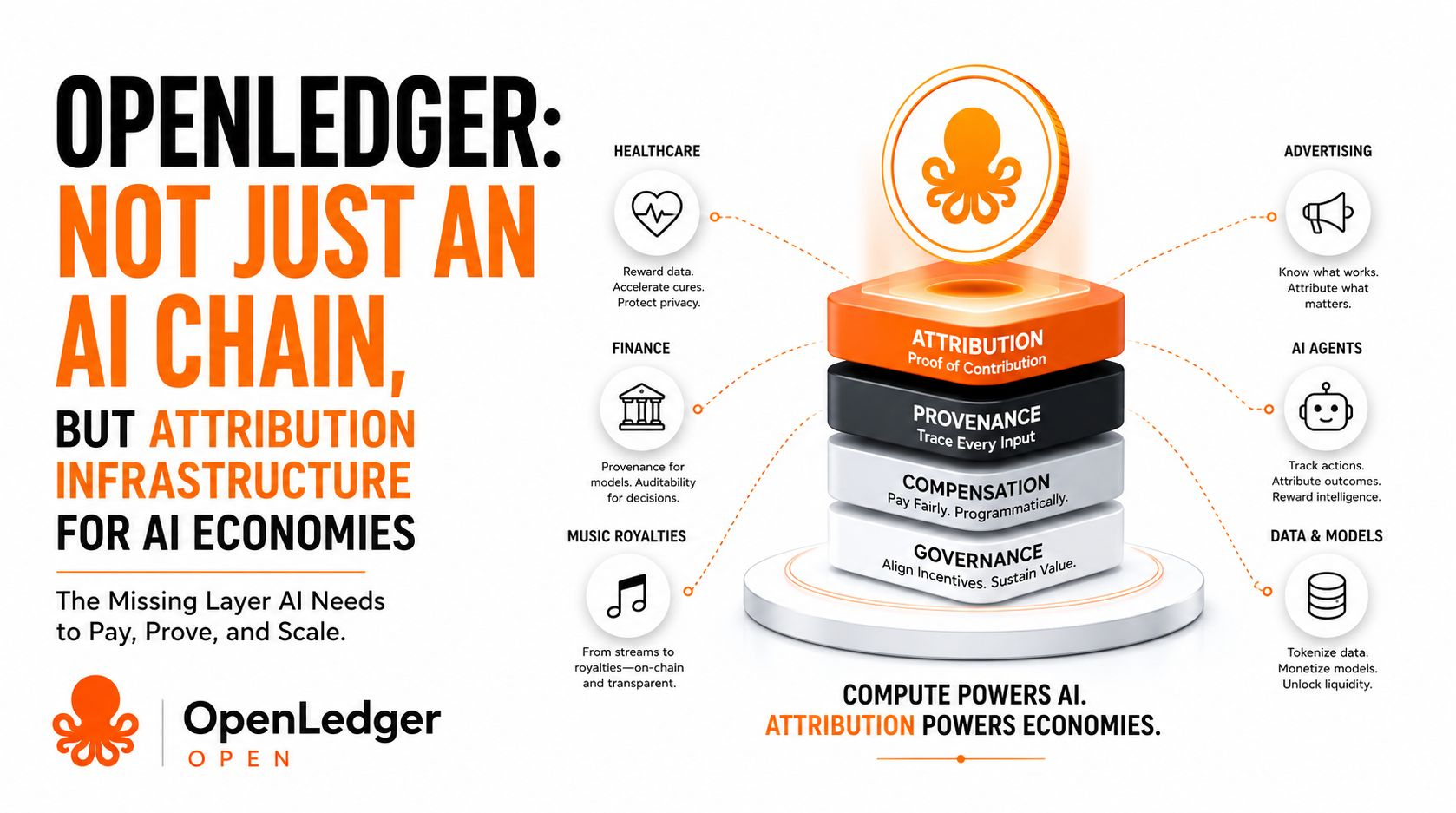
The more interesting interpretation is that OpenLedger is trying to build attribution infrastructure an accounting layer for AI economies. Not faster inference. Not cheaper GPUs. A system that attempts to answer a harder question:
Who created value inside an AI workflow and who gets paid?
For most of the AI cycle, the industry’s obsession has been compute.
More GPUs. Bigger clusters. More tokens processed per second.
But compute scales. Attribution doesn’t.
And attribution may end up being the scarcer economic primit
The hidden bottleneck: AI doesn’t know how to pay people
Today’s AI stack is surprisingly primitive economically.
Data enters. Models train. Outputs generate revenue.
But contribution accounting is mostly broken.
Training sets are opaque. Fine-tuning layers blur ownership. Retrieval systems remix external sources. Agent workflows chain outputs across dozens of components.
Everyone benefits.
Nobody can cleanly prove who deserves what.
OpenLedger explicitly positions itself around on-chain tracking of datasets, training actions, model deployment, rewards, and what it calls Proof of Attribution.
That sounds niche until you map it to real industries.
Healthcare: the data paradox
Healthcare doesn’t suffer from a shortage of medical data.
It suffers from an inability to coordinate incentives.
Hospitals own records. Researchers build models. Patients generate underlying value.
Yet compensation rarely flows proportionally.
If a radiology model trained on thousands of contributed datasets becomes commercially valuable, the payment path is almost never granular.
Attribution infrastructure asks a different question:
Could every model improvement carry a traceable economic lineage?
Not because morality demands it.
Because markets eventually demand accounting.
Advertising: AI knows conversion, not contribution
Advertising already operates as an attribution machine.
But AI complicates it.
An AI campaign may involve:
synthetic creative generation
historical customer datasets
optimization models
agentic execution layers
post-processing systems
Who produced the lift?
Current systems approximate.
Attribution-native systems try to measure.
That distinction matters because once AI starts autonomously spending budgets, capital allocation becomes inseparable from auditability
Finance: provenance becomes risk infrastructure
Finance has tolerated black boxes only up to a point.
If AI agents recommend loans, allocate portfolios, or execute treasury decisions, firms eventually need to answer:
Why did this happen?
Where did the signal originate?
Can contributors be audited?
OpenLedger’s design emphasis on provenance and traceability pushes toward that direction rather than pure compute provision.
The thesis isn’t “AI on-chain.”
It’s “AI with receipts.”
Music royalties: the closest analogy
Music may actually be the best mental model.
Streaming didn’t create music.
It created programmable distribution and royalty accounting.
AI could face the same transition.
Models increasingly resemble creative economies:
data contributors = songwriters
model builders = producers
inference layers = distributors
users = listeners
The unsolved layer is royalty routing.
If AI outputs become monetizable, attribution becomes less like analytics and more like publishing rights infrastructure.
Reframing $OPEN: less compute token, more economic ledger
Most AI tokens are valued like future GPU businesses.
That creates a problem.
Compute tends toward commoditization.
Cloud markets compress margins.
Hardware advantages decay.
OpenLedger’s more ambitious bet is different.
$OPEN appears designed to coordinate attribution, governance, usage fees, contributor rewards, and model economics across the lifecycle of AI interactions rather than simply paying for execution.
In that framing:
Gas becomes accounting overhead.
Inference payments become royalty streams.
Governance becomes policy over value distribution.
Rewards become programmable compensation.
That changes the valuation narrative.
The question stops being:
> How much inference runs?
And becomes:
> How much economic activity needs attribution?
If AI becomes a network of agents, datasets, and models transacting with one another, provenance itself could become an asset class.
But this thesis can fail
There are reasons to stay skeptical.
First, attribution is brutally difficult.
Modern models don’t consume data linearly. Contributions interact. Influence changes over time. Perfect causal accounting may be mathematically impossible in many systems.
Second, adoption friction is real.
Developers optimize for speed and usability, not philosophical fairness.
Third, token demand may not persist.
A protocol can create attribution without necessarily creating durable token capture.
Fourth, there’s a danger of measuring what’s measurable rather than what’s valuable.
Over-engineered accounting systems sometimes become bureaucratic layers instead of productive infrastructure.
Even OpenLedger’s own framing of attribution and compensation assumes that usage can be tracked and rewarded meaningfully at scale — an idea that remains early and unproven.
So the contrarian view is not:
OpenLedger wins.
It’s narrower.
The market may be pricing AI as a compute problem when the harder long-term problem is economic coordination.
If AI turns into an economy rather than a product, the biggest winners may not be the chains that execute intelligence.
They may be the systems that keep score.