
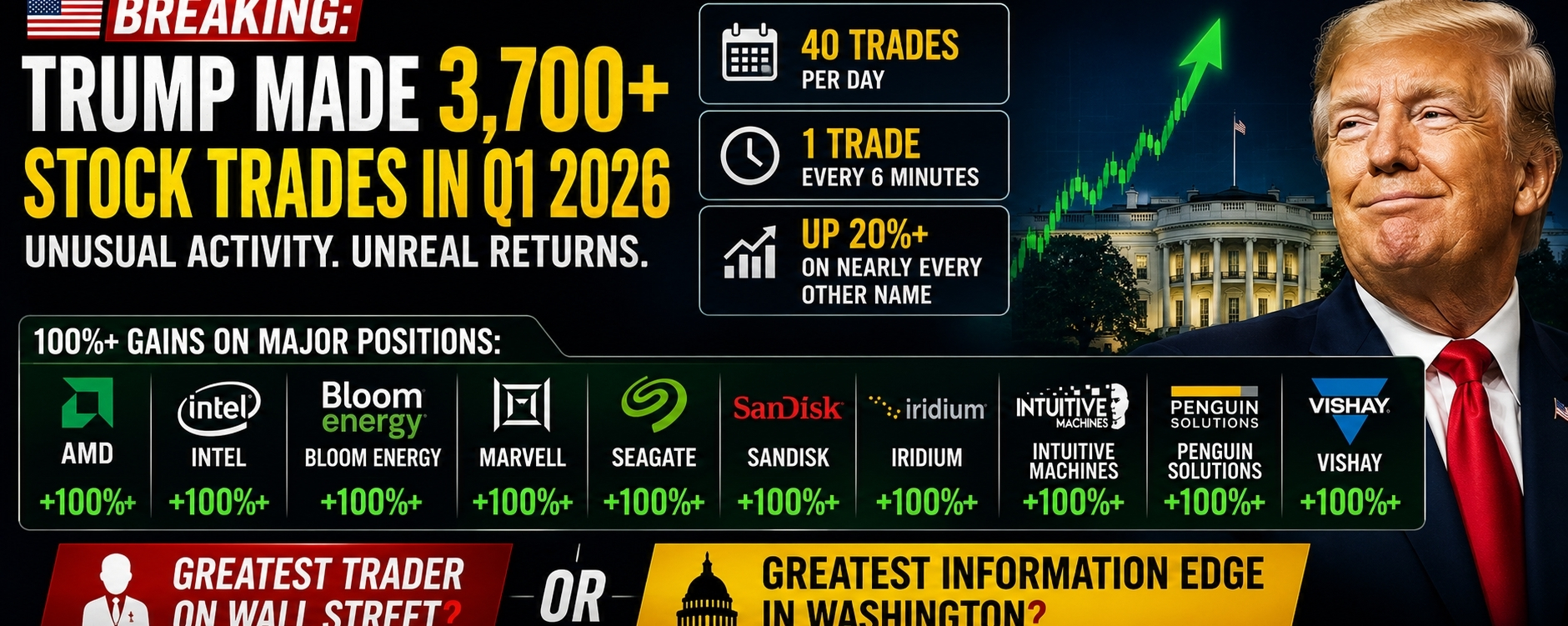

Over the past few hours, I’ve been looking at numbers that honestly feel difficult to ignore. Reports claim Donald Trump made more than 3,700 stock trades in Q1 2026 alone—roughly 40 trades per day, or one every few minutes during market hours. From my perspective, that’s not normal activity for a political figure. That’s hedge-fund-level intensity.
What stands out to me even more is the performance. Positions in companies like Advanced Micro Devices, Intel, Bloom Energy, Marvell Technology, and others reportedly delivered gains above 100%, while many remaining positions were up significantly as well. And interestingly, most of these companies operate in sectors directly tied to government priorities—AI infrastructure, semiconductors, energy, defense, and communications.
From where I’m standing, this naturally raises questions. Are these simply incredibly timed trades? Or does proximity to policy create an informational advantage that ordinary investors simply don’t have access to? Because when performance repeatedly aligns with sectors connected to administration priorities, people are going to notice.
Another thing I’m noticing is how this reflects the growing overlap between politics, markets, and strategic industries. Today, government decisions can move entire sectors instantly—especially chips, AI, defense, and energy. That means anyone positioned correctly before policy shifts can generate enormous returns very quickly.
At the same time, I think it’s important to stay balanced. Strong performance alone doesn’t prove wrongdoing. Markets are driven by trends, narratives, and positioning, and experienced traders can absolutely outperform during volatile periods. But the scale, frequency, and timing here make the conversation unavoidable.
From my perspective, the key takeaway is simple:
This isn’t just about trading profits—it’s about access and influence.
Because in modern markets, information has become one of the most valuable assets in the world.
And when politics, policy, and capital start overlapping this closely,
people stop asking whether trades were smart…
and start asking what made them possible.