
I didn’t think ERC 4626 would end up being one of the most interesting parts of @OpenLedger AI vision. To be honest, when most people hear vault standard, their eyes glaze over instantly. Mine usually do too. Crypto has a habit of turning infrastructure into background noise while all the attention flows toward whatever looks futuristic on the surface. AI agents get attention. Autonomous systems get attention. Fancy dashboards get attention. Standardized financial rails usually don’t.
But the more I read #OpenLedger , the more I started feeling like the ERC 4626 integration might quietly be one of the smartest decisions in the entire ecosystem.
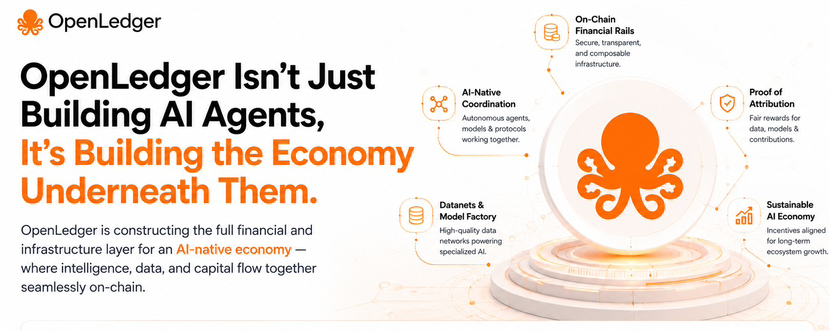
What changed my perspective was realizing $OPEN isn’t trying to build AI tools floating independently above DeFi. The protocol keeps describing an AI native economy where models, agents, contributors, validators, and applications interact continuously through on chain incentives. Once I started viewing the ecosystem that way, the need for standardized liquidity infrastructure suddenly felt obvious. If AI systems are going to coordinate capital, route value, execute transactions, and operate across decentralized environments, the rails underneath probably matter more than the interface users see on top.
That thought stayed in my head longer than I expected.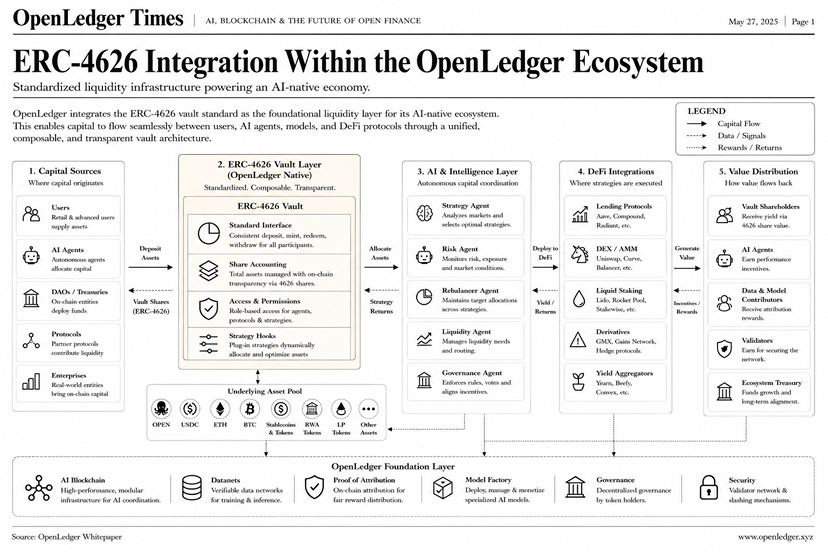
I started noticing how fragmented most DeFi infrastructure still feels today. Even experienced users jump through multiple protocols just to manage positions efficiently. Yield aggregation, vault management, liquidity movement, strategy execution, everything feels patched together manually. Humans compensate for the inefficiency because humans are adaptable. But autonomous systems don’t operate comfortably inside fragmented environments. They need consistency. Predictable standards. Clear accounting structures. Composable liquidity layers.
That’s where ERC 4626 suddenly stopped feeling boring to me.
The standard itself isn’t flashy. It simply creates a consistent framework for tokenized vaults and yield bearing assets. But maybe that simplicity is exactly why it matters so much inside OpenLedger’s long term vision. It is about specialized intelligence, AI agents, inference payments, and economically coordinated systems. None of that scales smoothly if liquidity management remains chaotic underneath. AI coordination eventually requires financial coordination too.
And financial coordination only works when systems can reliably communicate with each other.
I think that’s the part many people still underestimate when they talk about AI in crypto. Intelligence alone doesn’t create functioning economies. Infrastructure does. You can build the smartest agent in the world, but if capital movement, vault logic, and yield structures remain fragmented, the system eventually bottlenecks itself operationally. Reading OpenLedger’s architecture started making me think less about AI outputs and more about the invisible systems quietly supporting those outputs underneath.
That shift honestly changed how I interpreted the project.
The interesting thing is how naturally ERC 4626 connects back into OpenLedger’s broader ecosystem design. The whitepaper already frames inference itself as an economic activity. Models generate value. Contributors receive attribution rewards. Validators participate in securing the network. Agents execute tasks and interact with applications. Once those interactions become continuous, liquidity stops being passive infrastructure and starts becoming part of the intelligence layer itself.
That idea feels strange at first, but the more I sit with it, the more logical it becomes.
To be honest, I’m still skeptical about parts of the broader AI agent narrative across crypto. Markets are unpredictable, emotional, and constantly shifting. I don’t think autonomous systems magically solve that. But I also think people sometimes misunderstand what AI coordination actually means. Maybe the goal isn’t replacing humans entirely. Maybe it’s reducing friction between systems, capital, and decision making so the ecosystem itself operates more efficiently over time.
That version feels much more believable to me.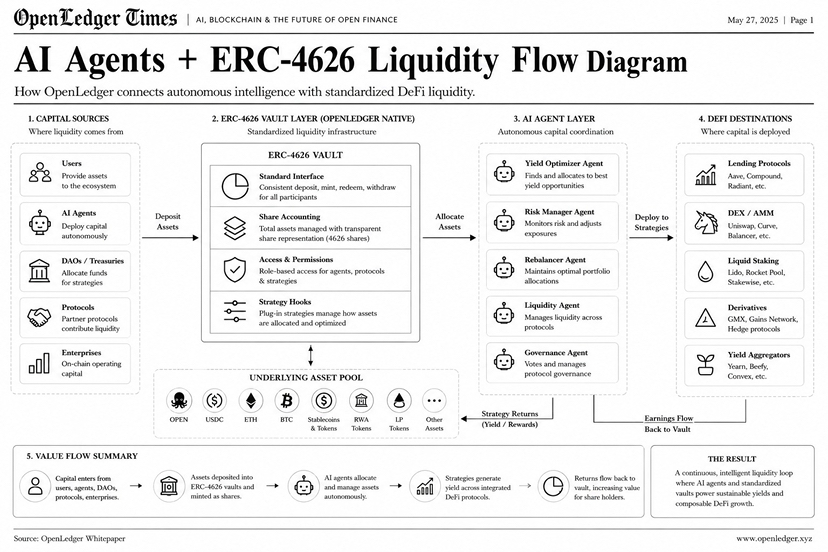
I also quietly respect that OpenLedger seems willing to focus on infrastructure before chasing surface level excitement. Most projects optimize for visibility first. OpenLedger’s architecture feels slower, more interconnected, and honestly more deliberate. Datanets connect into attribution. Attribution connects into incentives. Incentives connect into agents and models. Then suddenly ERC 4626 appears, and instead of feeling random, it feels like another structural layer reinforcing the same economic vision from underneath.
That cohesion is rare in crypto right now.
Maybe that’s why the integration stayed in my mind longer than I expected. Not because ERC 4626 itself is revolutionary, but because of what it suggests about how OpenLedger sees the future. The protocol doesn’t seem to view AI as a separate vertical sitting beside DeFi. It seems to view AI and finance as eventually becoming intertwined systems where intelligence coordinates capital continuously in the background.
And if that future actually arrives, standardized financial rails probably become far more important than most people realize today.