
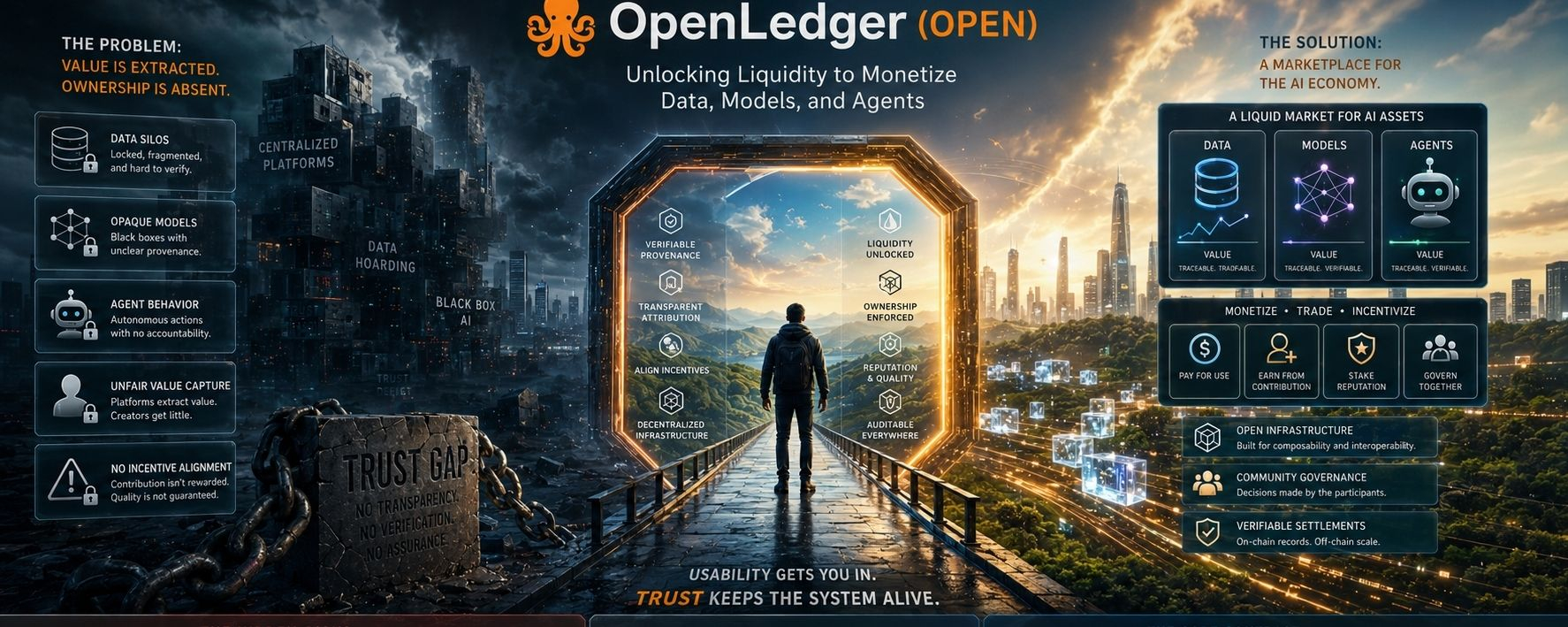
I have a hard time trusting anything that arrives already wrapped in a perfect narrative.
“AI blockchain” is one of those phrases that immediately raises the eyebrows, not because there is nothing there, but because it usually arrives with too much confidence and too little friction. OpenLedger (OPEN), with its promise of unlocking liquidity and turning data, models, and agents into monetizable assets, sounds like the kind of idea that should have been inconvenient, messy, and a little embarrassed to introduce itself. Instead, it comes dressed as a solution. That alone is reason enough to pause.
And yet, to be fair, there is a smart idea buried in the pitch.
There really is something compelling about trying to create a market structure around the things AI already depends on: data, model access, agent behavior, provenance, attribution, usage rights. Those are not abstract buzzwords. They are the raw materials of a system that increasingly runs on invisible labor and opaque inputs. If OpenLedger is trying to make those inputs legible, tradable, and traceable, that is not a trivial ambition. It is, in fact, one of the more intellectually serious responses to a very real problem in AI: value is being extracted everywhere, but ownership is often nowhere to be found.
That part makes sense.
Who would not want a cleaner way to coordinate incentives? Who would not prefer a system in which contributors can be compensated more directly, and users can know more clearly what they are consuming? If the platform can reduce the gap between creation and capture, between contribution and reward, then it is solving a real pain point rather than inventing a decorative one.
But that is also where the unease begins.
Because the deeper question is not whether a system like this is useful in principle. The real question is whether the usefulness survives contact with reality. The words “unlocking liquidity” sound efficient, even elegant. But liquidity for what, exactly? For tokens? For access rights? For model weights? For datasets of uneven quality and uncertain provenance? For agent behavior that can change the moment it encounters a new prompt? Once you move from the clean language of monetization to the ugly mechanics underneath it, the whole thing becomes harder to trust.
And trust is the point.
There is a large difference between making something measurable and making it reliable. There is an even larger difference between making it tradable and making it valuable. The modern tech world is full of systems that are technically elegant but socially fragile. They work beautifully until someone asks the obvious questions: Who verifies the input? Who bears the cost of error? Who audits the provenance? Who decides what counts as legitimate usage? Who is liable when the “agent” is wrong, the model is poisoned, or the data was never clean to begin with?
Those are not edge cases. They are the whole game.
This is the hidden risk in many blockchain-adjacent AI projects: they treat coordination as if it were the main problem, when in practice coordination is often the easy part. The hard part is assurance. Can the system prove that the data is original, the model is correctly represented, the agent is behaving as described, and the economic claim attached to all of it is not merely a glossy abstraction? A market can price almost anything. That does not mean the market is pricing reality.
And there is another problem, one that tends to hide behind the promise of decentralization. When a project says it is building a more open economy around data and models, it often sounds like it is distributing power. But does it really distribute power, or does it simply repackage power into a more complex interface? A system can look participatory while still concentrating control in the hands of those who understand the architecture best. It can look transparent while becoming more difficult to inspect. It can look democratic while actually increasing dependence on the platform itself.
This is the trap of polished infrastructure. The easier it is to use, the more tempting it is to stop asking what is being hidden to make it that easy.
And that is where adoption and assurance part ways.
Adoption is the front-end story. Assurance is the back-end reality. Adoption asks whether people will try it. Assurance asks whether they should trust it. Those are not the same question, even though product teams often speak as if they are. A system that helps people monetize data or coordinate with AI agents may indeed attract attention. But attention is not confidence. Activity is not legitimacy. A thriving interface is not proof that the underlying claims are sound.
What happens when incentives distort behavior? What happens when contributors start optimizing for tokens rather than truth? What happens when model creators package outputs for revenue instead of reliability? What happens when “liquidity” becomes the point, and the quality of the underlying asset becomes secondary? Every financial layer invites speculation, and every speculative layer invites shortcuts. That is not a philosophical objection. It is a structural one.
The deeper concern is that this kind of architecture can make confidence look engineered. It can make trust feel automated. But trust is not something you encode away. It has to be earned, repeatedly, under conditions of uncertainty. If OpenLedger is serious, it must contend with all the ugly questions that make the pitch sound less elegant: How are rights enforced across jurisdictions? How are synthetic or contaminated data sources handled? How are agents assessed when they are non-deterministic? What does it mean to “own” a model in a system where models are increasingly derivative, compositional, and constantly updated?
Those questions matter because the promise here is not small. It is not just a tool. It is an economic grammar for AI. And whenever a project proposes a new grammar, it is quietly asking us to reorganize our assumptions about value, labor, attribution, and control. That is ambitious. It is also dangerous, because the more ambitious the grammar, the easier it is to mistake elegance for truth.
I keep coming back to the same contrast: usability versus trust.
Usability gets the demo. Trust has to survive the second year.
Usability gets the white paper. Trust gets the dispute. Usability wins the launch. Trust wins or loses the ecosystem. And in systems like this, the failures are rarely dramatic at first. They are subtle. A dataset is less clean than advertised. A model’s provenance is harder to verify than assumed. An agent’s actions are harder to attribute than the interface suggests. A tokenized incentive leaks into behavior in ways nobody modeled. Small frictions accumulate. Then one day the platform is still functioning, but the confidence around it has evaporated.
That is the real risk with projects that promise to monetize everything: they can become very good at making value visible before they have proven that value is durable. They can make scarcity look programmable. They can make ownership feel native. They can make liquidity sound like wisdom.
But the oldest rule in technology still applies. If a system depends on trust, and its design makes trust harder to audit, harder to verify, and easier to outsource, then the system is not solving the trust problem. It is decorating it.
That is the warning here.
Not that OpenLedger is obviously wrong. Not that the idea is empty. It is smarter than that. More interesting than that. Which is exactly why it deserves suspicion. The polished versions of difficult ideas are often the ones most likely to hide the difficult parts. And in the end, the question is never whether a platform can make data, models, and agents more liquid.
The question is whether, once the liquidity has been unlocked, anyone still knows what they are actually holding.
