Open AI has a scaling problem that most people still ignore.
Everyone talks about bigger models, faster inference, and smarter agents, but very few talk about the thing that actually powers AI in the first place: data attribution.
While reading about OpenLedger, one idea stood out to me immediately:
AI cannot become truly decentralized if the people contributing data, models, and intelligence are invisible.
Right now, most AI systems operate like black boxes. Data gets collected from everywhere, models get trained behind closed doors, and value flows mostly to centralized companies. The people who actually provide useful datasets or improve specialized models rarely receive transparent recognition or long-term rewards.
That is where OpenLedger’s concept becomes interesting.
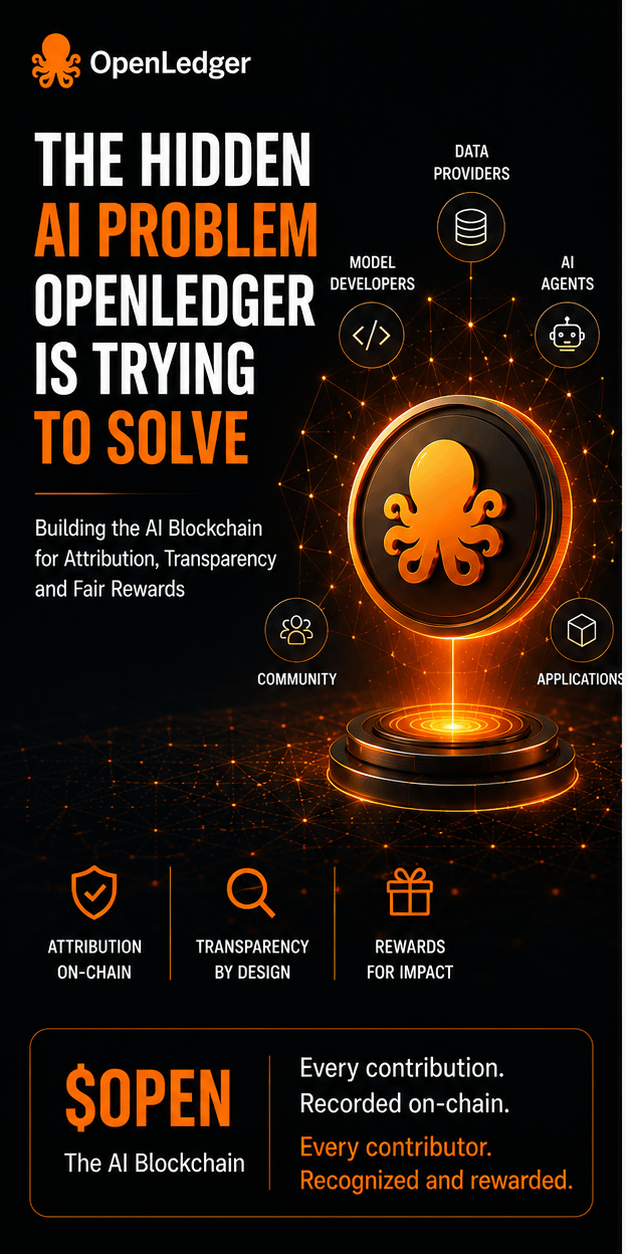
Instead of treating AI as a closed system, OpenLedger introduces the idea of an “AI Blockchain” where every contribution across the AI lifecycle can be recorded on-chain.
Not just transactions. Not just tokens. Actual AI contributions.
Data providers, model developers, and even agent contributors can have provable attribution tied to the value they create. OpenLedger calls this “Proof of Attribution” and honestly, this might be one of the more important concepts for the future of decentralized AI.
Because specialized AI needs specialized data.
A medical model cannot improve without healthcare datasets. A trading model cannot evolve without market behavior data. A gaming AI cannot adapt without player interaction patterns.
But high-quality data does not appear magically. People create it, refine it, organize it, and maintain it. Without incentives, the pipeline eventually weakens.
What OpenLedger seems to understand is that attribution is not just about fairness. It is infrastructure.
If contributors can prove ownership and impact, then AI development becomes more transparent, traceable, and economically sustainable. Instead of extraction, you get participation.
And this changes something bigger:
AI shifts from being controlled by a few centralized entities into a collaborative economy where value can flow back to contributors directly.
That is the part I think many people are underestimating.
Most discussions around AI + crypto focus only on hype cycles, agents, or token narratives. But infrastructure for attribution, provenance, and accountability may end up becoming one of the most important layers of the entire AI economy.
Because eventually, the question will not just be: “What can AI generate?”
It will become: “Who contributed to the intelligence behind it, and how are they rewarded?”
That is the problem OpenLedger is trying to solve with $OPEN .
And honestly, after reading deeper into the whitepaper, it feels less like another AI token and more like an attempt to redesign the economic layer of AI itself. @OpenLedger #OpenLedger