
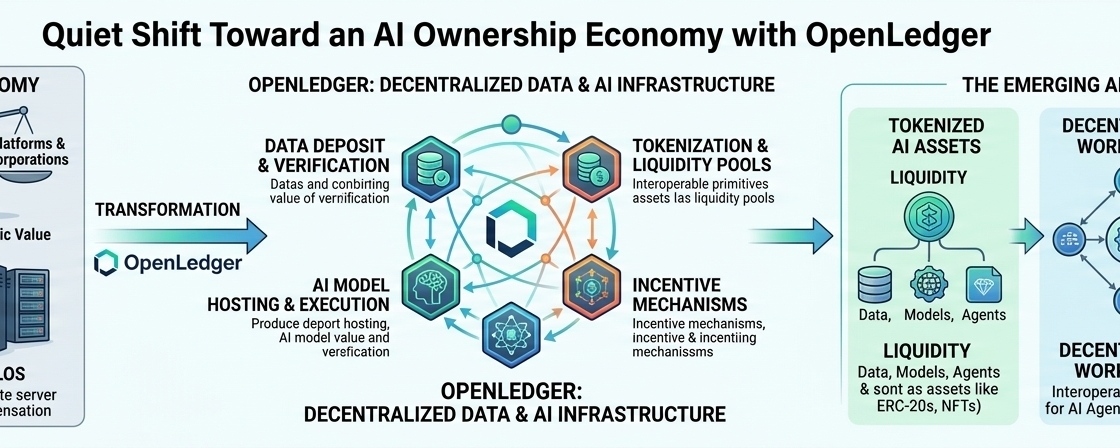

I still remember the phase when every crypto project suddenly became “AI-powered” overnight. You’d open X, scroll for two minutes, and see another token promising intelligent agents, autonomous systems, or decentralized intelligence layers. Most of it felt strangely empty. Fancy language. Huge diagrams. Very little clarity about where actual value was supposed to come from.
That’s probably why OpenLedger caught my attention differently.
Not because it shouted louder than everyone else. Honestly, it was the opposite. The idea felt more grounded than most AI narratives floating around crypto lately. Instead of treating AI like some magical black box, OpenLedger seems focused on something people usually ignore until it becomes a problem data ownership and liquidity.
And maybe that sounds less exciting at first. But the more I thought about it, the more it started making sense.
For years, crypto figured out how to tokenize assets, transfer value, and coordinate communities online. AI, meanwhile, exploded by consuming massive amounts of data and computational resources. But there’s still this awkward gap between the people creating valuable data or models and the systems profiting from them. OpenLedger seems to be trying to close that gap in a blockchain-native way.
What interested me most is the idea of turning data, models, and even AI agents into liquid assets instead of isolated tools sitting behind closed systems. That changes the conversation a bit. Suddenly, contributors aren’t just passive users feeding platforms for free. There’s a possibility of ownership layers forming around intelligence itself.
I remember when DeFi first started unlocking idle capital. Before that, crypto mostly felt static to me. Coins just sat in wallets. Then lending, liquidity pools, and staking appeared, and capital became productive. OpenLedger gives me a similar feeling except the asset here isn’t only money. It’s information, models, and machine intelligence.
That feels strange to type out honestly.
Because we’re entering a period where data may become one of the most contested assets online. AI systems need it constantly. Fresh data. Behavioral patterns. Specialized information. But most people contributing that value still don’t really participate economically. OpenLedger seems to recognize that imbalance instead of pretending it doesn’t exist.
I’ve also noticed something else in crypto lately. Infrastructure projects are becoming harder to explain casually, but sometimes those are the ones that quietly matter the most over time. Meme coins can dominate attention for weeks, maybe months, but infrastructure usually determines where ecosystems actually settle later.
Still, I’m not fully convinced the market understands how to price AI blockchains yet.
Sometimes it feels like investors are throwing “AI” into the same speculative bucket without separating actual utility from narrative momentum. Maybe I’m overthinking it, but there’s probably a huge difference between projects using AI as branding and projects genuinely restructuring how AI economies function.
OpenLedger seems closer to the second category.
The liquidity angle is especially interesting because liquidity changes behavior. When assets become transferable and composable, entirely new ecosystems appear around them. We saw that with ERC-20s. We saw it with NFTs despite all the noise around that cycle. If AI models and agents eventually become tradable, interoperable primitives, then blockchain infrastructure suddenly becomes much more relevant to AI development itself.
That possibility keeps sitting in the back of my mind.
At the same time, there are obvious questions. Scalability is one. Incentive design is another. And honestly, crypto hasn’t always been great at handling systems that rely heavily on real-world quality contributions. Token rewards can attract participation fast, but maintaining meaningful participation over time is harder. A lot harder.
I wonder how OpenLedger balances openness with quality control as the ecosystem grows.
Because AI systems are only as useful as the data and models feeding them. If incentives become distorted, the network could easily drift toward quantity over usefulness. We’ve already seen similar issues in parts of Web3 where farming rewards became more important than creating value.
But maybe the timing for this kind of infrastructure is finally right.
AI has moved beyond being a niche tech conversation now. It’s everywhere. Developers are building agents. Companies are integrating language models into workflows. Retail users interact with AI daily without even thinking about it anymore. The demand for decentralized alternatives or complementary systems probably grows naturally from there.
And crypto has always been oddly good at experimenting with ownership structures before traditional systems catch up.
Another thing I appreciate is that OpenLedger doesn’t seem obsessed with replacing AI companies outright. That narrative usually feels unrealistic to me. Centralized AI labs have enormous resources and talent concentration. But blockchain networks don’t necessarily need to replace them to matter. They can create parallel incentive systems that solve different problems.
That distinction matters.
I also think people underestimate how important monetization layers are for future AI ecosystems. Everyone talks about model performance, speed, and capabilities. Fewer people talk about who gets rewarded for contributing knowledge or training inputs over time. Yet that economic layer might become one of the defining issues of the AI era.
Crypto naturally gravitates toward those questions because tokenized systems force value distribution into the open.
There’s also something psychologically interesting happening here. For years, users got comfortable giving platforms unlimited data for free because the tradeoff felt invisible. Now AI makes that exchange more obvious. Suddenly people realize their inputs are helping train systems with massive economic value attached to them.
That awareness changes things.
Or maybe it will. I’m not entirely sure yet.
The market moves so fast that it’s easy to mistake short-term attention for long-term importance. Some AI narratives will disappear quietly after speculation cools down. Others will evolve into infrastructure people rely on without even noticing. Right now it’s difficult to tell which category projects belong to.
OpenLedger sits in an interesting position because it touches multiple themes at once AI, ownership, liquidity, coordination. Sometimes that overlap creates opportunity. Sometimes it creates confusion.
I guess that uncertainty is part of why I keep watching projects like this instead of instantly forming strong opinions. Crypto usually looks messy before it looks obvious. People laugh at concepts for months until suddenly they become normal.
I remember that happening with stablecoins. With DeFi. Even with staking.
So when I look at OpenLedger, I’m less interested in whether the market gets excited this week or next month. I’m more curious about the broader direction it points toward. A future where intelligence itself becomes economically networked feels both fascinating and slightly uncomfortable at the same time.
Maybe that tension is exactly why it matters.
