
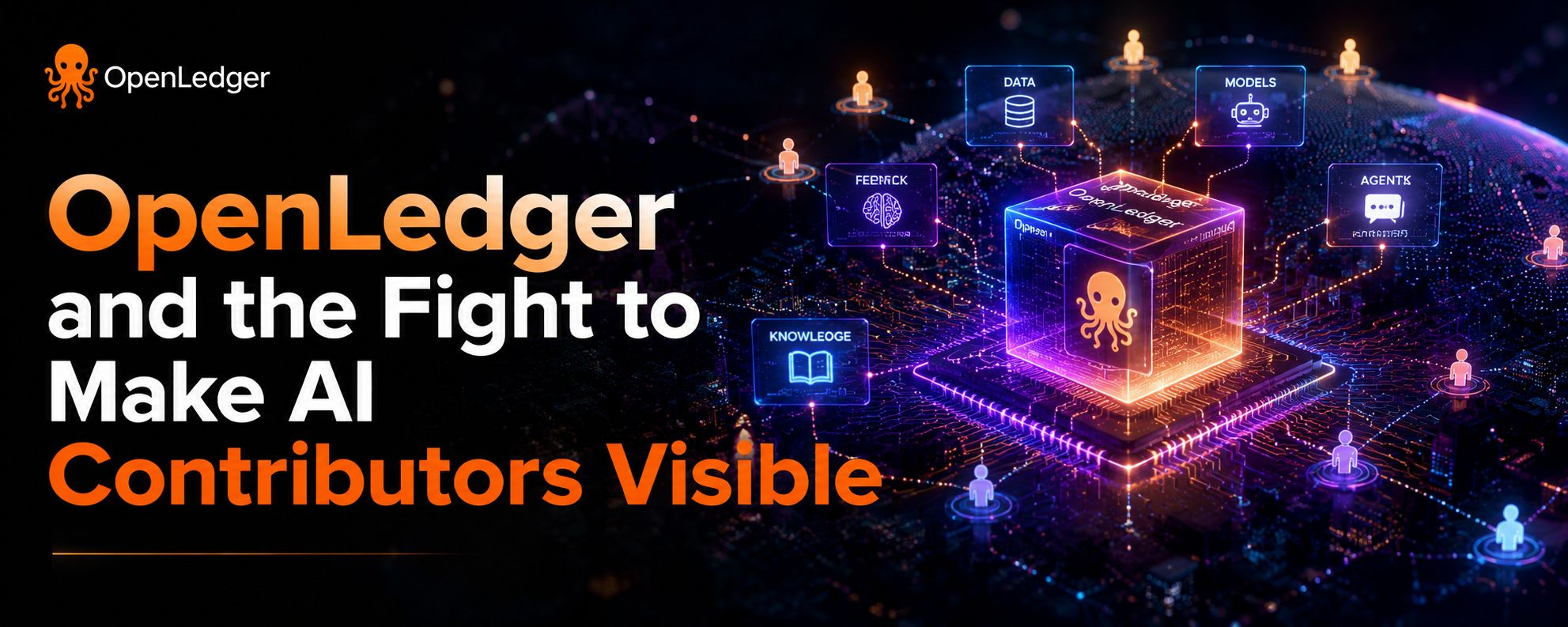

I keep coming back to one uncomfortable thought whenever I look at the AI industry: almost everyone getting paid is standing at the front of the machine, while most of the people creating the machine’s value are buried somewhere behind the walls.
A user opens an AI app, types a question, gets an answer in seconds, and leaves impressed. The product earns revenue. The model provider gains attention. The interface becomes the brand people remember. But the deeper you look, the stranger the system starts to feel. The answer did not appear from nowhere. It came from datasets collected over years, niche expertise written by people nobody credits, feedback loops built by communities, and information refined by thousands of invisible contributors who usually receive nothing after the model becomes commercially useful.
That is why OpenLedger caught my attention.
Not because it calls itself an AI blockchain. Honestly, that phrase has almost lost meaning at this point. Every other project wants to attach itself to AI. What makes OpenLedger different is that it seems less obsessed with selling intelligence and more obsessed with tracing where intelligence actually comes from.
That sounds subtle, but I think it changes the entire conversation.
Most AI companies behave like restaurants that only charge for the final dish while pretending ingredients magically appeared in the kitchen for free. OpenLedger feels like an attempt to build the accounting system behind the kitchen. Who supplied the ingredients? Which ones mattered most? Which sources keep getting used? Who deserves a cut every time the system creates value?
The project’s idea around Datanets is where this becomes interesting to me. Instead of treating datasets as disposable fuel for training, OpenLedger frames them almost like productive digital infrastructure. A dataset is not just something uploaded once and forgotten. It can continuously contribute to models, retrieval systems, and agents while staying economically linked to the network.
That changes the emotional relationship people have with data.
Right now, most contributors upload information into AI systems with the same feeling people used to have posting content onto early social platforms. Maybe it helps. Maybe it disappears. Maybe someone else monetizes it later. OpenLedger is trying to turn contribution into ownership instead of sacrifice.
And honestly, that feels timely.
The AI industry keeps talking about bigger models, but I think the real scarcity is becoming high-quality context. General intelligence is getting cheaper very fast. What is becoming expensive is trustworthy, specialized, constantly updated information. A model can sound intelligent about almost anything now, but sounding informed and actually being informed are different things.
That gap matters.
A medical assistant, a legal agent, or a financial AI tool cannot survive on generic internet noise forever. Eventually these systems need reliable inputs from people who actually know what they are talking about. The question is whether those people will continue giving away their knowledge for free while billion-dollar AI layers build on top of it.
OpenLedger’s Proof of Attribution feels like an attempt to answer that tension before it becomes a crisis.
The idea is simple on the surface: if your data, model contribution, or retrieval source helps generate value, the system should be able to recognize that contribution and reward it. But underneath that is a much bigger philosophical shift. OpenLedger is treating intelligence less like a single product and more like a supply chain.
That framing makes more sense to me than the usual “decentralized AI” pitch.
When people talk about AI, they usually imagine one giant brain. In reality, modern AI looks more like logistics. Information moves between datasets, retrieval layers, models, inference systems, agents, and users. Most of the economic value gets captured at the final interaction point, even though the system depends on a huge network of upstream contributors.
OpenLedger seems to be asking: what if those upstream layers stopped being invisible?
Its recent progress matters because the project is no longer operating purely as an idea. The move toward mainnet infrastructure and live attribution systems means OpenLedger is entering the dangerous phase where theories collide with reality. That is where projects become interesting. Not when they announce visions, but when they try to operationalize them.
And to be clear, this is not an easy problem.
Attribution inside AI is messy. Data influence is difficult to measure cleanly. A useful answer may come from dozens of overlapping sources. Some information shapes training quietly in the background while other information directly influences retrieval during inference. There is no perfect formula that can calculate contribution with total fairness.
But maybe perfection is not the point.
Right now, the AI economy barely even attempts fairness at the input layer. The current system behaves as if valuable data should simply be grateful to participate. OpenLedger is at least trying to build a structure where contribution remains economically visible after intelligence gets packaged into products.
That could become more important than people realize.
Because eventually AI stops being impressive and starts becoming infrastructure. And once something becomes infrastructure, questions about ownership, incentives, and compensation become unavoidable. We already saw this happen with the internet itself. Early internet culture was built on free contribution and optimism. Then platforms consolidated value while contributors fought for scraps of visibility.
AI feels like it is heading toward the same tension.
The projects that survive long term may not be the ones with the loudest demos or the most cinematic AI agents. They may be the ones that solve the uncomfortable economic questions underneath the industry. Who gets paid? Who owns contribution? Who controls context? Who captures the upside when intelligence becomes scalable?
That is why I think OpenLedger is more interesting than it first appears.
It is not really trying to sell people a smarter chatbot. It is trying to build economic memory for AI systems. It wants intelligence to remember where it came from.
And honestly, that idea feels more important than another marginal improvement in model performance.
Because the future AI economy probably does not fail from lack of intelligence. It fails when the people producing valuable inputs realize the system has no meaningful way to recognize them. Once that happens, high-quality information becomes harder to access, more fragmented, and increasingly privatized.
OpenLedger is betting that the next phase of AI will not just be about generating answers faster. It will be about building systems that can finally track, price, and reward the invisible work hiding behind those answers.
That is a much harder problem than building another AI interface.
But it is also a much more important one.