
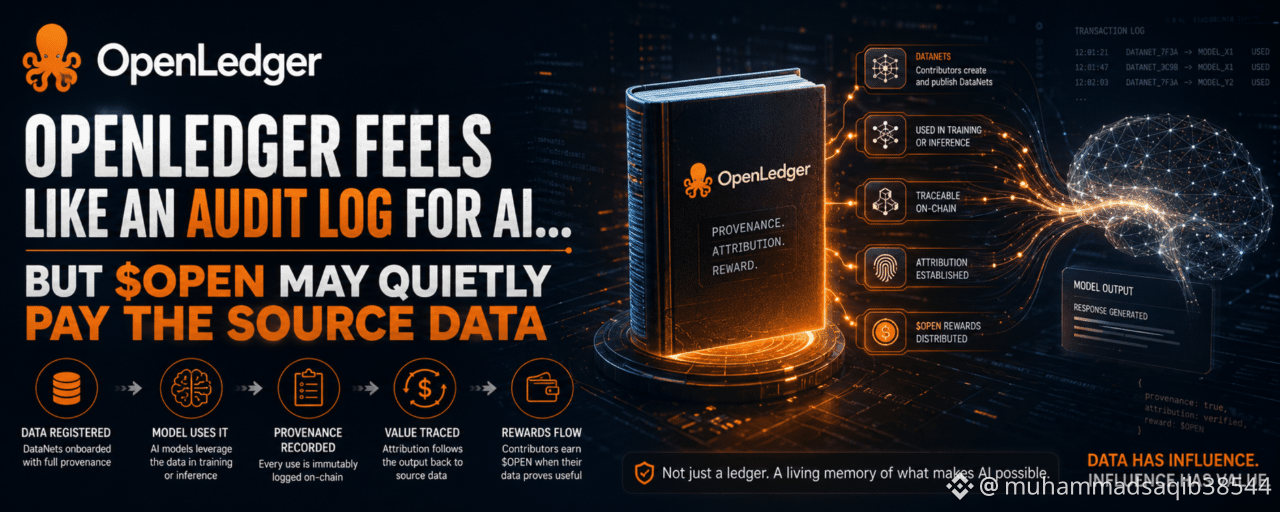
I didn't notice it at first. OpenLedger looked like one more AI project that had wrapped itself in a cleaner and a sharper promise.
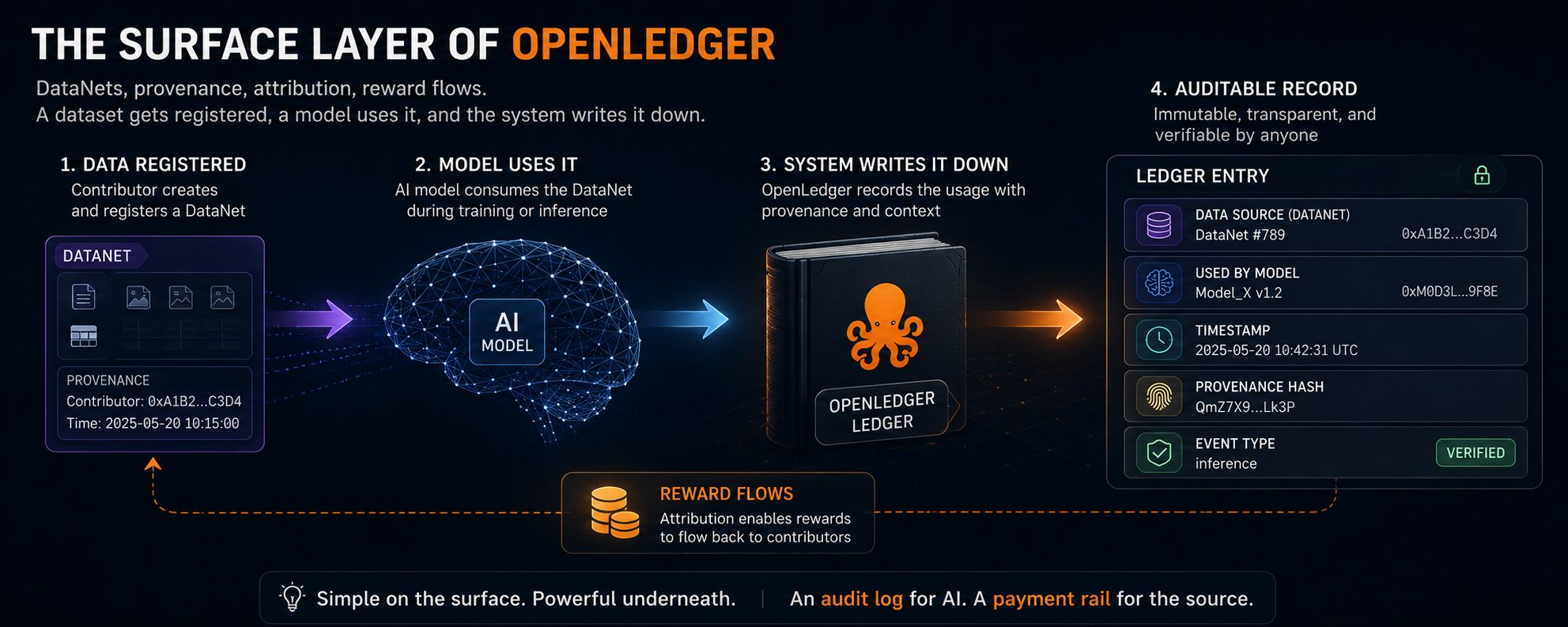
The first thing I saw was the surface layer. DataNets, provenance, attribution, reward flows. It all sounded orderly enough, almost familiar if you have watched enough infrastructure projects try to make machine learning feel legible.
What stayed with me was how ordinary it seemed at the start. A dataset gets registered, a model uses it, and the system writes it down. Nothing dramatic. Just a ledger with a more ambitious name than most.
Then I watched two contributors build DataNets that looked similar enough to be interchangeable. Same kind of structure. Same kind of effort. Yet one kept appearing in downstream traces while the other barely moved.
That was where the friction started. It felt slightly uneven in a way that had nothing to do with visible quality on the front end. The difference was not about who posted more or who arrived earlier. It was about which data became useful later, and whether the system could actually see that usefulness when the model answered someone else.
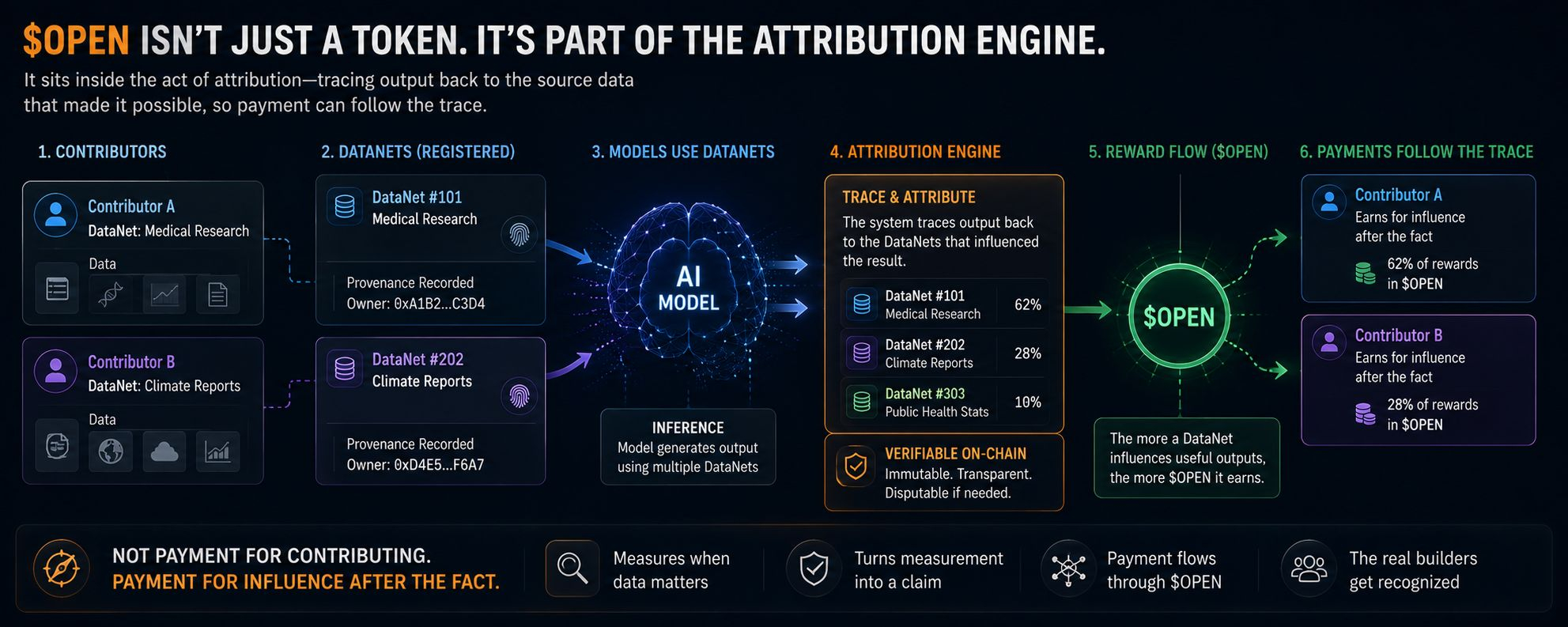
I’m not fully convinced yet, but that is where OPEN started looking different to me. It doesn’t seem to sit on top of the AI stack as a decorative token. It sits inside the act of attribution itself, where output is traced back to the data that made it possible and payment can follow that trace.
That changes the mood of the whole thing. Once I started thinking in those terms, the registry stopped feeling like a filing cabinet and started feeling like a memory system. Not a static archive. Something closer to a live record of which inputs keep resurfacing inside inference.
It also makes the contributor side feel less like a one time upload and more like a long, uncertain wager. A DataNet can be well made and still stay quiet. Another can be messier and keep showing up because the model keeps leaning on it. I’m not sure if that is intentional or just an emergent effect of the design, but it is hard to ignore.
And that is the part I keep turning over. OpenLedger is not just saying that data matters. It is trying to measure when data matters, then turn that measurement into a claim. That feels more structural than a normal reward system, because the reward is not attached to the act of contributing. It is attached to influence after the fact.
That starts to feel like a different kind of market altogether. Not a market for storage. Not even a market for access. More like a market for repeated usefulness, where the same contribution can matter again every time a model reaches for it.
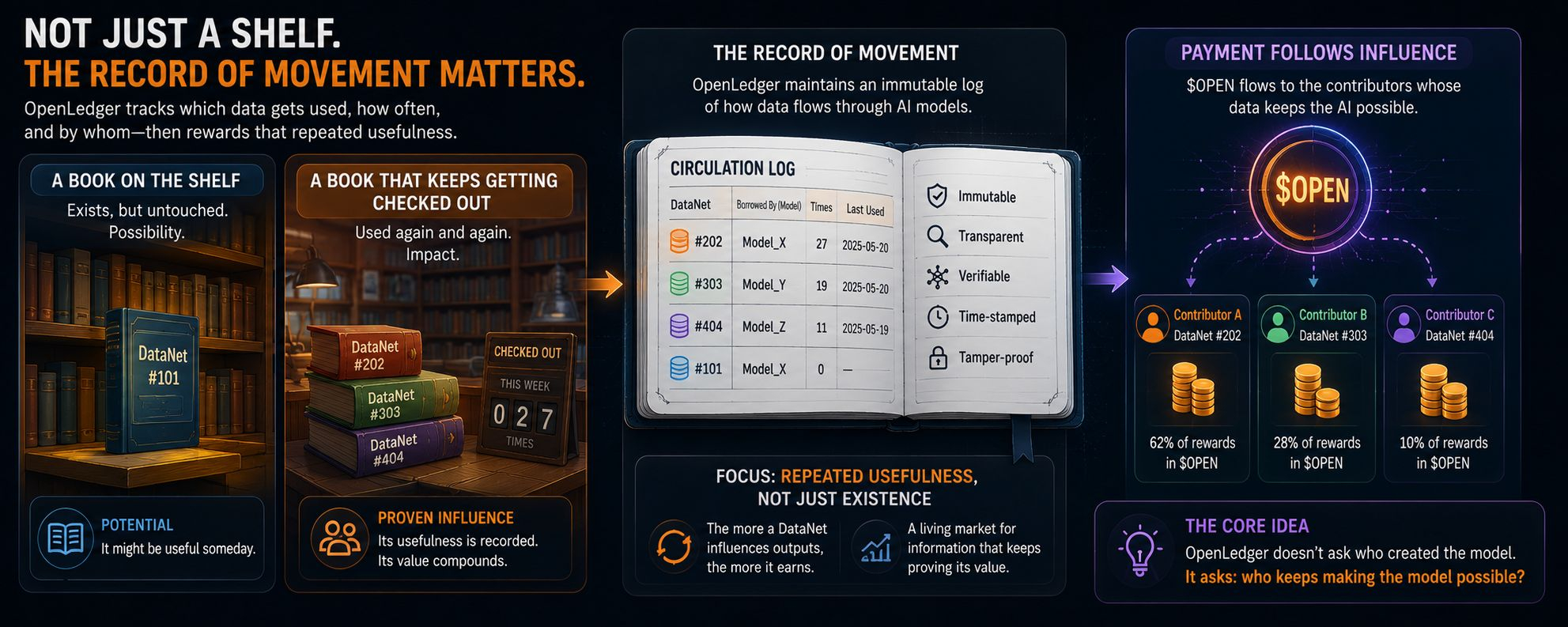
The closest thing I can compare it to is a library circulation desk. A book sitting on a shelf is one thing. A book that keeps getting checked out is another. The shelf matters, but the record of movement matters more.
OpenLedger seems to care about that second part. It wants to know which pieces of information keep getting borrowed, copied inward, and paid back out through the protocol. That is a more unsettling idea than it sounds at first, because it makes usefulness measurable in a way that can be disputed later.
Still, I can’t ignore the tension inside it. If attribution is too loose, the whole system becomes theater. If it is too exact, people will start shaping DataNets around what can be traced cleanly instead of what is genuinely useful. Those are not the same thing.
There is also the harder problem of scale. A system like this depends on models revealing enough of themselves to make the traces meaningful. If the output becomes too generalized, or if the trail gets too noisy, then the payment loop can weaken without anyone announcing that it has failed.
I keep coming back to the same small discomfort. OpenLedger wants to make data visible enough to be paid, but not so simplified that the payment becomes a fiction. That balance feels fragile.
Maybe that is why the OpenLedger stayed with me after the first glance. It is not really asking who built the model. It is asking who kept making the model possible.
And that question is harder to leave alone.