
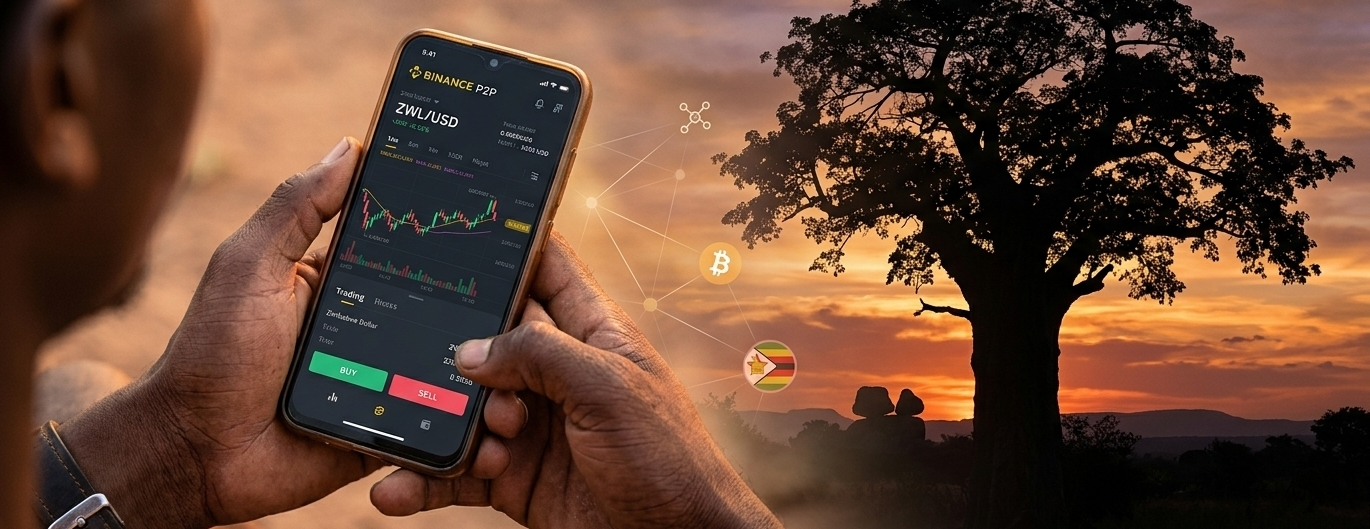
🤖 Growing up in Zimbabwe teaches you one thing fast: legacy financial systems aren’t designed to save you. When sanctions, heavy banking restrictions, and hyperinflation choke traditional channels, ordinary citizens are the ones left holding the bag. While the West often debates blockchain as a theoretical luxury or a speculative trade, for millions in developing economies, it is an active, parallel infrastructure for survival, entrepreneurship, and financial sovereignty.
1. Bypassing Fractured Financial Corridors ⛓️
When international sanctions and complex geopolitical friction isolate a nation’s banking network, the heaviest burden falls on ordinary citizens and small businesses. Legacy cross-border wires become slow, unpredictable, and prone to sudden freezes. Correspondent banks treat transactions from the region with extreme suspicion, driving up fees and tying small transfers in endless bureaucratic red tape.
Blockchain completely flips this dynamic by substituting institutional trust with mathematical certainty. Because decentralized networks operate on a peer-to-peer architecture, a transaction from Harare to London or Bulawayo to Dubai requires no intermediary bank.
> The Decentralized Edge: By cutting out the middleman, blockchain removes the choke points created by economic sanctions. Money moves smoothly across borders because the protocol does not care about geographic flags or institutional blockades. It only cares about cryptographic validity.
>
2. The Lifeline for Small Businesses (SMEs) 💼
For Zimbabwe’s vibrant informal economy and small-to-medium enterprises (SMEs), holding local fiat or navigating rigid formal exchange systems has long been a major business risk. Traditional local currency channels have historically struggled to maintain a stable store of value, making it incredibly difficult for tuckshop owners, local manufacturers, and cross-border traders to price inventory or pay foreign suppliers reliably.
```
[Traditional Supply Chain] ---> Intermediary Banks ---> High Fees & Delays
[Blockchain Supply Chain] ---> Peer-to-Peer (P2P) ---> Real-Time Settlement
```
Through the use of stablecoins and major digital assets, small businesses have built a reliable financial buffer. They use decentralized rails to:
*Settle Supplier Invoices Instantly:*
Merchandisers can pay for imports in real-time without waiting days for formal foreign currency allocations.
*Preserve Working Capital:** Profits are instantly converted into digital assets, sheltering hard-earned business capital from local inflation.
Eliminate Costly Remittance Fees:
Instead of losing substantial percentages to traditional money transfer agencies when receiving diaspora support, families and businesses receive funds directly into digital wallets for fractions of a dollar.
3. The Smartphone Economy: Democratizing Youth Income 📱
Perhaps the most inspiring facet of the blockchain revolution in Zimbabwe is its accessibility. The barrier to entry for the legacy financial system involves proof of residence, formal payroll slips, and steep maintenance fees. The barrier to entry for the decentralized economy? A basic smartphone and an internet connection.
With youth unemployment historically high across the region, a tech-savvy generation has refused to be left behind. Armed with nothing but mobile data, thousands of young Zimbabweans have integrated themselves into the global digital economy:
*Global Freelancing & Remote Work:** Young developers, graphic designers, content creators and writers are bypassing local banking limitations by receiving payments for their work globally via digital assets.
*Peer-to-Peer (P2P) Trading:** Micro-entrepreneurs leverage local liquidity pools, acting as independent digital money changers, facilitating trade, and securing a consistent daily income.
*Micro-Tasking and Web3 Gig Economies:** From participating in global decentralized finance (DeFi) ecosystems to content creation on Web3 social platforms, the digital landscape has effectively exported local talent to the global stage without requiring a passport.
## Looking Forward: A Legitimacy Milestone 🚀
The grassroots success of these networks hasn't gone unnoticed. Moving past previous years of regulatory hesitation, Zimbabwe’s financial landscape took a historic leap forward with new legislation—including amendments via the Finance Act—establishing clear, legal definitions for virtual assets and introducing structured regulatory oversight. Far from driving the technology underground, formalization and real-time compliance tracking are providing local startups and entrepreneurs with the institutional legitimacy they need to scale safely.
Growing up in an unstable economic climate teaches you not to take financial systems for granted. By placing financial power directly into the palm of anyone with a smartphone, decentralized currency isn't just a glimpse of the future—it is actively keeping the present afloat.
### What is your take?
Do you think peer-to-peer infrastructure can permanently replace traditional banking corridors in developing regions? Let’s talk in the comments below! 👇
#Zimbabwe #Web3 #P2PTrading #CryptoInAfrica #FinancialFreedom