

I think most people are still looking at AI and blockchain from the surface level.
Every day I see the same conversations repeating across crypto and tech. Smarter AI agents. Bigger models. Faster automation. More powerful tools. And honestly, after a while, a lot of it starts sounding the same. Everyone talks about the final product because that is the easiest thing to see.
But the more time I spent studying @OpenLedger, the more I started thinking the real story is happening underneath the output itself.
Because AI does not magically create value on its own.
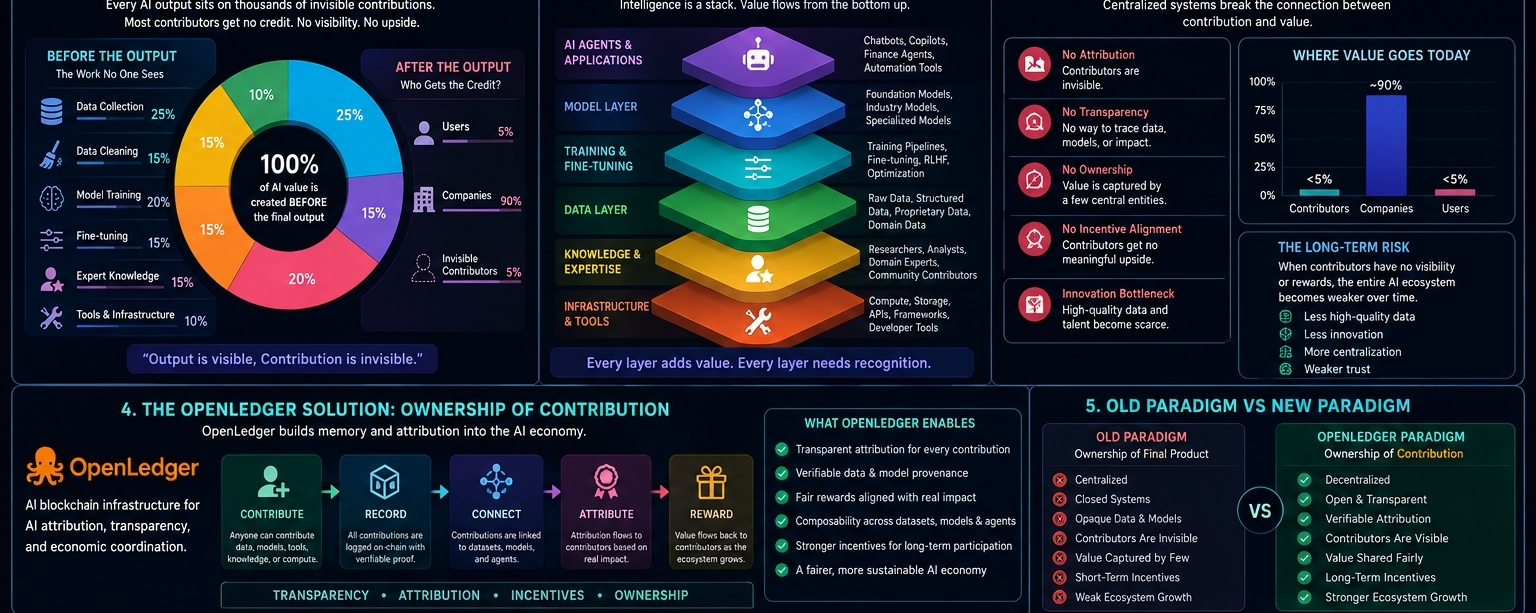
Before an AI model ever answers a question, writes code, generates research, or powers an agent, there is already an entire invisible economy working behind it. Data has to be collected. Information has to be cleaned. Models need training. Developers need to fine-tune systems. Experts contribute knowledge. Builders create tools around the models so people can actually use them in real life.
That entire process creates enormous value.
The strange part is that most of the people contributing to that value become invisible once the final AI product goes live.
Users only see the polished output. Companies capture most of the attention. And the deeper layers behind the intelligence slowly disappear into closed systems nobody can track clearly.
That is the part that made OpenLedger stand out to me.
At first glance, people might just call it another “AI blockchain.” But I think that description misses the bigger idea completely. The more I looked into it, the more it felt less like a simple blockchain project and more like an attempt to build memory and attribution into the AI economy itself.
And honestly, that changes the conversation in a very important way.
Most systems today focus on ownership of the final product. OpenLedger seems to focus on ownership of contribution.
That sounds simple, but it is actually a huge shift in thinking.
Instead of only asking: “Who owns the AI?”
the deeper question becomes: “Who helped create the intelligence behind it?”
That is where things become interesting.
Because AI is built in layers.
A specialized medical model becomes useful because researchers contribute high-quality medical data. A finance agent performs better because analysts and traders shape the information underneath it. A coding model improves because developers constantly refine and train it over time.
In most systems today, those contributions disappear into centralized infrastructure. The output remains visible, but the path behind it becomes almost impossible to track.
OpenLedger seems to be exploring whether blockchain can solve that visibility problem.
Not just by storing information on-chain, but by creating a transparent system where datasets, models, agents, and contributors remain connected to the value they help create.
The more I thought about it, the more I realized this is not really about hype words like “AI agents” or “on-chain intelligence.”
It is about economic coordination.
It is about whether AI can grow without turning every contributor into invisible labor.
And I think that question matters far more than people realize right now.
Because the future of AI probably will not belong only to giant general-purpose models controlled by a few massive companies. A huge amount of future value may come from smaller specialized systems that understand narrow industries deeply.
Legal AI. Medical AI. Research-focused models. Local language intelligence. Industry-specific agents. Financial automation tools.
All of these systems depend heavily on expert knowledge and specialized data.
But high-quality contributors will eventually stop participating if the system gives them no visibility, no attribution, and no meaningful upside.
That creates a long-term problem for AI itself.
If contributors feel disconnected from the value they help create, the ecosystem slowly becomes weaker. Trust declines. Incentives disappear. Useful data becomes harder to access. Innovation becomes more centralized.
This is why OpenLedger started making more sense to me when I stopped viewing it purely as a blockchain project.
It feels more like an infrastructure layer for tracking contribution inside AI economies.
A system trying to answer difficult but important questions:
Where did the intelligence come from? Which datasets shaped the model? Which contributors improved it? Which agents depend on which systems underneath? Who should benefit as the value grows over time?
Those questions are much deeper than simple speculation narratives.
Of course, ideas alone are never enough. Execution is everything. Systems like this still need to prove they can attract real developers, real users, real data, and real demand. They also need to make the experience simple enough that normal people can participate without feeling overwhelmed by technical infrastructure.
That part will decide whether projects like this actually succeed.
But even now, I think the direction itself is worth paying attention to.
Because AI is becoming more powerful every year, while ownership and control are becoming more concentrated at the same time.
OpenLedger seems to be pushing toward a different model one where contribution stays visible instead of disappearing once the machine starts producing outputs.
And honestly, that may end up being one of the most important conversations in AI over the next decade.
Not just who builds intelligence.
But who gets remembered for helping create it.