
I’m watching people work harder than ever to produce things they’ll never own. Not factories anymore, not even offices. Just fragments of attention scattered across screens. A sentence typed into a chatbot. A correction on a map. A photo uploaded absentmindedly while waiting for tea. Someone training an algorithm without realizing it. Someone else refining a model with every click, every hesitation, every small preference. The strange thing is how invisible the labor has become. You can’t point to it anymore. There’s no punch clock. No warehouse. Just behavior turning quietly into infrastructure.
And the money moves somewhere else.
I keep noticing how modern systems have become experts at absorbing value before people even recognize they created it. A musician uploads drafts for “engagement.” A researcher shares years of niche knowledge online because obscurity feels worse than exploitation. Drivers feed maps. Gamers train physics engines. Millions of people pour intelligence into platforms that speak the language of community while behaving like extraction machines. We call it participation because the alternative would sound too harsh.
What feels different now is not the exploitation itself. Markets have always done this. It’s the texture of it. The extraction is softer, almost polite. Wrapped inside convenience. Wrapped inside personalization. Wrapped inside AI assistants that seem magical precisely because they were assembled from the unpaid residue of human lives.
I was thinking about this the other night while watching a small shopkeeper count cash at closing time. He still trusts physical money because he can feel where it came from. He knows which customer bought rice, which one delayed payment, which one bargained too long. There’s a chain of memory attached to each note. Digital systems erased that feeling. AI systems erase it even more. Value enters enormous black boxes now. Data goes in. Profit comes out somewhere else. Most people stand too far away to see the connection.
And maybe that’s the real tension underneath all this excitement around artificial intelligence. Everyone talks about what AI can generate, but almost nobody asks who continuously feeds it. Models do not appear from nowhere. Intelligence at scale requires oceans of human behavior. Tiny repetitive acts. Corrections. Preferences. Patterns. Context. Human beings are still underneath the machine, but hidden so deeply that the system begins to look autonomous.
I’ve been noticing another shift too. Quietly, people are becoming aware that their data has weight. Not philosophically. Financially. The realization arrives slowly, almost reluctantly. If corporations can build trillion-dollar systems from distributed human input, then maybe data itself is not exhaust. Maybe it’s labor. Maybe models are not isolated products but collective economies.
That thought changes the atmosphere.
Because once you see data as labor, strange questions appear. Why are the people producing intelligence the least rewarded participants in the chain? Why do centralized platforms behave like landlords of information they didn’t truly create? Why does ownership disappear precisely where contribution becomes most massive?
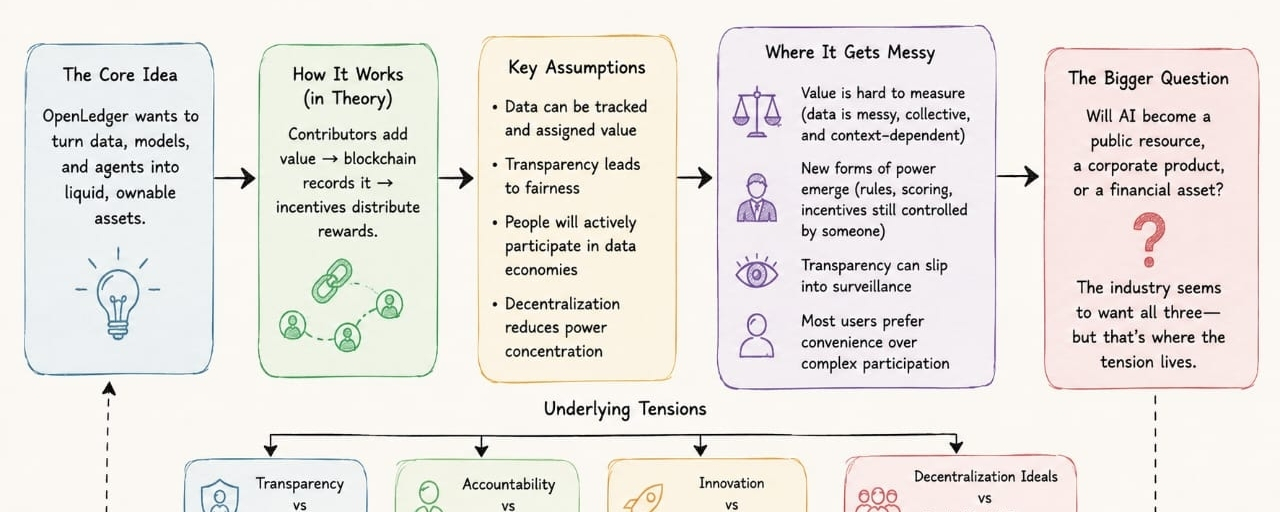
And somewhere in the middle of all these questions, new structures start emerging almost accidentally. Systems trying to treat data, models, even autonomous agents less like captive assets and more like things that can move, earn, circulate. Liquidity not just for capital, but for intelligence itself. I don’t think most people fully understand what that means yet. Maybe neither do the builders. But you can feel the pressure building beneath the surface of the internet, like markets searching for a missing mechanism.
Not louder. Just inevitable.
Because eventually every extraction system reaches the same problem: the people generating value begin to notice.
And once they notice, they start looking for exits.